
In November, looking from the tail end of autumn toward the threshold of winter, the deep fragrance of late autumn permeates the gradually deepening air, and nature is filled with seasonal ingredients as if leaving behind the season's final gift. Let us explore fresh seasonal fish and sashimi, natural wild greens and vegetables, and sweet fruits that capture the fleeting moments of autumn in November, offering the last flavors of the season crafted by time.
November seasonal fish
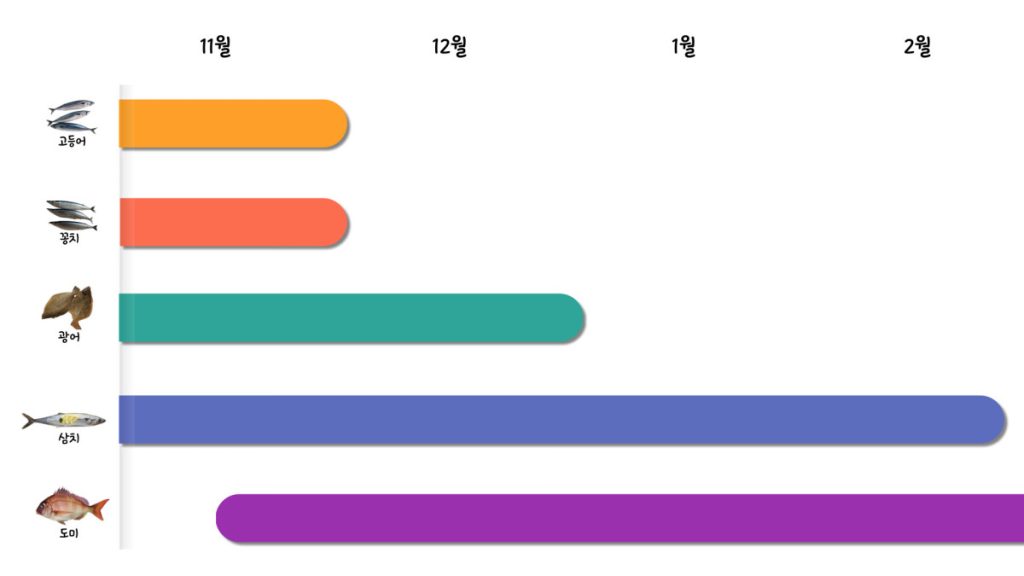
Spanish mackerel
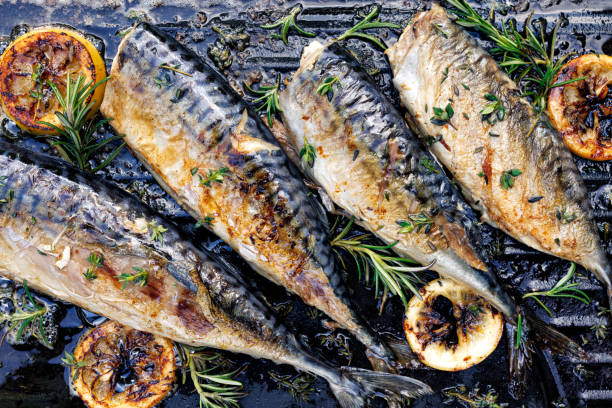
Spanish mackerel is a very popular seasonal fish characterized by its light and tender flavor. Compared to horse mackerel, it has a moderate fat content, offering a light yet soft texture without being greasy. Because the flesh itself is soft and tender, grilling is preferred over stews or steaming. Since Spanish mackerel lacks a swim bladder, it dies quickly once brought out of the water and is therefore not distributed as live fish; however, in major production areas, it is utilized for "pre-sashimi." In the Yeosu region, Spanish mackerel sashimi is often wrapped in leafy greens alongside the local specialty, gat kimchi, and eaten with makjang or chojang sauces; although it lacks a soft texture due to its tenderness, its diverse flavors make it a delicacy. When used in Japanese sashimi or sushi, it is often prepared by "aburi" (searing) the surface with a torch or by smoking.
| Standard language (scientific name) | Spanish mackerel (Scomberomorus niphonius), Sawara (サワラ), Spanish mackerel |
| classification | Scombridae, Scombridae, Scombridae, Spanish mackerel |
| Major production areas | West and South Coast areas including Yeosu, Jeollanam-do and Narodo, Goheung, Jeollanam-do |
| seasonal | November ~ February |
| spawning season | april ~ June |
| Cooking with it | Grilled Spanish mackerel, braised Spanish mackerel, Spanish mackerel sashimi, etc. |
Red sea bream

Sea bream is a general term for fish of the Sparidae family, such as black sea bream, rock sea bream, and striped sea bream, but among them, red sea bream (Pagrus majorRed seabream is the most popular and famous fish in the snapper family, highly popular as a premium ingredient in Asian regions including Korea and Japan. It is rich in inosinic acid and has an excellent umami flavor when aged as sashimi, but it is also famous for being difficult to age because it softens easily. Its peak season, when it tastes best, is from November, when the weather gets cold, until the spawning season in April. Once April passes, wild red seabream carrying roe begin to be caught, causing the price to drop to around 10,000 won per kilogram (as of 2024); however, although the price is low, red seabream carrying roe is not recommended for sashimi because its flesh is too soft.
Red sea bream is delicious whether eaten raw, sushi, grilled, or steamed. Its large, firm head is ideal for extracting fish broth, so it is frequently used in soup dishes such as Jiri or Ramen. When eating red sea bream as sashimi, the removed skin is blanched in hot water, or the fish is filleted with the skin on, and hot water is poured over the skin to cook only the skin before slicing it into sashimi. This cooked skin is called Matsukawa because it resembles pine bark. The price of red sea bream typically hovers around 35,000 won per kilogram (as of 2024), but it may vary depending on the day's catch, the season, and the location of sale.
| Standard language (scientific name) | Red sea bream (Pagrus major), Madai (真鯛), Red Seabream |
| classification | Order Perciformes, Family Sparidae, Genus Tseudomonas, Tseudomonas |
| Major production areas | The southern coast and Jeju |
| seasonal | November ~ March |
| spawning season | April ~ June |
| Cooking with it | Grilled sea bream, braised sea bream head, sea bream ramen, etc. |
rockfish (Sebastes)

rockfish, commonly known as Ureok(Sebastes schlegelii)As its name suggests, it is a fish belonging to the family Sebastes, inhabiting the coasts of Northeast Asia, including Korea, Japan, and China. It is particularly abundant along the southwestern coast and is also farmed, making it easily accessible even in local sashimi restaurants. Interestingly, the standard name "Ureok" refers to a shellfish, but because the standard name for the rockfish, *Sebastes schlegelii*, has already become established as "Ureok," the fish is referred to as the "Ureok shellfish." The Japanese name for *Sebastes schlegelii* is "Mebaru," and in English, it is called "Korean Rockfish.".
This mild-flavored white fish is famous for its large head, which results in a low yield; consequently, it is renowned for the refreshing spicy stew made from its tough skull bones. When eaten raw as sashimi, it offers a chewy and clean taste, but from its peak season in November, it gains fat and develops a rich umami flavor. The spawning season is from April to June.
Farmed rockfish available year-round typically weigh around 700–800g and cost about 20,000–30,000 won per kilogram. In contrast, large wild rockfish, which are caught only during their peak season and occasionally distributed, can exceed 50,000 won per kilogram and taste so good that it feels almost unfair to compare them to smaller ones. During the peak season, it would be a good idea to visit fishing grounds known for their abundance, such as Taean or Tongyeong, to taste the wild variety. As a side note, I searched for rockfish-related festivals and found the Samgilpo Rockfish Festival; although I am not entirely sure why, it appears to be held in July or August. If I get the chance, I plan to visit and add to this post.
| Standard language (scientific name) | rockfish (Sebastes schlegelii) |
| classification | Sebastes schlegelii, family Sebastes, genus Sebastes |
| Major production areas | Southwestern coastal areas including Taean and Sinan |
| Geographical Indication System | Sinan Dried Rockfish (No. 27) |
| Related festivals | Samgilpo Rockfish Festival (August) |
| seasonal | November ~ February |
| spawning season | April ~ June |
| Cooking with it | Raw fish, braised fish, spicy rockfish stew, fermented rockfish soup, etc. |
stone flounder

The stone flounder, commonly known as *Doldodari*, belongs to the family Pleuronectiformes and primarily inhabits the coastal waters of Korea, Japan, and China. In Japanese, it is called *Ishigarei* (イシガレイ), a combination of *Ishi* (stone) and *Karei* (flounder). However, confusion often arises in Korea because the high-end species known as the striped flounder is mistakenly called *Ishigari*. In Japanese, the striped flounder is called *Samegarei* (サメガレイ); it is a much more expensive fish than the stone flounder and looks completely different. True to its name, *Doldodari* is characterized by hard, stone-like keratin on its skin. It is a fish with a very firm texture and a clean taste, making its unique texture worth trying at least once.
November seasonal seafood
cockles

Cockles are primarily produced along the southern and western coasts of Korea and mainly inhabit brackish waters where seawater and freshwater mix. There are three main types of cockles distributed in the market: the true cockle (standard name: cockle), the new cockle (standard name: new cockle), and the blood cockle (standard name: blood clam). The largest and reddest type is the blood clam, while the cockles we commonly encounter are mostly new cockles. True cockles are entirely wild-caught, produced in small quantities, are expensive, and are rarely distributed in the market as most are consumed locally. True cockles are smaller than new cockles, have a firm texture, and are sweet. They seem to taste best when eaten in a seasoned salad or lightly steamed with aromatic herbs such as wild chives.
| Standard language (scientific name) | Cockles (Tegillarca granosa), Scapharca subcrenata |
| classification | Order Arcidae, Family Arcidae, Genus Arcidae, Clam |
| Major production areas | The South and West Coast areas, the Beolgyo tidal flats in Boseong-gun, Goheung-gun, and Yeosu-si |
| Geographical Indication System | Boseong/Beolgyo Cockles (No. 1), Yeosu Yeojaman New Cockles (No. 20) |
| Related festivals | Beolgyo Cockle Festival (November) |
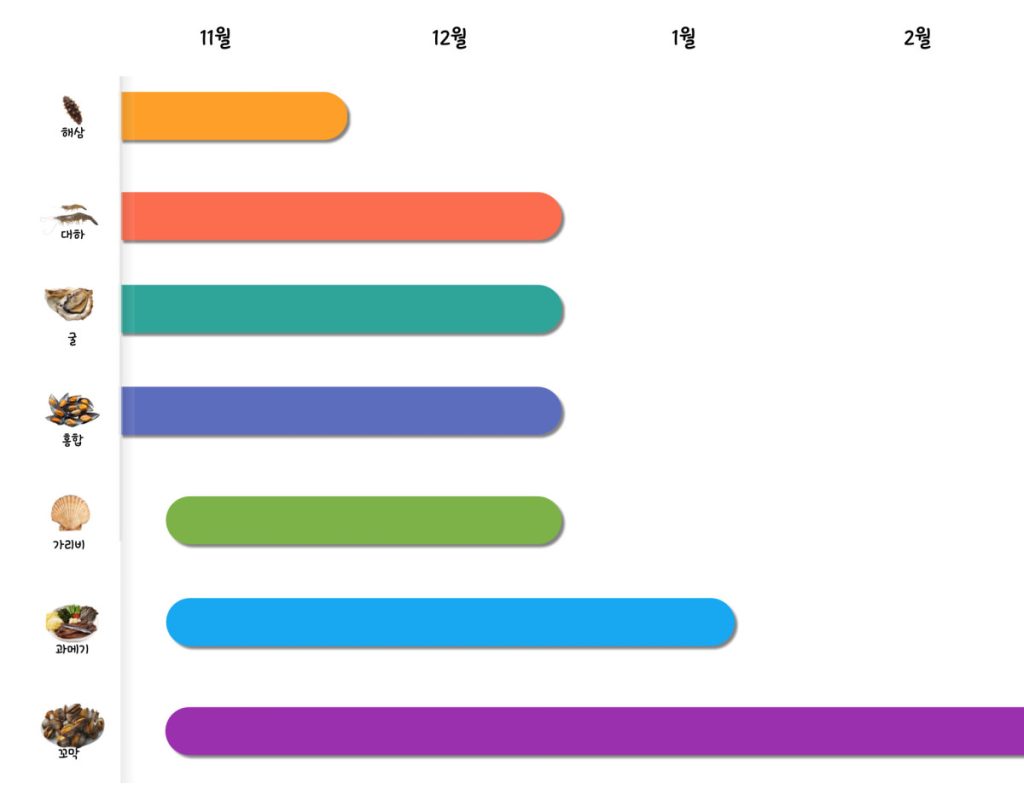
| seasonal | November ~ March |
| spawning season | July ~ September |
| Cooking with it | Steamed cockles, cockle bibimbap, seasoned cockles, etc. |
scallop
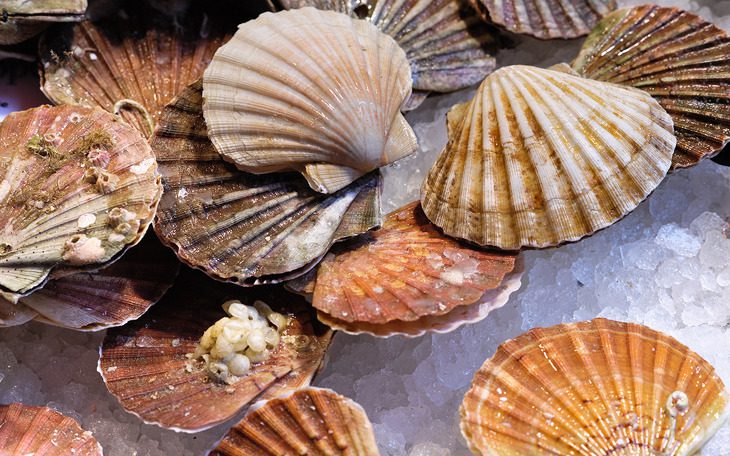
About 12 species of scallops are found in the waters off Korea, and the most commonly distributed species in the market are the giant scallop (True Scallop), bay scallop, red scallop, and silk scallop. Among these, all three species except the silk scallop are in season from November through winter and are popular worldwide for their soft texture and sweet taste. Although giant scallops are farmed in small quantities in the Goseong area of Gangwon-do, they are mostly imported from Japan, one of the largest producers of giant scallops. Bay scallops and red scallops are mainly farmed and distributed in areas such as Tongyeong in South Gyeongsang Province and Goseong in Gangwon-do.
Scallops possess a soft and moist texture, with an appealing sweet yet savory flavor. While delicious on their own, their mild taste and aroma make them easy to harmonize with various ingredients, allowing them to be widely used in many dishes. In East Asia, they are frequently used in sashimi, sushi, and soups, whereas in the West, the adductor muscle is primarily consumed, with steaks and dishes featuring sauces such as butter and cream being particularly famous.
The delicate flavor of scallops pairs excellently with alcohol; they are famously paired with white wines such as Chardonnay or Sauvignon Blanc, while warm sake complements the scallops' sweetness well. Like sake, Cheongju, a traditional Korean liquor, is also a good pairing, and surprisingly, it goes well with the sweet Makgeolli. However, it is best if it is not too sweet.
| Standard language (scientific name) | scallop |
| classification | Order Pterocarya, Family Scallopidae |
| Major production areas | Aquaculture in areas such as Goseong, Gangwon Province and Tongyeong, Gyeongnam Province |
| Related festivals | Goseong Scallop Seafood Festival |
| seasonal | It varies by variety, but mainly from November to February |
| spawning season | It varies by variety, but mainly from May to August |
| Cooking with it | Raw scallops, steamed scallops, scallop steak, butter-grilled scallops, etc. |
Gwamegi

Gwamegi is originally a food made by tying herring with straw ropes and naturally drying it in the cold winter wind for about 3 to 10 days. Recently, as herring catches have declined, it is often made with Pacific saury, which is similarly oily and in season in November; consequently, many people think of Pacific saury first when they hear the word gwamegi. There are two types: whole gwamegi, which is dried with the internal organs intact, and sliced gwamegi, which is made by removing the internal organs and splitting the fish in half; however, sliced gwamegi, which has had the internal organs removed due to the high risk of spoilage, is the most commonly distributed.
As the fish is dried, the oil naturally seeps out, resulting in a superb taste with concentrated umami and a unique flavor. However, due to its distinctive aroma and the potential for a fishy taste, it tends to be polarizing. It is commonly eaten wrapped in seaweed, kelp, or leafy greens with a spicy vinegar dipping sauce. Whole gwamegi tends to be even more polarizing; compared to the tightly dried sliced gwamegi, the semi-dried whole gwamegi retains the texture of the fresh fish, and many people dislike its strong fishy taste and mushy consistency. Nevertheless, there is a significant fan base that considers whole gwamegi to be the best in terms of taste, as the oil from the internal organs is aged along with the flesh and permeates the meat.
| Major production areas | Pohang, Gyeongbuk |
| Related festivals | Guryongpo Gwamegi Festival (November) |
| seasonal | November ~ January |
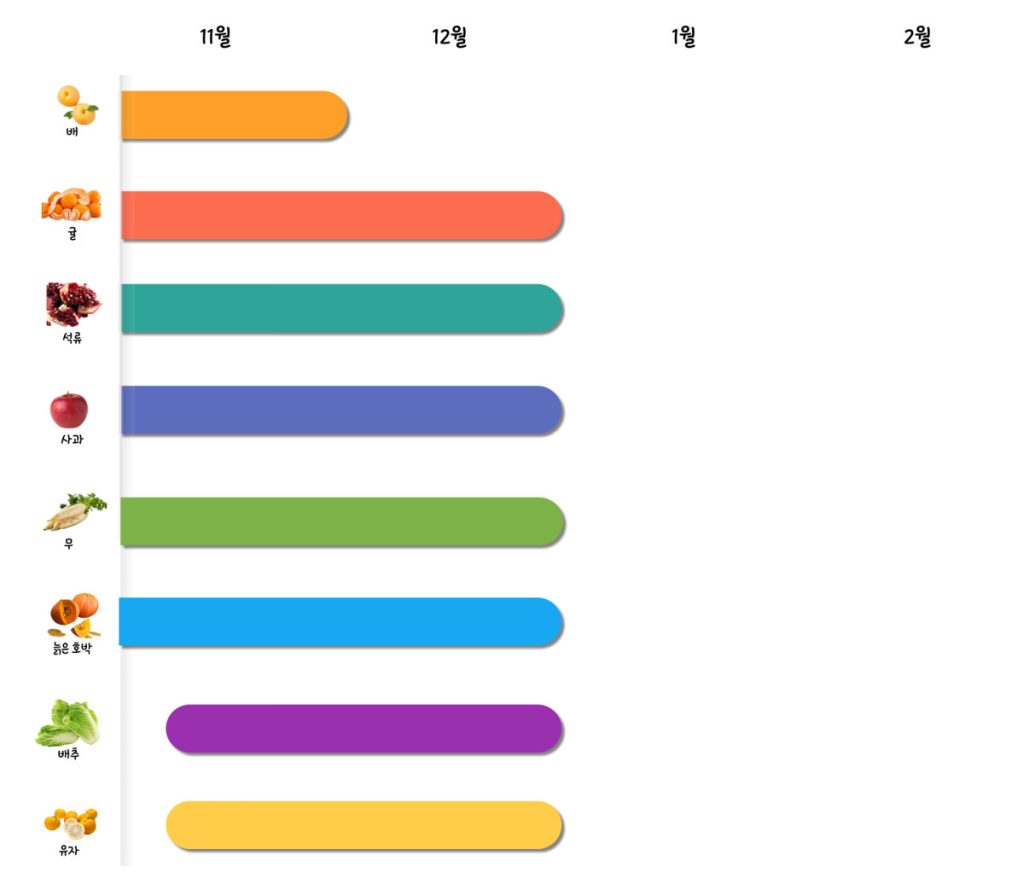
November Seasonal Vegetables and Fruits
napa cabbage
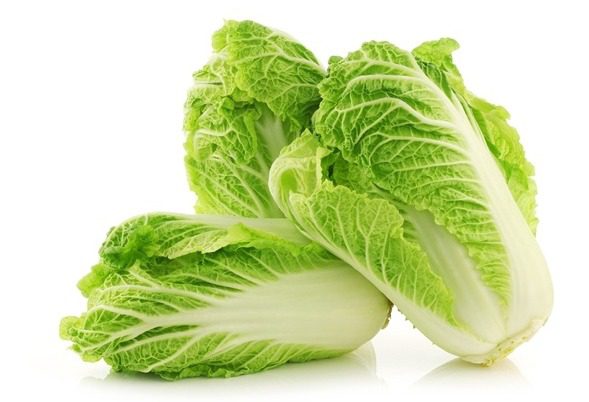
Napa cabbage, and specifically winter cabbage, is one of the most important vegetables in Korean cuisine and is an essential vegetable for Gimjang, the process of making kimchi. Although napa cabbage is produced throughout the four seasons, the cabbage used for Gimjang is the seasonal autumn cabbage, which is sown in the summer of August and harvested starting in late October. The cool climate of autumn is the optimal season for growing cabbage, resulting in superior quality compared to cabbage grown in other seasons.
| Standard language (scientific name) | Napa cabbage (Brassica rapa var. glabra Regel) |
| classification | Brassicaceae Brassica genus Turnip Cabbage |
| Major production areas | Haenam, Jeollanam-do; Gangneung/Taebaek, Gangwon-do, etc. |
| Geographical Indication System | Haenam Winter Cabbage (No. 11) |
| Related festivals | Pyeongchang Highland Kimjang Festival, Goesan Kimjang Festival |
| seasonal | November ~ January (Autumn cabbage) |
| Cooking with it | Kimchi, clear clam cabbage soup, cabbage dumplings, cabbage pancakes, etc. |
Yuja
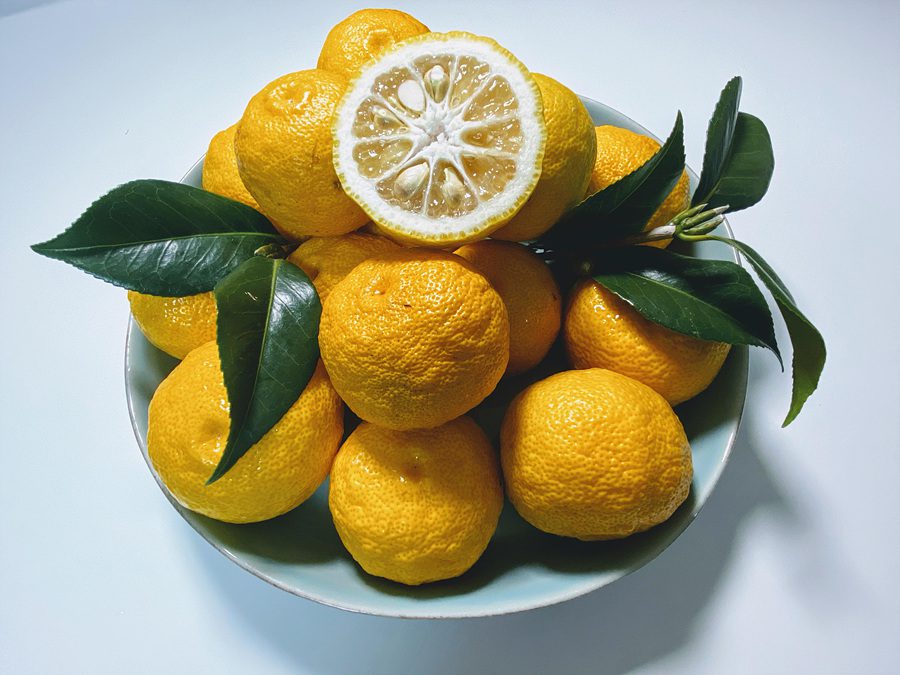
Yuja is a citrus fruit primarily cultivated in Korea and Japan, and is widely consumed as warm yuja tea, especially during the cold season. The fruit itself possesses a unique sweet aroma distinct from yuja, combined with a bitter and sour taste, while retaining the refreshing scent of lemon and lime. This characteristic aroma of yuja comes mainly from the peel, which is utilized in various dishes.
Yuzu is mainly used for yuzu tea or yuzu jam, but it is also widely used in desserts such as purees, sauces, and sherbets, and is frequently used as a kick to add a unique flavor to minimalist dishes. Yuzu is also widely used as an ingredient in alcoholic beverages; in Goheung, a major production area, it is used to make traditional liquors such as 'Goheung Yujaju,' a medicinal liquor that utilizes yuzu as an ingredient, and 'Yuzushu' in Japan is a liqueur made from yuzu that is gaining great popularity as a sweet dessert drink.
| Standard language (scientific name) | Citrus junos |
| classification | Sapindales, Rutaceae, Citrus genus, Yuzu tree |
| Major production areas | Goheung, Jeollanam-do |
| Geographical Indication System | Goheung Yuja (No. 14) |
| Related festivals | Goheung Yuja Festival (November) |
| seasonal | November ~ February |
| Cooking with it | Yuja jam, yuja tea, yuja cheesecake, etc. |