A soft and creamy texture in harmony with the flavor of butter, the umami of egg yolk, and the freshness of lemon Hollandaise sauce. The sight of egg yolks flowing down from the Eggs Benedict is the highlight of brunch.
The calories of Hollandaise sauce are per 100g
약 417kcal It is known as (fat 95%, protein 4%, carbohydrate 1%).
This velvety sauce features a harmonious blend of the richness of butter, the smooth flavor of egg yolks, and the refreshing acidity of lemon juice. It is characterized by a creamy taste that melts in the mouth, with a touch of salt and the aroma of cayenne pepper adding depth.
index
- History of Hollandaise Sauce
- The essence of Hollandaise sauce, emulsion
- Hollandaise derivative source
- Dishes and pairings using Hollandaise sauce
- Making Homemade Hollandaise Sauce
History of Hollandaise Sauce

Hollandaise sauceHollandaise SauceWhen you first hear the name, it is easy to think it is a Dutch sauce. In fact, 'Hollandaise' means 'Dutch style' in French. However, the birthplace of this sauce is France, and there are several theories regarding the origin of the name.
The most likely theory is that the name was given during the Franco-Dutch War of 1672. It is said that the name was given because high-quality butter imported from the Netherlands was used at the time.
Another theory suggests that it originated from Isigny-sur-Mer, a famous butter-producing region in Normandy, France (famous for Isigny butter), and was once called 'Sauce Isigny'.
The first record of Hollandaise sauceIt appears in the cookbook 'Le Cuisinier François' by French chef François Pierre de La Varenne in 1651.
‘In the recipe for 'Asparagus with Fragrant Sauce,' he described making it by mixing good fresh butter, vinegar, salt, nutmeg, and egg yolks. This is the prototype of today's Hollandaise sauce.
La Varenne and the Revolution of French Sauces
La Varennes is a pioneer who led French cuisine away from the excessive use of spices in medieval European cooking, guiding it toward bringing out the natural flavors of ingredients. His writings are regarded as the starting point of modern French cuisine. By the 19th century, the great chef Antoine Carême systematically classified French sauces.
He organized sauces into four basic series, which were later developed by Auguste Escoffier in 'Le Guide Culinaire' in 1902 to become the ones we know today. 5 Mother Sauces The system was completed.
| Mother sauce | Main ingredients | characteristic |
|---|---|---|
| Espagnole | Brown broth, brown roux | Brown sauce with a rich meaty flavor |
| Velouté | White broth, yellow roux | Soft and velvety texture |
| Béchamel | Milk, white roux | Cream-based white sauce |
| Hollandaise | Egg yolk, butter | Warm oil painting sauce |
| Tomato | Tomato, broth | Fresh tomato base |
Escoffier said that the excellence of French cuisine lies precisely in its sauces. To borrow his expression, sauces are the key element that enabled French cuisine to achieve its global status.
Hollandaise sauce is a unique sauce among these five base sauces that creates its thickness solely through the emulsifying power of eggs, without using a flour roux.
The essence of Hollandaise sauce, emulsion
The creamy and velvety texture of Hollandaise sauce is scientifically EmulsificationThis is thanks to the phenomenon. Originally, water and oil do not mix. However, a special component in egg yolk works magic to bind the two together.
In egg yolks LecithinIt is rich in a phospholipid called lecithin. Lecithin molecules have a unique structure, with one end being affinity for oil and the other for water. Thanks to this duality, lecithin surrounds the fat droplets in butter and stabilizes them, preventing them from clumping together.
The emulsifying ability of egg yolks
The egg yolk itself is already a complex emulsion of fat and water. About 651% of the yolk is fat, but most of the water is tightly bound to proteins and phospholipids, exhibiting excellent ability as a natural emulsifier.
For emulsification to succeed in Hollandaise sauce Temperature managementis the most important.
Egg yolk protein begins to coagulate at 70–77°C (160–170°F). If this temperature is exceeded, the protein clumps together to form small granules, and the sauce separates and breaks down.
Conversely, if the temperature is too low, the butter will solidify. Butter begins to melt at about 30°C (85°F) and remains in a semi-solid state at room temperature. Therefore, Hollandaise sauce must always be kept warm, and the ideal storage temperature is about 63°C (145°F).
Here is another tip. When making the sauce acidic ingredients (lemon juice or vinegar)When added, the pH is lowered to about 4.5. In an acidic environment, egg proteins develop a property of repelling each other, so they do not clump together but spread out into a soft network.
Thanks to this, the sauce does not coagulate even when heated to 90°C (195°F), allowing for more leisurely cooking.
| Cooking conditions | optimal temperature | caution |
|---|---|---|
| Heat egg yolk | 60~65°C | Coagulation begins at 70°C or higher |
| When adding butter | 50~60°C | If it is too hot, the yolk cooks. |
| Store after completion | About 63°C | Cover with lid to prevent moisture evaporation |
| When adding acid | Up to 90°C possible | Prevents coagulation when maintaining pH 4.5 |
What should you do if the sauce has separated and gone bad? Don't panic. Simply warm up a fresh egg yolk and a spoonful of water, then add the ruined sauce little by little while stirring. The fresh yolk, rich in lecithin, will re-emulsify the sauce and revive it.
Hollandaise derivative source

Hollandaise sauce is called the 'mother sauce' because it serves as the foundation for numerous derivative sauces. Adding herbs, fruits, or cream to the basic Hollandaise transforms it into sauces with completely different characteristics. Each derivative sauce pairs perfectly with specific dishes.
The most famous derivative source is by far the Béarnaise Saucec. Instead of lemon juice for hollandaise, use a reduction made by simmering white wine and vinegar with shallots and tarragon. The distinctive anise aroma of tarragon adds herbal depth to the sauce.
Béarnaise boasts the best pairing with steak and is also known by the nickname 'steak sauce'.
Mousseline Sauce, Or Chantilly sauce is made by folding whipped cream into Hollandaise. It is characterized by a lighter and fluffier texture and is good to serve with fish or vegetable dishes.
In Madame Benoît's recipes, egg white foam is sometimes used instead of whipped cream.
Maltaise SauceThis is a version with added blood orange juice and zest. Named after the Mediterranean island of Malta, this sauce features an exquisite sweet citrus aroma. It pairs particularly well with asparagus or steamed vegetables.
| Derivative source | Additional materials | Recommended dishes |
|---|---|---|
| Béarnaise | Tarragon, shallots, white wine reduction | steak, grilled meat |
| Mousseline | whipped cream | Fish, vegetables |
| Maltaise | Blood orange juice, zest | Asparagus, steamed vegetables |
| Noisette | brown butter | fish, poultry |
| Dijon | Dijon mustard | Pork, chicken |
In addition to that Beurre NoisetteIt is made into brown butter by heating the butter until it turns brown, adding a savory nutty flavor, and, Sauce DijonIt adds Dijon mustard to provide a tangy flavor.
Dishes and pairings using Hollandaise sauce
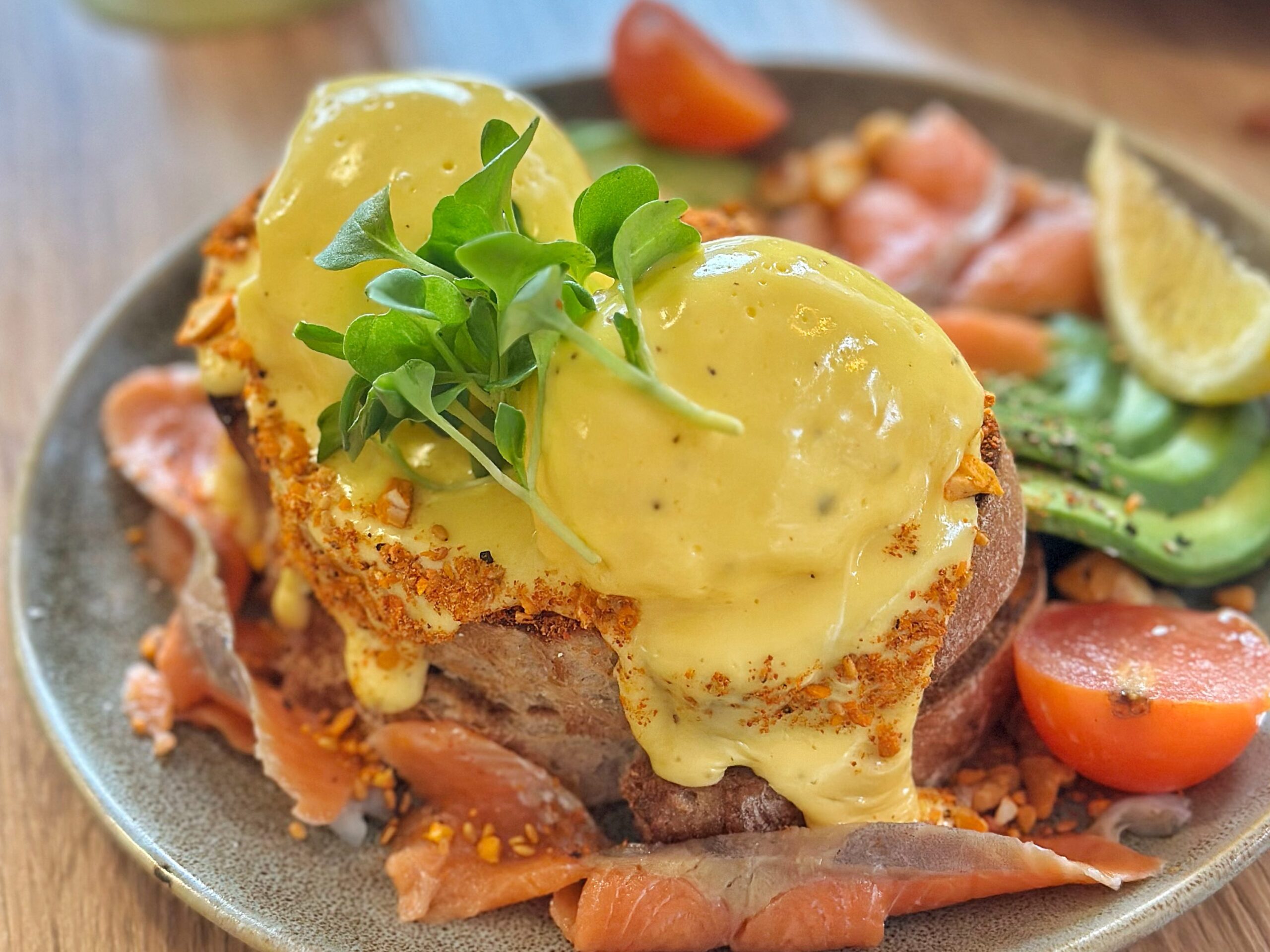
The first dish that comes to mind when you think of Hollandaise sauce is, of course... Eggs BenedictThe quintessential brunch dish, consisting of ham or bacon and a poached egg on an English muffin topped with golden hollandaise sauce, originated in New York in the late 19th century.
There are two leading theories regarding the origin of Eggs Benedict. The first is the story that it originated in 1894 at the Waldorf-Astoria Hotel from a dish ordered by Wall Street stockbroker Lemuel Benedict as a hangover cure.
The second theory is that it was created by Chef Charles Lanhofer in 1860 at Delmonico's Restaurant in Manhattan for a regular customer, Madame Le Grand-Bénédict.
Whichever is true, Eggs Benedict remains a must-have item at brunch cafes around the world. The moment you gently break a poached egg with a fork, letting the yolk flow out and blend with Hollandaise sauce, is arguably the highlight of brunch.
Eggs Benedict Variations
- Egg Royal/Atlantic: Smoked salmon instead of ham
- Egg Florentine: Spinach instead of ham
- California Benedict: Add avocado
- Eggs Chesapique: Uses crab cakes
Another classic pairing with Hollandaise sauce is asparagusIn fact, La Varène's original recipe from 1651 was itself a 'fragrant sauce with asparagus.' Eating steamed asparagus drizzled with warm hollandaise sauce is a classic combination that has been enjoyed for hundreds of years.
 Crab CakeThe combination with Hollandaise sauce is also a beloved classic on the U.S. East Coast. Topping a crispy crab cake with Hollandaise sauce creates a fantastic harmony of the crab meat's sweetness and the buttery flavor of the sauce. It is also the quintessential Maryland-style brunch.
salmonIt also pairs wonderfully with other dishes. When Hollandaise sauce is poured over grilled or poached salmon, the buttery flavor harmonizes with the salmon's richness. Additionally, Hollandaise sauce is an excellent partner for vegetable dishes such as steamed broccoli and cauliflower, poached poultry, and fish dishes in general.
One thing to note is that this sauce must be consumed within 1 to 2 hours of preparation. If left at room temperature for too long, it will separate, and if refrigerated and then reheated, the butter may crystallize, ruining the texture.
Making Homemade Hollandaise Sauce
Hollandaise sauce is notoriously difficult to make. However, if you understand the principles of temperature control, you can certainly succeed at making it at home. Harold McGee introduced at least five ways to make Hollandaise, and here we will look at the method with the lowest failure rate.
Basic Ingredients (Serves 2)
- 2 egg yolks (room temperature)
- 100~120g unsalted butter
- 1 tablespoon lemon juice (or white wine vinegar)
- A little salt
- A little cayenne pepper or white pepper
- 1 tablespoon of water
Step 1: Making Clarified Butter
Slowly melt the butter over low heat. As the water evaporates, bubbles will form, and white whey protein will float to the surface. Once the bubbles subside, skim off the white film on top and carefully pour out only the clear yellow butter.
Discard the casein sediment that has settled at the bottom. The clarified butter produced in this way is pure fat, which makes the sauce smoother.
Step 2: Making the Egg Yolk Base
Boil water in a pot and place a heat-resistant bowl over it (double boiler). Add egg yolks, 1 tablespoon of water, and lemon juice to the bowl and whisk continuously. Move to the next step when the yolks gradually soften, increase in volume, and reach a consistency that stretches like a ribbon. Be careful not to heat for too long during this process.
Step 3: Emulsifying the butter
Remove the bowl from the heat and continue stirring while adding the warm clarified butter very little by little. Start with a few drops, then pour in a thin stream. Add the next amount of butter whenever it is completely mixed. Being patient and proceeding slowly is the key to success.
Step 4: Seasoning
Season with salt and cayenne pepper. You can also add lemon juice to adjust the acidity. The finished sauce should be slightly thinner than mayonnaise and thick enough to coat the back of a spoon.
| Problem situation | cause | Solution |
|---|---|---|
| The source is separated | The temperature was too high or the butter was added too early | Re-emulsify by gradually adding the separated sauce to 1 new egg yolk + 1 tablespoon of water. |
| Granules formed | Egg coagulation | Sieve to remove granules, then re-emulsify |
| The sauce is too thick | dehydration | Adjust the concentration by adding warm water little by little. |
| The sauce is too watery | Insufficient amount of butter or insufficient heating of egg yolks | Add more butter or stir while heating over low heat |
Simple method using a blender
It is easier to make using a blender or hand mixer. First, mix the egg yolks and lemon juice at high speed, then slowly pour in the hot butter while the mixer is running. It is done when the mixture thickens and the sound of the mixer changes.
It is best to use the finished hollandaise sauce immediately. If storage is necessary, keep it warm in a thermos or heat it in a double boiler with the lid closed, stirring occasionally. It is best to avoid reheating butter after refrigeration, as this causes the crystals to separate and ruins the texture.
Hollandaise sauce is certainly tricky to make, but once you succeed, the sense of accomplishment and the taste reward are greater than any other sauce. How about making Eggs Benedict with homemade Hollandaise sauce this weekend morning?