
Yangpyeong, spread out along the waterways of Dumulmeori where the Bukhan and Namhan Rivers meet, is located just an hour away from Seoul yet embraces the natural bounty of its mountains and rivers.
This region, designated early on as a special eco-friendly agricultural zone to protect the water sources of the metropolitan area, has instead fostered specialty products featuring clean water and soil despite the regulations.
From Hanwoo beef and Cornelian cherries to wild greens, chives, and watermelon. And even the hangover soup and cold noodles crafted from these ingredients as they passed through riverside villages and markets. Yangpyeong's specialties and local cuisine have been gathered in one place.
index
Yangpyeong specialties
Yangpyeong Hanwoo

Yangpyeong is designated as a Special Water Quality Conservation Area to protect the water source for the Seoul metropolitan area. It is a land where neither factories nor large-scale livestock farms can be expanded at will.
However, the farmers here turned this pharmaceutical into a brand. Clear Water Yangpyeong HanwooThe name is the result.
Local farmers say that cattle raised in clean water and air have meat of a different quality. It is known to be characterized by a bright crimson cross-section after slaughter.
The place where Yangpyeong Hanwoo shines the brightest is the Sansuyu Hanwoo Festival, held annually from late March to early April in Sansuyu Village, Gaegeun-myeon. A market selling Hanwoo food is set up amidst the rice paddies and fields where yellow sansuyu flowers are in full bloom.
Gaegun-myeon is a town with a particularly high number of Hanwoo farms, and during the festival, you can enjoy freshly slaughtered Hanwoo at reasonable prices. It operates as a self-service restaurant, making it a great place to enjoy without any pressure.
[Image insertion location: Scene of the Hanwoo food market at the Sansuyu Hanwoo Festival]
Where can you find Yangpyeong Hanwoo?
You can purchase meat for grilling or stew directly at farm direct sales outlets in the Gaegun-myeon area.
The Sansuyu Hanwoo Festival from late March to early April is the time when you can enjoy it at the lowest price.
Cornelian cherry
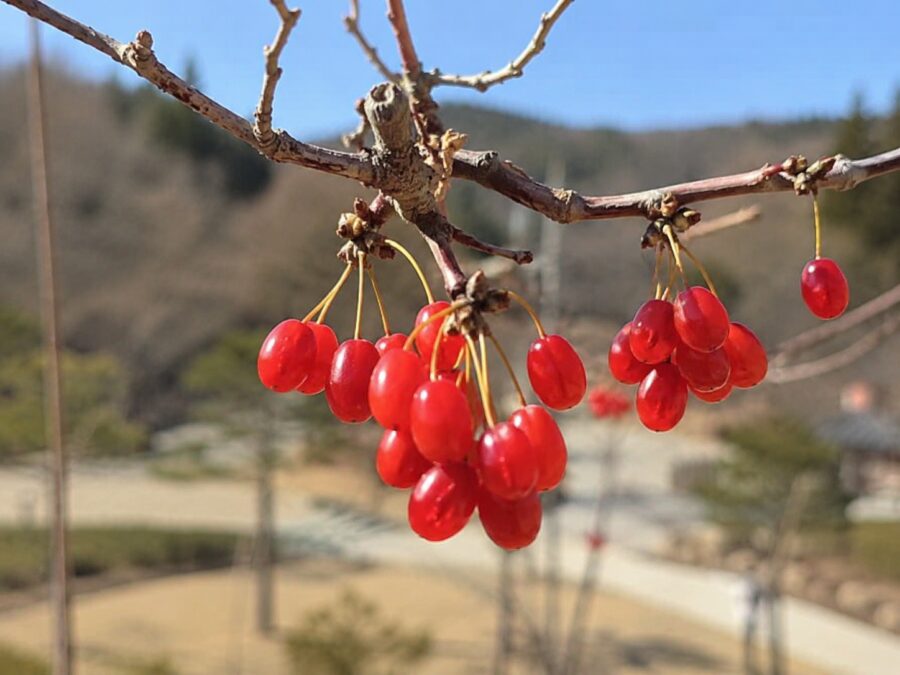
In the areas of Naeri, Jueup-ri, and Hyang-ri in Gaegun-myeon, over 7,000 Cornelian cherry trees more than 100 years old have gathered to form a village. It is called Sansuyu Village.
In spring, these trees burst into yellow blossoms all at once, coloring the rice paddies, fields, and even the village alleys entirely yellow. When autumn comes, ripe red Cornelian cherry fruits take their place. The Cornelian cherry is regarded as the landscape of this region itself.
When the flowers bloom, it becomes a famous spring flower spot in itself, and when the fruit ripens, it is used as an ingredient for tea and liquor. The characteristic of Cornelian cherry tea is its sour yet subtle sweetness.
It is against this backdrop that the Sansuyu Hanwoo Festival is held annually to coincide with the peak blooming of Sansuyu flowers. The two pleasures of walking along flower-lined paths and tasting Hanwoo beef are combined within a single festival.
Yangpyeong Sansuyu Hanwoo Festival at a Glance
Timing — Every year from late March to early April, for two days (weekend) coinciding with the peak bloom of Cornelian cherry blossoms
Location — Gaegun-myeon town center (main venue), Naeri, Jueup-ri, and Hyang-ri Sansuyu Villages (sub-venue)
Yongmunsan Mountain wild greens
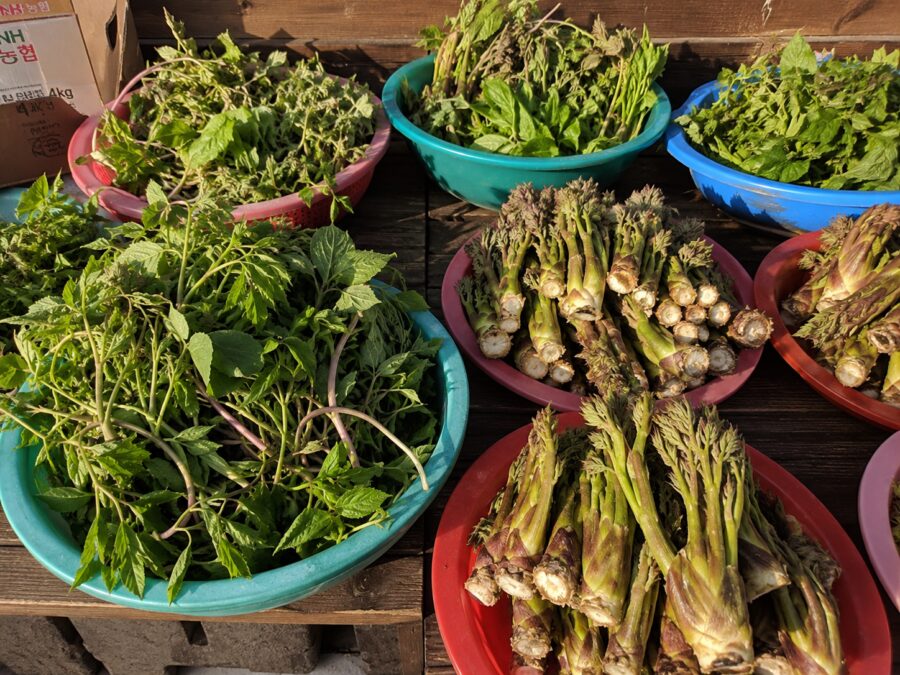
Dongguk Yeojiji, compiled during the mid-Joseon Dynasty, records that wild mountain vegetables from Yongmunsan Mountain were offered as tribute to the king. The vegetables from this region have been regarded as the best since ancient times, to the extent that the same content is repeated in almost every geographical text compiled thereafter.
Mt. Yongmun, standing at 1,157 meters above sea level, is one of the highest mountains in Gyeonggi Province. The high altitude causes the seasons to be delayed by a beat, to the point where snow falls near the summit even in May. This extreme diurnal temperature range and the soil in the deep valleys allow wild greens to grow slowly and firmly.
In spring, starting with Aralia elata, daylilies, bear's garlic, wild aster, and bracken appear in succession. Wild herb gatherers unanimously agree that the herbs grown in the valleys of Yongmun Mountain are much less bitter than the same varieties picked by the river.
Among them, deodeok is particularly famous in the area around Mt. Yongmun. Wild deodeok, which grows slowly on shaded mountain slopes covered with fallen leaves, has an aroma twice as strong as that grown in fields, and when you take a bite, a spicy yet slightly bitter taste lingers deep in the throat. This is why restaurants at the entrance of Mt. Yongmun serve grilled deodeok alongside their main dishes.
Every year from late April to early May, the Yongmunsan Wild Greens Festival is held in the area around the Yongmunsan tourist site. At the direct sales booths, you can purchase freshly harvested wild greens at a lower price than in the market, and there are also opportunities to taste wild green dishes and participate in harvesting experiences.
Yangdong chives

The Yangdong-myeon area at the eastern end of Yangpyeong-gun is a mountainous region boasting clean air and pure water. The chives grown here are... Clear-water Yangpyeong chivesall.
In 2005, as Yangpyeong was designated as the nation's first eco-friendly agricultural special zone, the county selected several crops, including chives, as its top 10 premium specialty crops and has been cultivating them intensively.
As a result, Yangdong-myeon chives have established themselves as a representative local crop, with over 170 farm households producing 5,500 tons annually and generating over 18 billion won in revenue.
It is characterized by being grown using organic fertilizers such as wood vinegar and herbal nutrients, moving away from traditional greenhouse cultivation methods. The strong aroma and tender, soft stems are considered the strengths of Yangdong chives.
It is shipped to the Garak-dong Agricultural and Fisheries Market and is regarded as the best chives in the country; locally, it is most commonly enjoyed in chive pancakes or fresh kimchi.
Cheongun Watermelon

Cheongun Watermelon, which refers to watermelons grown in the Cheongun-myeon area, is also a crop that Yangpyeong has selected and cultivated as one of its top 10 premium specialty crops, along with chives.
Grown with the goal of achieving the nation's highest level of taste through rigorous cultivation management based on eco-friendly certification. The mountainous terrain results in significant diurnal temperature variations, which create conditions that boost the watermelon's sugar content.
Cheongun watermelon and Yangpyeong leafy greens each generate annual sales of about 2 billion won, forming a pillar of Yangpyeong's eco-friendly agriculture along with chives and purslane.
High-quality Yangpyeong watermelons are shipped to the Garak-dong Agricultural and Fisheries Wholesale Market and are highly popular among locals as a delicacy to cool down in the midsummer heat.
Yangpyeong local food
Yangpyeong Haejangguk
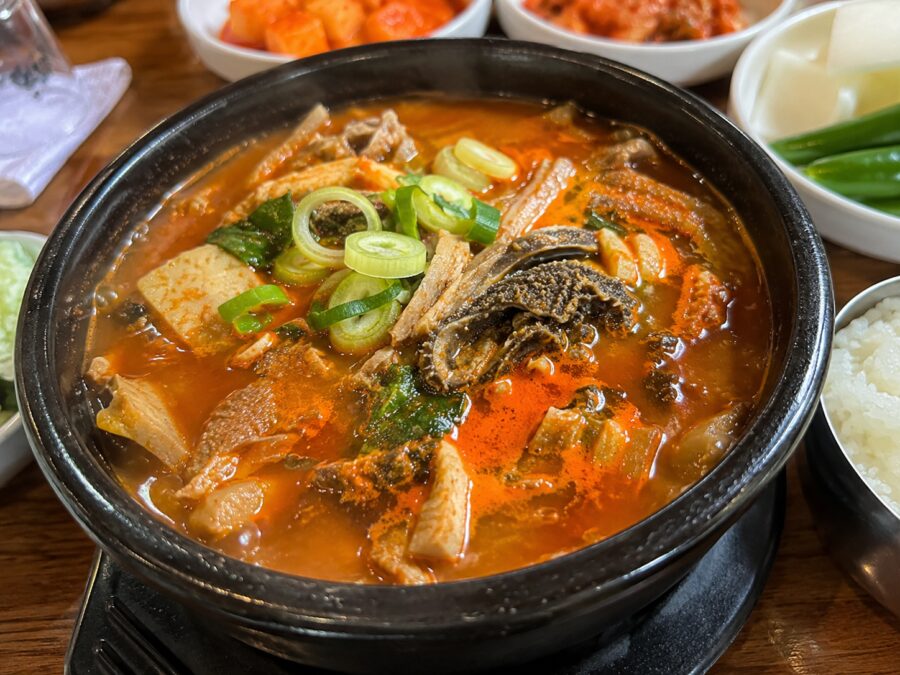
It is no exaggeration to say that the first food that comes to mind when hearing the name Yangpyeong is haejangguk. It is said that it started in the late 1960s at a small shop in Sinnae Village, Gaegeun-myeon.
At that time, there were many laborers working on bridge construction along the Bukhan River while traveling on rafts. An old woman bought cow offal and bones at the Yangpyeong cattle market and started cooking and selling gukbap to them.
This soup, which became famous by word of mouth among laborers on rafts, gradually made its way to Seoul and established itself under the name Yangpyeong Haejangguk. Even today, a shop near Yanggeun Bridge known as the original is bustling with customers.
The basic form of Yangpyeong Haejangguk is made by generously adding blood sausage, tripe, bean sprouts, and dried radish greens, and simmering it spicy with chili oil. It has more abundant ingredients and a richer broth than regular blood sausage haejangguk.
It is served in a hot earthenware pot generously filled with large chunks of blood sausage and offal; the blood sausage is savory and tender, while the tripe retains a delightful chewy texture. The flavor deepens even further when mixed with rice and topped with radish kimchi and regular kimchi.
[Image insertion location: Yangpyeong Haejangguk boiling in an earthenware pot with blood sausage and offal]
Yangpyeong Haejangguk Restaurant
Original Sinnae Haejangguk (Sinnae-gil, Gaegun-myeon) — The original restaurant dating back to the late 1960s. Characterized by large chunks of blood sausage and offal.
Yangpyeong Sinnai Seoul Haejangguk (near Yanggeun Bridge) — The main branch with locations throughout the metropolitan area. Price range around 10,000 won.
Okcheon Naengmyeon

The origin of Okcheon Naengmyeon dates back to the Korean War. In 1950, Lee Kwon-hyeok and Kim Sun-deok, a couple who had fled from Geumcheon, Hwanghae Province, stayed in Busan with the intention of returning to their hometown as soon as the war ended.
However, as the armistice line solidified, the road back to their hometown was blocked, and in 1952, the couple settled in Okcheon, where Yongmunsan Mountain is located. Having run a cold noodle restaurant in Geumcheon, they started the same business here.
The couple, who ran a restaurant called Hwanghae Restaurant and sold cold noodles along with dishes made from freshwater fish they caught themselves, narrowed their menu to four items—water cold noodles, spicy cold noodles, meatballs, and sliced boiled pork—starting in 1967 as the cold noodles became famous.
The large number of military bases in this area also contributed to the nationwide spread of Okcheon Naengmyeon. Soldiers who frequently transferred their posts spread the word, carrying the name of Okcheon Naengmyeon far and wide.
Unlike Pyongyang Naengmyeon or Hamheung Naengmyeon, which follow North Korean place names, it is named after the village where it was settled. 玉川The third-generation owners of the shop say that the unique feature of Okcheon Naengmyeon is that it is attached exactly as it is.
The noodles, made by mixing hulled buckwheat and sweet potato starch, are thicker and chewier than Pyongyang Naengmyeon. Dongchimi broth is added to the mild stock to create a deep flavor.
The meatballs served with cold noodles look similar to donggeurangtteok, but they have a much firmer and drier texture because they contain no tofu and have a higher proportion of pork. Enjoying cold noodles, meatballs, and sliced boiled pork together is called Okcheon Naengmyeon Samhap.
Since Hwanghae Restaurant opened, cold noodle restaurants have sprung up one after another in the Okcheon-ri area, naturally forming a cold noodle village. Compared to Pyongyang cold noodles, it differs in that the noodles are thicker and provide a greater sense of fullness as a meal.
Okcheon Naengmyeon Delicious restaurant
Okcheon Naengmyeon Hwanghae Restaurant (Okcheon-myeon, Main Branch & Branch) — The originator of Okcheon Naengmyeon. Water & Spicy Cold Noodles in the 10,000 won range, Meatballs & Sliced Boiled Pork in the 20,000 won range.
Okcheon Myeonok — Another popular restaurant in Okcheon Naengmyeon Village featuring Pyongyang-style cold noodles.
Yongmunsan Namul Bapsang
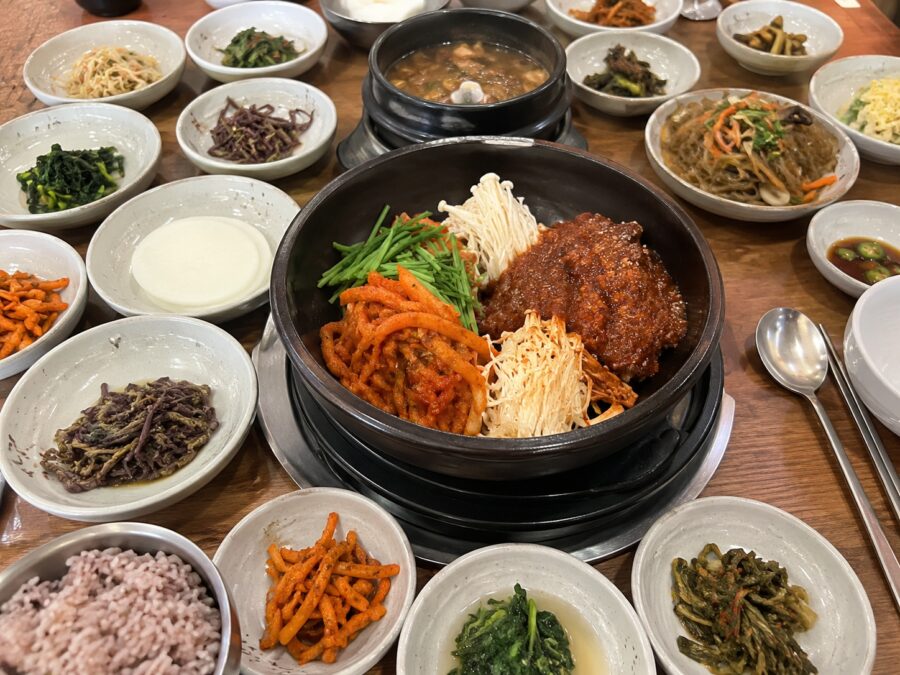
Restaurants serving wild vegetable or barley rice set meals have long been established in the village at the foot of Mt. Yongmun. Although these dishes do not have specific names, they have naturally become a staple dining spot for those climbing to Yongmunsa Temple.
While the specifics vary slightly from shop to shop, the general flow is the same. Barley or mixed grain rice is served with various vegetable side dishes made fresh that day, accompanied by soybean paste stew and one or two grilled dishes. Seasonal vegetables from Yongmun Mountain, such as Aralia elata, Ligularia fischeri, Aster scaber, and Osmunda japonica, form the centerpiece of the side dishes.
In the spring, freshly harvested greens are served, and after the season passes, dried greens prepared during their prime are served. Regular customers say that dried greens have a deep flavor distinct from fresh greens due to the process of drying, rehydrating, and stir-frying them.
There are many restaurants where you can order grilled deodeok as a standalone dish. The deodeok grown in the Yongmunsan area has a strong aroma, so when grilled, a savory and slightly bitter scent wafts far and wide. Enjoying a meal of seasoned vegetables along with grilled deodeok is the standard dining experience in this region.
Yangpyeong Seasonal Food Calendar
To truly experience Yangpyeong, it is best to visit according to the seasons. Each season has its own distinct time, from spring when Cornelian cherry blossoms bloom, to just before summer when deodeok and chives are at their peak, and finally to midsummer when watermelons are sweet.
| food | Seasonal period | Signature taste | How to enjoy the recommendations |
|---|---|---|---|
| Cornelian cherry | Late March to early April (flowers) / Autumn (fruits) | Sour and subtle sweetness | Sansuyu Tea, Sansuyu Hanwoo Festival Viewing |
| Yangpyeong Hanwoo | Year-round, festivals are in March and April | bright crimson flesh | Grilled meat, wild vegetable bibimbap |
| Yongmunsan Mountain wild greens and deodeok | April–June (Fresh greens) / Year-round (Dried greens) | Bitter and fragrant | Namul Bapsang, Grilled Deodeok, Wild Vegetable Festival (Late April to Early May) |
| Yangdong chives | Spring to early summer | Strong scent, soft stems | Chive pancake, fresh kimchi |
| Cheongun Watermelon | July~August | High sugar content | As fresh fruit |
You can make the most of your visit to Yangpyeong by following an itinerary that includes viewing the mist at Dumulmeori, finishing a bowl of cold noodles at Okcheon Naengmyeon Village, and then heading over to Gaegun-myeon Sansuyu Village to taste Korean beef.
Similar Posts
A Comprehensive Guide to Must-Visit Places and Hidden Gems in Buyeo, Chungnam
Buyeo, located in the southwestern part of Chungcheongnam-do and in the middle reaches of the Geum River, is home to Sabi, the last capital of Baekje…
Jeju, A Guide to Traditional Liquors and Local Breweries | Omegi-sul, Gosori-sul, Peanut Makgeolli
Until the Joseon Dynasty, rice was a very precious commodity on Jeju Island. Accumulated on top of basalt…
Must-visit spots in Northwestern Jeju: A Complete Guide to Aewol, Hyeopjae, and Hangyeong Hidden Gems
Jeju's northwest is particularly windy, and because of that wind, it's even more...
Places to Visit in Buan, Jeonbuk: A Comprehensive Guide to Hidden Gems on the Byeonsan Peninsula
Buan, located at the western edge of Jeonbuk Special Self-Governing Province, is a place more familiar by the name Byeonsan Peninsula than by its actual name…
Yeongam, Jeonnam: A Comprehensive Guide to Traditional Liquor and Local Breweries
Yeongam does not have a famous local liquor. Like Jindo's Hongju or Haenam's Jinyangju…
Places to Visit in Yeongam, Jeonnam: A Comprehensive Guide to the BEST 7+ Hidden Gems and Travel Destinations
Yeongam is a county in the southwestern part of South Jeolla Province, situated with Mt. Wolchul behind it and extending to the estuary of the Yeongsan River. Plains…


