Legal Definition and Quality Standards of Scotch Whisky
Scotch whisky can only use the name 'Scotch whisky' if it meets strict legal regulations. Established in 2009 Scotch Whisky Regulations 2009It replaced the previous 1988 law and presented stricter standards.
This regulation has three purposes: consumer protection, protection of manufacturers' businesses, and protection of national tax revenue. As the reputation of Scotch whisky has grown worldwide, such legal protection has become even more important.
Key Legal Requirements for Scotch Whisky
According to Scotch whisky regulations, Scotch whisky must meet all of the following conditions.
Raw materials and manufacturing process: It must be produced at a distillery in Scotland using water and sprouted barley (other grains may be added). All grains must be processed into mash at the distillery and converted into a fermentable substrate using only the innate enzyme system. Fermentation must be carried out by adding only yeast.
Distillation strength: It must be distilled to an alcohol content of less than 94.81 TP3T. This is to preserve the aroma and flavor derived from the raw materials and manufacturing method. Distilling to a higher alcohol content results in a spirit closer to neutral, causing it to lose the unique characteristics of Scotch whisky.
Aging Regulations: It must be aged exclusively in oak barrels with a capacity of 700 liters or less, and must be aged in Scotland for at least 3 years. The aging location must be a customs warehouse or an authorized facility.
Final Product: The color, aroma, and flavor derived from the raw materials, manufacturing, and aging processes must be preserved. No substances other than water and ordinary caramel coloring may be added. The minimum alcohol content must be 401 TP3T.
European Union Regulation 110/2008 also provides a definition of whisky. According to this regulation, whisky must be distilled from sprouted grains or other grain mash, distilled to an alcohol content of less than 94.81 TP3T, and aged for at least 3 years in oak barrels of 700 liters or less.
These strict regulations guarantee the quality of Scotch whisky and enable consumers around the world to experience products of consistent quality. Currently, there are approximately 100 malt distilleries operating in Scotland, all of which comply with these legal standards.
| Regulation Items | Detailed requirements |
|---|---|
| origin | Distilled and aged in Scotland |
| raw material | Water, sprouted barley, yeast (other grains can be added) |
| distillation strength | Less than 94.81 TP3T ABV |
| Aging period | At least 3 years |
| aging container | Oak barrels of 700 liters or less |
| Bottling strength | Minimum 40% ABV |
| Permitted additives | Only water and caramel coloring are allowed. |
5 Classifications of Scotch Whisky by Ingredients
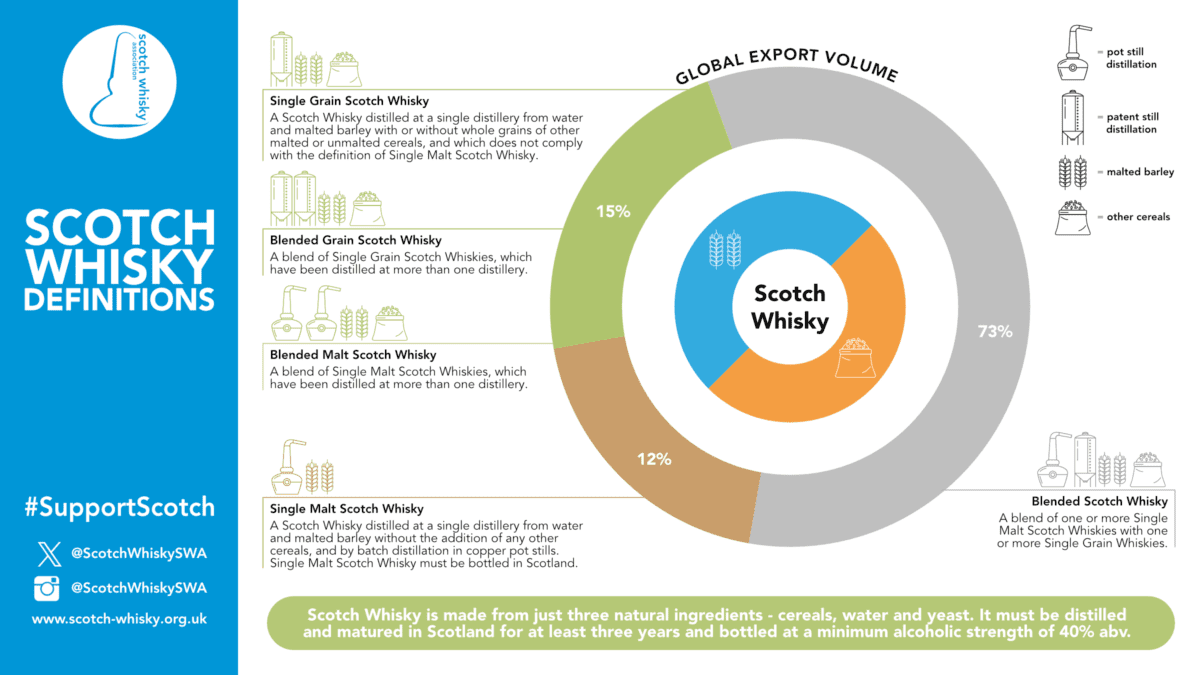
Scotch whisky regulations define five official categories. These classifications are distinguished by ingredients and production methods, and each possesses unique characteristics. While 'Single Malt' is often considered a premium whisky, each category has its own unique value and appeal.
1. Single Malt Scotch Whisky
Single malt is Single distilleryOnly at sprouted barleyIt is a whisky made using only single malt. Although single malt is sometimes misunderstood as whisky from a 'single barrel,' it can actually be a blend of whiskies from multiple barrels. 'Single' refers to a single distillery.
Single malt is produced using batch distillation in traditional copper pot stills. Each distillery has a unique flavor profile, which is determined by water characteristics, peat usage, fermentation time, the type of still, and the aging method.
Famous brands such as Glenfiddich, Glenlivet, and Macallan all belong to the single malt category. They are each representative distilleries of the Speyside region.
2. Single Grain Scotch Whisky
Single grain is also produced at a single distillery, but, unsprouted grainsWheat, corn, rye, etc. are used as the main ingredients. A small amount of sprouted barley is sometimes added as an enzyme source.
Single grain is a continuous distillation method Coffey StillIt is produced using a pot still. This allows for distillation to a much higher alcohol content than a pot still, producing a cleaner and lighter spirit. Grain whisky has a relatively neutral flavor, but is characterized by a creamy texture and a subtle sweetness.
Single grain has historically been overlooked, but it is being re-evaluated recently as it is being released as an independent product. Good examples include Girvan 25 Year and Cambus.
3. Blended Malt Scotch Whisky
Blended malt is Two or more distilleriesIt is a blend of single malt whiskies produced in [location]. In the past, it was called 'Vatted Malt,' but the official name was changed following a regulation revision in 2009.
This category includes no grain whisky at all and consists solely of malt whisky. Blenders can combine malts from various distilleries to create specific flavor profiles. Monkey Shoulder is a representative blended malt product.
Advantages of Blended Malt: Complex flavors can be created by combining regional characteristics. For example, a balanced whisky can be created by combining the peaty notes of Islay with the fruity notes of Speyside.
4. Blended Grain Scotch Whisky
Blended grain is a blend of single grain whiskies produced at two or more distilleries. Although this category is relatively less well-known, its light and smooth characteristics create an accessible whisky.
Innovative blenders like the Compass Box are introducing interesting products in this category. Blended grains are generally characterized by a mild, sweet, and creamy taste.
5. Blended Scotch Whisky
Blended Scotch At least one single malt와 One or more single grainsIt is a whisky blended with [ingredients]. This is the most popular category of Scotch whisky and accounts for approximately 681 TP3T of total Scotch exports.
World-famous brands such as Johnnie Walker, Chivas Regal, Ballantine's, Dewar's, Grant's, and Famous Grouse all belong to blended Scotch.
Blending is a highly skilled art. Master blenders sometimes combine more than 50 different malt and grain whiskies to create a consistent flavor profile. Premium blended whiskies contain a high proportion of malt whisky and add complexity by using spirits aged in sherry casks.
Purpose of blending: Grain whisky provides a light and clean basic matrix, while malt whisky adds complex flavors and character. The harmony of these two elements creates a balanced and approachable whisky.
Historically, blending began in the mid-to-late 19th century. At that time, the introduction of continuous distillation technology made the production of grain whisky possible, leading to the commercial development of blending. Initially, blending was used to make intense Highland whiskies smoother or to add flavor to bland Lowland whiskies.
| Category | raw material | distillery | characteristic |
|---|---|---|---|
| Single malt | Only germinated barley | Single distillery | The distillery's unique and strong character |
| Single grain | Various grains | Single distillery | Light and creamy flavor |
| Blended Malt | Only germinated barley | multiple distilleries | A harmony of various malts |
| Blended Grain | Various grains | multiple distilleries | Soft and accessible |
| Blended Scotch | Malt + Grain | multiple distilleries | Balanced complex flavor |
6 regions of Scottish whisky
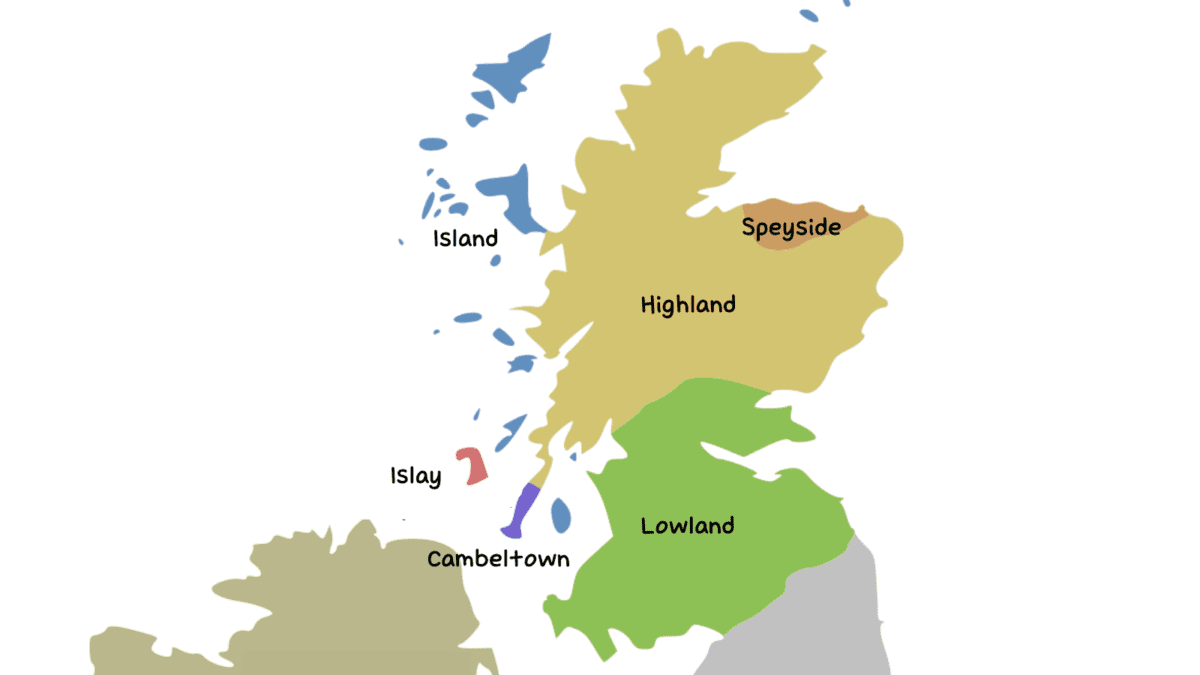
Scotland is a sacred place for whisky enthusiasts around the world. The whisky produced in this small country exhibits distinctly different characteristics depending on the region. Officially Scotch whisky regulationsIt specifies five protected areas: the Highlands, Lowlands, Speyside, Campbeltown, and Islay.
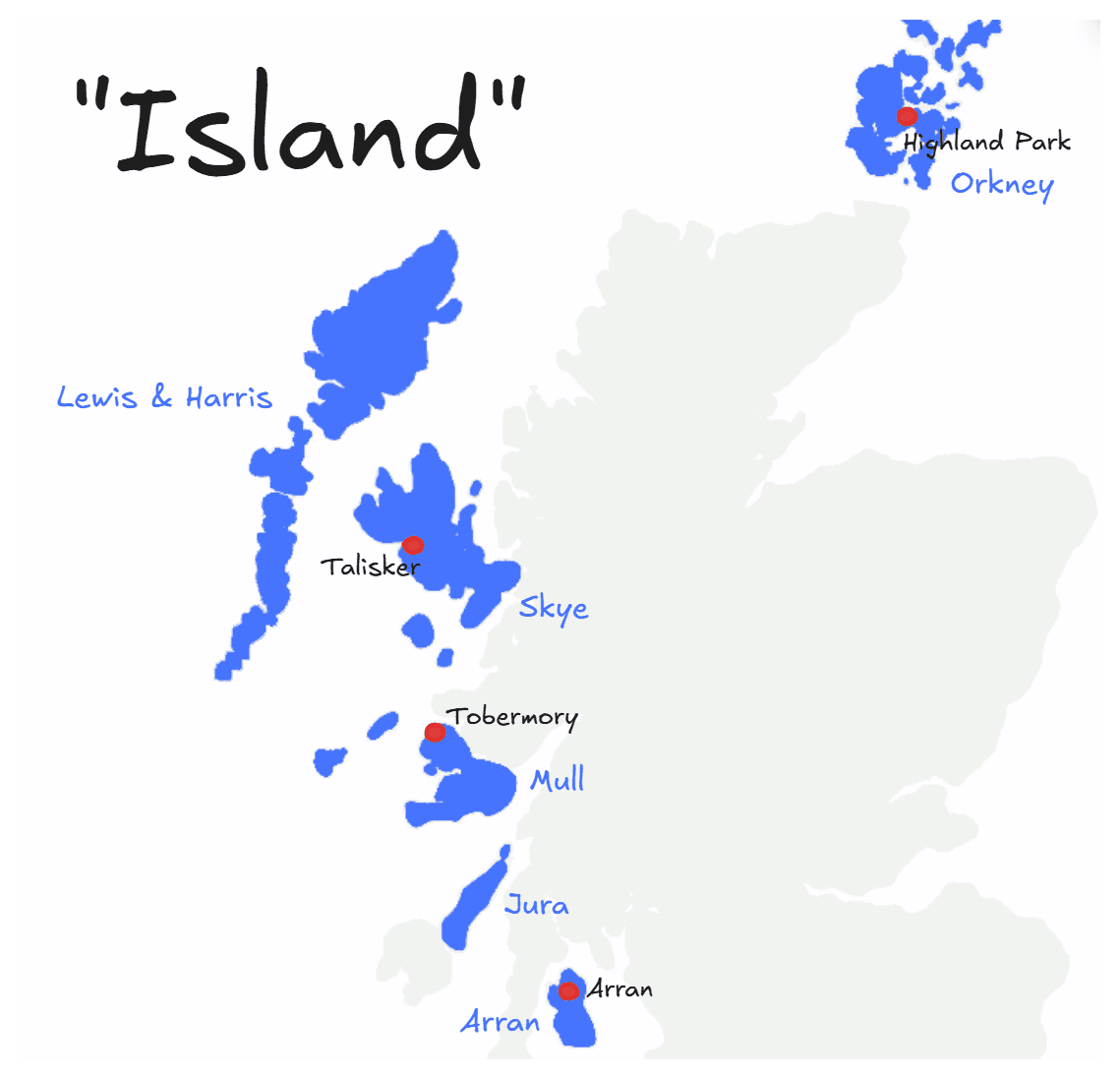
But in reality 6 regionsIt is more accurate to distinguish them as follows. The islands surrounding Scotland, that is Ireland That is the region. Although officially classified as a sub-region of the Highlands, whisky produced on islands such as Skye, Orkney, Arran, and Jura possesses characteristics distinctly different from the mainland Highlands. For this reason, many whisky experts and enthusiasts recognize Ireland as an independent sixth region.
Representative characteristics by region
Aylay: It is famous for its intense peat aroma and maritime characteristics. As a mecca for smoky and medicinal-feeling whiskies, it is a matter of strong personal preference.
Highland: As the most extensive region in Scotland, it is divided into the North, East, West, and South, each boasting a distinct flavor.
Ireland: Strongly influenced by the sea, salt and peat notes are commonly present, but each island possesses its own unique character.
Lowland: It produces a light, delicate, floral whisky. It has a tradition of triple distillation and is known as 'Morning Whisky'.
Campbelltown: Although it is the smallest region, it produces an intense and unique whisky with a harmony of saltiness, sweetness, and smoke.
The characteristics of each region are shaped by a combination of climate, topography, water properties, and manufacturing traditions spanning centuries. Although produced in the same country of Scotland, the elegant whiskies of Speyside and the peaty whiskies of Islay offer completely different experiences. Now, let us take a closer look at each region one by one.
Speyside – The region with the highest concentration of distilleries

Speyside Over 601 TP3T of Scotland's total single malt productionIt is the heart of whisky responsible for [the region]. Centered around the River Spey, this area is technically part of the Highlands, but due to the density of distilleries and unique flavor characteristics, it has been officially recognized as an independent whisky region.
Currently, more than 60 distilleries are operating in this region, concentrated within a narrow area of about 15 miles. The meltwater from the Grampian Mountains, the abundant malted barley of Bannanshire and Moray, and the development of the railroad era made Speyside a center of whisky.
Characteristics of Speyside Whisky
Speyside whisky is generally Rich in fruit flavor and sweet, with low peat usage It is known to have notes of apple, pear, honey, vanilla, and spices, and many products are aged in sherry casks, resulting in more complex flavors.
This region has the driest and warmest climate in Scotland, making it ideal for agriculture. The River Spey provides distilleries with a clean and excellent water source. Because the use of peat is rare, smoky whiskies are almost non-existent; instead, they are characterized by elegant and smooth flavors.
Ideal area for beginners: Speyside whisky is perfect for beginners thanks to its delicate and aromatic characteristics. It is complex yet accessible, and not overly intense, serving as a gateway to the world of whisky.
Major distilleries and sub-regions
Speyside is traditionally divided into eight sub-regions: Rothes, Strathisla, Lossie, Livet, Findhorn, Dufftown, Deveron, and Speyside Central.
Glenfiddich과 GlenlivetThey rank first and second among the world's best-selling single malt whiskies. Glenfiddich features a harmony of pear and apple fruit notes with the smoothness of oak, while Glenlivet is light and grassy, whereas Macallan is famous for its rich and sweet characteristics.
Balvenie is known for its complex, honey-like flavors, Aberlour for its rich taste with strong sherry influences, and Tomintoul and Glen Moray for their smooth and approachable styles.
Strathisla is a key component of Chivas Regal Blend. The distillery produces dry, fruity oak-flavored malts and believes that the fermentation characteristics, achieved using traditional wooden fermentation vats, play a crucial role in the whisky's character.
Recommended Representative Speyside Whisky:
- Glenlivet 12 Year – Smooth and rich in fruit flavors
- Macallan 12 Year Old Sherry Oak – Complex and strong sherry influence
- Balvenie Doublewood 17 Year – Complex and elegant flavors
| Local Information | Speyside |
|---|---|
| Distillery number | More than 60 (more than 60% in all of Scotland) |
| Signature Flavor | Apple, vanilla, oak, malt, nutmeg, raisin |
| Use feet | Very rare (rarely used) |
| characteristic | Rich in fruit scent, elegant and soft, ideal for beginners |
Islay – The sanctuary of peat

Islay is a small island located in the Inner Hebrides of western Scotland, but it is a sacred place for whisky enthusiasts. This island strong Peat scent과 Coastal characteristicsIt is famous for producing the most unique and distinctive whisky in the world.
Islay is known as the "Queen of the Hebrides," thanks to its fertile soil. Traditionally, an abundant supply of barley and peat has provided the perfect environment for whisky production. Currently, nine distilleries are operating on Islay, each possessing a unique character.
Unique characteristics of Islay whisky
The biggest characteristic of Islay whisky is peatIt is the use of peat. This island is composed mainly of peat, and distilleries use peat as fuel when drying malted barley. This imparts smoky, medicinal, and earthy flavors to the whisky.
Furthermore, the island is exposed to sea breezes and rain, which adds salty and seaweed-like flavors to the whisky. Islay whisky is known to have the most intense flavor of all Scotch whiskies. Complex notes of iodine, cocoa, saltiness, pepper, and moss emerge.
Points to note: Not all distilleries on Islay produce peated whisky. Distilleries located in the north of the island produce lighter, fruitier whiskies. Bruichladdich is the only distillery on Islay that produces non-peated malt, creating floral and elegant whiskies. (It is also the distillery that produces Octomore, often referred to as the ultimate peat whisky.)
Representative Islay Distilleries
LaphroaigIt is famous for its medicinal properties and strong iodine flavor. It is typical of the Islay style; while it may be shocking to first-time tasters, it is addictive for enthusiasts.
ArdbegIt has complex fruit and chocolate notes along with intense peat. LagavulinIt shows a perfect balance of sweet peat and coastal characteristics.
BowmoreIt is one of the oldest distilleries on Islay and is characterized by a balance of medium peat levels and fruit flavors. Caol IlaIt produces an approachable Islay whisky with relatively light peat and citrus notes. Caol Ila is also famous as one of Johnnie Walker's core spirits.
KilchomanIt is Islay's newest distillery, adhering to traditional methods of growing barley directly on the farm and using floor malting.
Recommended Representative Islay Whisky:
- Bruichladdich Classic Ladie – Non-peated Islay whisky
- Bowmore 12 Year – Medium fit and balance
- Ardbeg Ugerdal – Intense Feet and Complexity
| Local Information | Details |
|---|---|
| Distillery number | 9 (small but world-famous) |
| Signature Flavor | Seaweed, brine, carbolic soap, apple, smoke, herring |
| Use feet | Very High (Ailay's signature feature) |
| characteristic | Intense smoky, medicinal, coastal characteristics, the most distinctive whisky |
Islay whisky can certainly feel overwhelming and difficult at first, but if you take the time to experience it, you will become captivated by its complexity and depth. This is precisely why many whisky enthusiasts eventually become fans of Islay whisky.
Highlands – The most vast and diverse flavors

The Highlands are in Scotland The largest whisky production regionIt begins north of Glasgow, crosses between the mouth of the Clyde and the River Tay, and extends northward to Thurso. This vast region spans east to west and includes most of northern Scotland, excluding Speyside.
Due to the vast geographical scope of the Highlands, it is difficult to define a single regional style. Instead, it is more accurate to divide them into four sub-regions: Northern, Eastern, Southern, and Western. Each sub-region possesses unique characteristics.
Characteristics by sub-region
Northern Highlands: This region produces fresh, medium-bodied whiskies featuring heather, citrus, and partially coastal notes. Glenmorangie is known for its elegant and complex flavors, Dalmore for its grain and honey notes, and Old Pulteney for its coastal characteristics.
Eastern Highlands: The whisky from this region is full-bodied, dry, and very fruity. Glencadam and Fettercairn are located in this area, characterized by dry, malty traits and a light smoky flavor.
Southern Highlands: Deanston, Loch Lomond, and Glengoyne represent this region. Southern Highland whiskies generally possess complex flavors, accompanied by the dry finish characteristic of the Highlands. Glengoyne is known for its dry, fruity notes along with nutty flavors.
Western Highlands: This region produces full-bodied, peaty whiskies enveloped in smoke. Oban is at the pinnacle of boldness, while Ben Nevis is a lighter style that still retains sweet notes.
Diversity of the Highlands: Wild seas and impenetrable wilderness dominate the landscape, creating a breeding ground for powerful peaty dram while leaving room for floral and silky elegance. Fruitcake and oak harmonize with heather and smoke.
Representative Highland Distillery
GlenmorangieIt is a representative Highland whisky that is delicate, fruity, and floral. This distillery uses the tallest still in Scotland, which contributes to creating a light and elegant spirit.
DalmoreIt is famous as a rich whisky with a strong sherry influence. It is characterized by complex notes of chocolate, orange, and spices. DalwhinnieIt is located in the Central Highlands and offers a syrupy sweet flavor.
Royal LochnagarIt is one of only two existing distilleries to have received the 'Royal' title (the other being Royal Brackla). This honor was bestowed after Queen Victoria visited the distillery.
ArdmoreIt produces whisky combining fruit and smoke in the East. ClynelishIt is a coastal distillery in the Northern Highlands, and has a unique character with waxy and fruity notes.
Characteristics of Highland Whisky: One thing you can be sure of when drinking Highland whisky is that you can expect elegance and complexity in every drop. From light to salty coastal malts, the Highland offers pleasure for all tastes.
Recommended Representative Highland Whisky:
- Glenmorangie Original – Smooth vanilla and citrus scents
- Glendronach 12 Year – Richness of Sherry Cask
- Oban 14 Years – A blend of coastal characteristics and smoke
- Dalmore 12 Year – Complexity of chocolate and orange flavors
| Local Information | Details |
|---|---|
| Distillery number | More than 25 (the largest area in Scotland) |
| Signature Flavor | Fruitcake, malt, oak, heather, raisin, smoke |
| Use feet | Medium (varies depending on the region) |
| characteristic | Very diverse styles, distinct differences by sub-region |
Overall, Highland whiskies tend to be lightly peaty, yet spicy and heavy. The heather-covered landscapes of the Highlands are often reflected in the aromas of the whiskies produced there.
Lowlands – The home of smooth and delicate whisky

The Lowlands are of mainland Scotland. The southernmost regionIt is located south of the line connecting Dundee and Greenock. It encompasses the central belt, including Edinburgh and Glasgow, and most of southern Scotland.
This region is relatively flat and consists of sedimentary rocks, specifically sandstone and clay. This means that vast green spaces can extend far into the distance. The basins of the Clyde and Forth rivers occupy most of this area.
Characteristics of Lowland Whisky
Lowland whisky is Light, delicate, and floral It is known to be so. Whisky from this region is often called 'Morning Whisky' or 'Lowland Ladies,' due to its light and floral characteristics.
The typical Lowland flavor profile is peat-free, floral, citrusy, and sweet. Notes of cream, hay, cinnamon, and ginger are just below the surface. These characteristics make Lowland whisky a perfect choice for single malt beginners.
The tradition of triple distillation: Historically, many Lowland distilleries triple distillation They used a method that produces a lighter and purer spirit than standard double distillation. Auchentoshan is a distillery that continues triple distillation to this day, producing whisky with a refreshing citrus edge.
Representative Lowland Distillery
AuchentoshanIt is a representative distillery of the Lowlands. Located near Glasgow, this distillery is the only one in Scotland that still triple-distills all of its whisky. The result is a light and delicate whisky with refreshing citrus flavors reminiscent of lemon pancakes.
GlenkinchieIt is located near Edinburgh and is known as the 'Malt of Edinburgh'. This whisky has grassy notes and is creamy and smooth. Most of its production is used for blended whiskies, including Johnnie Walker, and only a portion is released as single malt.
BladnochIt is Scotland's southernmost distillery, which went through repeated closures and reopenings as it was acquired by various parties before being revived in 2015 by its current owner, David Prior. This distillery produces delicate whiskies with a harmonious blend of floral and fruity notes.
Historically, there were more distilleries in the Lowlands, but many have closed down. Whisky from closed distilleries such as Rosebank and Littlemill is now highly valued among collectors.
The Resurgence of the Lowlands: In recent years, the Lowland region has been experiencing growth with the emergence of new distilleries. This reflects the growth of the whisky industry as a whole and renewed interest in the Lowland style.
Recommended Representative Lowland Whisky:
- Oakentosh American Oak – A harmony of vanilla and citrus
- Glenkinchie 12 Year – Grassy notes and creamy characteristics
- Ocentrosion Three Wood – The Complexity of Triple Distillation
| Local Information | Details |
|---|---|
| Distillery number | Fewer than 5 (large area but few distilleries) |
| Signature Flavor | Grass, honeysuckle, cream, toffee, toast, cinnamon |
| Use feet | Almost none (unfitted style) |
| characteristic | Light and delicate, triple distillation tradition, known as 'Morning Whisky' |
The light and approachable characteristics of Lowland whisky make it ideal as an aperitif. They are perfect as an appetizer and pair well with delicate dishes. Lowland whisky also plays an important role in blended Scotch, providing smoothness and balance.
Campbeltown – A small but intense coastal region

Campbeltown is Scotland's The smallest whisky regionIt is the only city recognized as an independent region. Located at the tip of the Kintyre Peninsula, this remote city was once called the 'Whisky Capital of the World,' and more than 30 distilleries were in operation in the 19th century.
Today, only three distilleries remain in Campbeltown: Springbank, Glen Scotia, and Glengyle. Despite the scarcity of distilleries, Campbeltown still maintains its status as an independent whisky region.
Unique characteristics of Campbeltown whisky
Campbeltown whisky is Saltiness, sweetness, smoke, and vanilla and fruit flavorsIt possesses all of these simultaneously. This is the result of the combination of a coastal location and a manufacturing method unique to the region.
Whisky from this region is more similar to the Lowland style than the Highland style, but it is sweeter and more robust. The influence of coastal air and ports gives the whisky a briny profile. Flavors of smoke, vanilla, and toffee are also common.
Ocean Impact: All distilleries in Campbeltown are located near the sea, and the port was originally built to transport precious whisky from Scotland to London. This marine environment influences the whisky during cask maturation, imparting unique salt characteristics.
Three surviving distilleries
SpringbankIt is a symbol of Campbeltown. The distillery is still family-owned and adheres to traditional manufacturing methods. Springbank uses a unique 2.5-distillation process, which produces a robust, smoky, and maritime whisky.
The same company Longrow와 HazelburnThey also produce two other styles. Longrow is heavily peated and closer to the Islay style, while Hazelburn is triple-distilled and is lighter and more delicate.
Glen ScotiaIt produces a lighter, grassy malt. Salt and caramel notes add nuance to the light-bodied whisky. It lies midway between Islay and Speyside.
GlengyleIt is the newest distillery and reopened in 2004. Their Kilkerran whisky is light and sweet, but has unique oily and salty notes.
Campbeltown Malt Whisky Festival: Every year, Campbeltown hosts the Malt Whisky Festival, offering visitors the opportunity to taste the region's whisky, learn about the production process, and celebrate the role whisky plays in Scottish history and society.
Recommended Representative Campbeltown Whiskeys:
- Springbank 10 Years – Robust and marine characteristics
- Long Low Fitted – The Intensity of the Islay Style
- Glen Scotia 15 Year – Light and grassy scent
- Kilkeran 12 Years – Oily and Salty Notes