Japanese whisky now proudly ranks among the world's top five whiskies, alongside Scotland, Ireland, the United States, and Canada. Since Nikka's Yoichi 10-Year-Old received the highest score from Whisky Magazine in 2001, Japanese whisky has swept countless top awards at international competitions. In 2015, Yamazaki Single Malt Sherry Cask 2013 was even selected as the world's best whisky by the World Whisky Bible.
Let’s take a detailed look at everything from the origins of this unique style, developed with Japan’s distinctive craftsmanship and refined palate based on techniques learned in Scotland 100 years ago, to its unique manufacturing methods, drinking culture represented by highballs, and even recommended products for beginners.
index
- The History of Japanese Whisky – A 100-Year Legacy Created by Two Masters
- The Manufacturing Method of Japanese Whisky – Craftsmanship Beyond Scotland
- Introduction to Japan's Major Distillery
- Japanese Whisky Drinking Culture – From Highball to Mizuwari
- Recommended products for Japanese whisky beginners
The History of Japanese Whisky – A 100-Year Legacy Created by Two Masters

Whiskey was first introduced to Japan in 1853, when the U.S. fleet led by Commodore Perry visited to demand the opening of Japan. At the time, whiskey was served to Shogunate officials, and the following year, a cask of whiskey was presented as a gift to Shogun Tokugawa Iesada. However, the true history of Japanese whiskey begins with two pioneers: Shinjiro Torii and Masataka Taketsuru.
In 1918, Masataka Taketsuru, a young engineer at Settsu Shuzo, went to Scotland to study. While studying chemistry at the University of Glasgow, he simultaneously gained practical experience at various distilleries. In particular, he stayed at the Hazelburn Distillery in Campbeltown for two to three months, where he learned the essence of whisky production and recorded this experience in detail in two notebooks. These "Taketsuru Notes" would later become a textbook for the Japanese whisky industry.
When Taketsuru returned in 1920, Settsu Shuzo, which had sent him to Scotland, had abandoned its whisky business plans due to financial difficulties. Meanwhile, Shinjiro Torii, who had achieved success in the wine business, was dreaming of full-scale domestic whisky production. Torii learned of Taketsuru, who had learned the techniques in Scotland, and recruited him under extraordinary conditions: a 10-year contract with an annual salary of 4,000 yen.
The two men differed in their opinions regarding the location of the distillery. Taketsuru preferred a northern region like Hokkaido, which has a climate similar to Scotland, while Torii wanted a suburb close to consumption centers. Eventually, Yamazaki, located on the outskirts of Kyoto, was chosen as a compromise. The area was famous for its excellent water—so much so that Sen no Rikyu had built a tea room there—and the environment, where three rivers converged and fog frequently set in, was ideal for aging whisky.
In 1924, Japan's first whisky distillery, the Yamazaki Distillery, was completed, and in 1929, the first Japanese whisky, Shirofuda (White Label), was released. However, the strong smoky aroma of the Scottish style did not suit the taste of Japanese people at the time. Sales were sluggish amidst harsh criticism that it "smells like smoke." Torii did not give up and, after numerous blending attempts, released Suntory Kakubin in 1937, which suited the Japanese palate, and this product achieved great success.
After his 10-year contract ended, Taketsuru decided to become independent and establish his own distillery. He settled in Yoichi, Hokkaido, which he believed had a climate most similar to that of Scotland. With the Yoichi Distillery beginning operations in 1936, the Japanese whisky industry began to develop in earnest, centered around the two giant corporations, Suntory and Nikka.
The Manufacturing Method of Japanese Whisky – Another Form of Craftsmanship from Scotland

Japanese whisky started out modeled after Scottish whisky, but over time, it has developed its own unique characteristics. The biggest difference is that a single company must produce all the spirits of various styles in-house. In Scotland, there is active trading of spirits between various distilleries, whereas in Japan, there is almost no trading of spirits between competing companies.
To overcome these limitations, Japanese distilleries have developed methods to produce various styles of whisky in a single location. Distilleries such as Yamazaki and Hakushu operate multiple types of pot stills of different shapes and sizes, combine direct fire and steam heating, and use both stainless steel and wood for their fermentation tanks. Through this, they produce a wide range of styles, from smoky and peaty Islay malts to light and delicate Speyside malts.
The characteristics of the key stages of Japanese whisky production are as follows.
During the malting stage, Japanese distilleries historically produced their own malt, but currently, most purchase it from commercial maltsters. They primarily use unpeated or lightly peated malt, along with small amounts of medium- and heavily peated malt. While some import Scottish peat, an increasing number of distilleries are utilizing local peat in recent years.
The water used in the mashing process varies from soft to medium hard, and the pH is maintained within the neutral range. Since the clarity of the wort influences the development of flavor components such as esters and fatty acids, each company has its own unique policy. Kirin applies beer brewing technology to produce clear wort, thereby creating fragrant and fruity esters. Suntory also pursues aromatic and complex aromas by maintaining a high degree of wort clarity.
| division | Japanese whisky | Scottish whisky |
|---|---|---|
| Concentrate trading | Almost no transactions between companies | Active trading between distilleries |
| distillation method | Producing various styles at one distillery | Specialized styles for each distillery |
| use yeast | Distilled yeast + Beer yeast combination | Mainly uses distilled yeast |
| Aging temperature | Large annual temperature range (4~27°C) | Relatively constant |
| Special Orcs | Mizunara (Japanese oak) usage | Mainly American/European oak |
During the fermentation stage, Japanese distilleries use both stainless steel and wooden fermentation tanks. Of particular note is the method of yeast usage. While the use of ale yeast has recently been declining in Scotland, some Japanese distilleries still place importance on using both distillation yeast and ale yeast for brewing. Using both types of yeast together results in a distinctive survival rate profile during fermentation and adds complex flavors to the New Make spirit.
During the distillation process, Japanese distilleries utilize pot stills of various shapes and sizes. Nikka’s Yoichi Distillery adheres to a direct coal-fired method using stills with descending rhine arms, while the Miyagikyo Distillery uses indirect heating in spherical stills. Suntory produces various types of spirits by operating a diverse array of pot stills with different shapes, sizes, and heating methods at its two malt distilleries. The wash (fermented liquid) has an alcohol content of 7–81 TP3T, which becomes a raw wine with an ABV of 20–251 TP3T after the first distillation. In the second distillation, it separates into three parts—head, heart, and tail—with only the heart portion becoming the New Make spirit for aging.
The secret to the unique flavor of Japanese whisky, Mizunara oak
One of the most unique elements symbolizing Japanese whisky is Mizunara (Japanese oak, Quercus mongolica). cask It is used. Young spirit aged in Mizunara casks has a coconut scent, and after long aging, it transforms into a fragrant oriental aroma comparable to Kara or sandalwood. Chemical analysis reveals that whisky aged in Mizunara casks has a higher proportion of trans-lactones compared to American or European oak. It has been found that these trans-lactones contribute to the distinctive coconut flavor.
Japan's climatic characteristics also play a significant role in terms of the aging environment. The seasonal temperature variation in Japan is much greater than in Scotland. The annual temperature at the Yamazaki distillery ranges from 10 to 27°C, Hakushu from 4 to 22°C, and Yoichi records colder temperatures than Scotland from November to March. These temperature fluctuations affect the interaction between the cask and the whisky, creating a flavor profile different from that of Scotland even with the same aging period. According to Suntory data, the average annual evaporation loss (angel's share) in the warehouse is approximately 2.51 TP3T.
Introduction to Japan's Major Distillery
Currently, there are over 50 whisky distilleries operating or planned for construction in Japan. Let's take a brief look at some of the most historic and influential major distilleries among them. Detailed information on each distillery will be covered in depth in a separate article.

The Yamazaki Distillery (established in 1923), operated by Suntory, is Japan's first whisky distillery and is located between Kyoto and Osaka. Characterized by a mild climate with high humidity, it produces rich and deep malt whisky by operating various types of pot stills. The Hakushu Distillery (established in 1973) is located within a national park in the southern Japanese Alps and produces a clean and refreshing style of whisky using soft water that has passed through granite layers and the cool climate at an altitude of 700 meters.
 Nikka's Yoichi Distillery (established in 1936) was founded by Masataka Taketsuru and is located in Hokkaido, which has a climate most similar to Scotland. It adheres to direct coal-fired distillation and is characterized by a heavy, smoky style. The Miyagikyo Distillery (established in 1969) is located near Sendai in northeastern Honshu and, in contrast to Yoichi, produces a smooth, fruity whisky. Nikka blends the spirits from both distilleries to create a balanced product.
 The Fujigotenba Distillery (established in 1973), operated by Kirin, is located at the foot of Mt. Fuji and is a complex distillery that produces both malt and grain whisky. Since the 2000s, numerous craft distilleries have emerged, led by the Chichibu Distillery (established in 2008). Chichibu's Ichiro's Malt has proven the potential of Japanese craft whisky by winning consecutive awards at international competitions. In addition to this, distinctive craft whiskies are being produced in various regions across the country, including Akashi, Nagahama, and Shizuoka.
Japanese Whisky Drinking Culture – Highball and Mizuwari
Japan's whisky drinking culture is quite different from that of Scotland or other countries. While enjoying premium single malts straight or on the rocks is similar worldwide, a unique Japanese way of drinking blended whisky has developed.
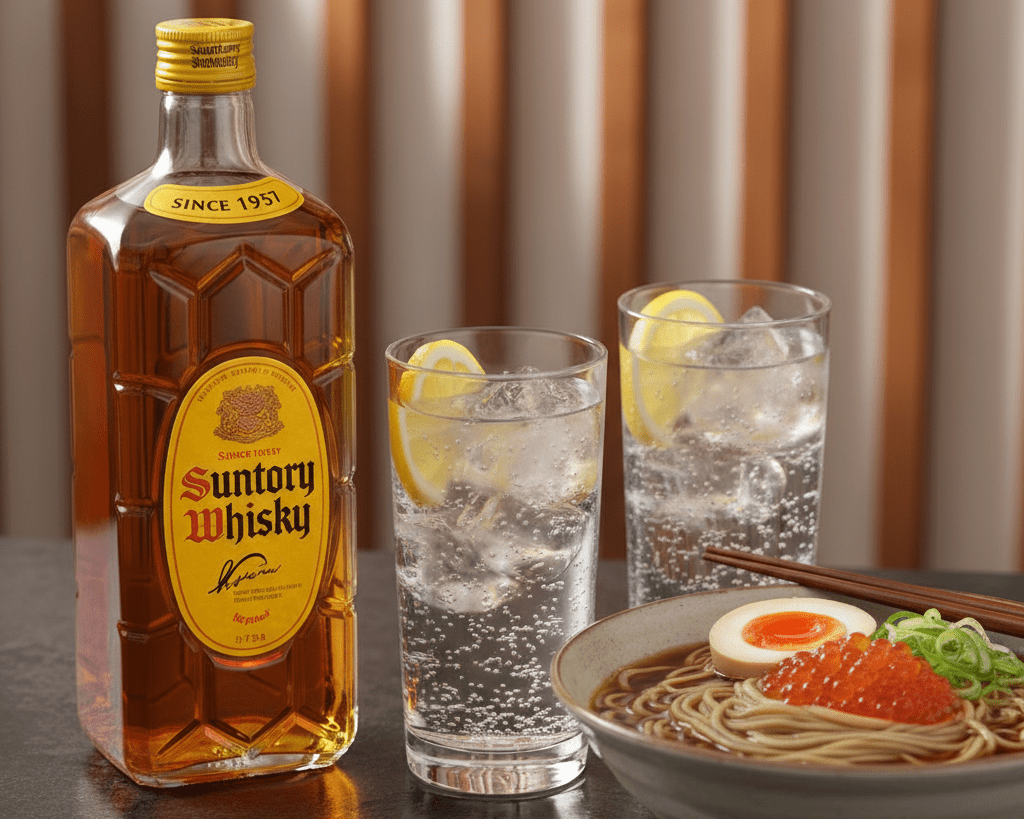
The most representative example is the Highball. This cocktail, made by mixing whiskey and sparkling water, became popular during the period of rapid economic growth in the 1950s, but its popularity waned after 1983 due to the stagnation of the whiskey market. However, it achieved a dramatic revival in 2008 when Suntory launched a massive "Kakuhighball" campaign. Its refreshing carbonation, affordable price, and low alcohol content captivated the younger generation and female consumers, and the whiskey market grew by 171% the following year.
In addition to the Highball, there are other unique Japanese ways of drinking whiskey. Mizuwari is a method of drinking whiskey mixed with water in a ratio of about 2 to 2.5 times; it became popular around 1965 as the culture of drinking whiskey with Japanese food took root. Oyuwari is a method popular in winter, involving mixing whiskey with hot water. Whiskey diluted in this way pairs well with Japanese food, making it suitable for enjoying as a drink with a meal.
Another characteristic of Japanese whiskey culture is the bottle-keeping system. In this system, when a customer purchases a bottle of whiskey at a bar or izakaya, the establishment stores it so that the customer can continue drinking it whenever they return. The customer's name is written on the bottle, and this practice became very popular as it harmonized well with Japan's drinking culture of pouring drinks for one another. In the past, keeping bottles of expensive imported whiskeys such as Johnnie Walker Black, Old Parr, and Ballantine's was also a kind of social status symbol.
This diversity in drinking culture has also influenced Japanese whisky production. Japanese blended whisky is designed to preserve its flavor not only when drunk straight but also when diluted with water or carbonated water. The suppression of the strong smoky aroma characteristic of Scottish whisky and the emphasis on a light and smooth taste are also results of this drinking culture.
Recommendations for Japanese Whisky Beginners

If you want to get into Japanese whisky but don't know where to start, refer to the following recommendations. It is best to approach it step-by-step according to your budget and preferences.
According to the 'Japanese Whisky' standards established by the Japan Brewing and Alcohol Manufacturers Association in 2021, authentic Japanese whisky must be mashed, fermented, and distilled within Japan, aged within Japan for at least three years in wooden barrels of 700 liters or less, and bottled within Japan. You can determine if a product meets these standards by checking the label for the 'Japanese Whisky' designation when purchasing.
The most recommended product for beginners is Suntory Kakubin. As the most beloved blended whisky in Japan since its launch in 1937, it allows you to experience the fundamentals of Japanese whisky at a reasonable price. It is also the most popular whisky for highballs in Korea; it is refreshing when drunk as a highball, while you can enjoy smooth vanilla and grain aromas when drunk with water or on the rocks. Nikka's Black Nikka Clear is also recommended as a cost-effective entry-level option.
Moving on, the world of single malt opens up. Yamazaki Single Malt (Noeiji) features a harmonious blend of fruit aromas and the oriental nuances of Mizunara oak. Hakushu Single Malt is characterized by refreshing herbal notes and light smokiness, making it ideal for enjoying as a highball in the summer. Nikka's Yoichi Single Malt is a heavy style with notes of peat and the sea, while Miyagikyo Single Malt is smooth and rich in fruit flavors.
| step | Recommended Products | characteristic | Recommended way to drink |
|---|---|---|---|
| introduction | Suntory Kakubin | Smooth and balanced taste | Highball, Mizuwari |
| introduction | Black Nika Clear | Clean and light flavor | Highball, on the rocks |
| middle class | Yamazaki Single Malt | Fruity notes, oriental nuances | Straight, on the rocks |
| middle class | Hakushu Single Malt | Herbal scent, light smokiness | Highball, Straight |
| middle class | Yoichi Single Malt | Peat notes, heavy body | Straight, a few drops of water |
| premium | Hibiki Japanese Harmony | delicate balance | Straight |
| premium | Nikka From The Barrel | High alcohol content, rich flavor | Straight, on the rocks |
Hibiki is a representative brand in the premium segment. Japanese Harmony, the most affordable product in the Hibiki lineup, is a blend of malt spirits from Yamazaki and Hakushu with grain spirits from Chita, showcasing the essence of Japanese whisky blending technology. Nikka From The Barrel is highly popular among enthusiasts for its high alcohol content of 51.41 TP3T and rich flavor. Suntory Chita Single Grain Whisky is a good choice if you want to experience the charm of grain whisky.
Due to the global popularity of Japanese whisky, there is currently an ongoing shortage of raw spirit. Products with specified ages, such as Yamazaki 12-Year, Hakushu 12-Year, and Hibiki 17-Year, are often hard to find or command a premium. However, since no-aged products also boast sufficiently high quality, I recommend that beginners start with easily available items to gradually build their experience. Recently, products from craft distilleries, including Ichiro's Malt from Chichibu, have also been gaining attention, so it would be worth giving them a try if the opportunity arises.
The world of Japanese whisky is deep and vast. A single glass of whisky embodies the efforts of artisans who, throughout a century of history, have learned from Scottish traditions while creating a unique Japanese identity.