
In the world of Scotch whisky, peated whisky boasts the most distinctive and intense character. In particular, whiskies from Islay captivate enthusiasts worldwide with their unique smoky and medicinal flavors. So, where does this intense flavor come from?
index
- What is Peat? The smoky soul of whiskey
- Peating Process. How to impart peat and smoky flavors to malt.
- How is PPM, the measure that distinguishes strong pits, measured?
- Octomore's Secret: A Special Method to Achieve the World's Highest PPM
- Why don't other distilleries produce ultra-high PPM peat whisky?
What is Peat? The smoky soul of whiskey

What is peat?
In Korean, peat is called *itan* or *totan*. However, the whiskey industry primarily uses the term 'peat,' based on its English pronunciation. feetIt is a gift of nature formed over thousands of years.
It is formed in wetlands or swamps as plants such as mosses, grasses, shrubs, and trees partially decompose and are compressed in an oxygen-deficient environment. In Scotland, it is defined as “organic sediment formed by the partial decomposition of mosses and other plants under moist conditions.”.
How slow is the formation rate of pits?
A peat grows at a rate of about 1 mm per year. This means it takes as many as 100 years for a 10 cm layer to form. Most of the current peat layers began to form after the end of the last ice age about 12,000 years ago.
In Scotland, peat is primarily found in the wetlands of Islay, the Orkney Islands, and parts of Speyside. Characteristics vary slightly by region, due to differences in the types of plants that make up the peat.
The peat of Islay is influenced by seaweed and sea breezes, possessing iodine and marine characteristics, whereas the mainland, with its abundance of trees and heather, exhibits more earthy and woody scents.
The various fragrance components of peat
The smoke produced when burning peat contains more than 80 aromatic compounds.
| phenol compounds | Flavor characteristics | A place you can meet in everyday life |
|---|---|---|
| Phenol | Medicinal disinfectant scent, TCP note | Band-Aid, dental disinfectant, mouthwash |
| Guaiacol | burnt wood, smoky scent | Smoked bacon, barbecue meat, campfire smoke |
| Syringol | Sweet and spicy vanilla scent | Clove, vanilla ice cream, oak scent |
| Cresol | Earthy scent, tar, organic scent | smell of new tires, asphalt roads, leather products |
| Bromophenol | Seaweed, marine characteristics | Smell of laver, kelp, and seaside tide pools |
The combination of these compounds is that we peat whiskyIt creates a complex flavor that can be felt.
Peating Process. How to impart peat and smoky flavors to malt.

In the whisky manufacturing process, peat is used in only one step.
It is the kilning stage, where the malt is dried.
Malt production and fitting timing
Barley is first soaked in water to begin the germination process.
Germination activates enzymes that convert starch in barley into fermentable sugars.
Generally, barley is soaked in water for about 2 days and then germinates for 3-4 days.
The sprouted malt must now be dried, at which point the pitting process begins.
What happens in the kiln
After the malt is transferred to a drying kiln called a 'kiln' for drying, the wet malt is spread out on a perforated bottom.
Below, a lump of peat is scooped up with a shovel and put into the fire.
The peat does not burn completely but chars, producing thick gray smoke.
As this smoke surrounds the malt, phenolic compounds are adsorbed onto the surface of the moist malt husk.
Adjust fitting time and intensity
The longer malt is exposed to peat smoke, the more phenol is adsorbed.
The Laphroaig distillery burns 1.5 tons of peat per day in its kilns and uses only peat as fuel.
Generally, malt is exposed to smoke for about 12 to 18 hours.
However, most distilleries use other fuels, such as coke, in parallel to control phenol levels.
Depending on the temperature, if it usually exceeds 48 hours, the malt husks are already sufficiently dry and can no longer absorb smoke.
| Fitting level | Total phenol (PPM) | Representative distillery |
|---|---|---|
| Light | 1-5 ppm | Burnnahaven, Kaolila (Highland Style) |
| Medium | 5-15 ppm | Highland Park, Talisker |
| Heavy | 15-50 ppm | Laphroaig, Lagavulin, Ardbeg |
| Super Heavy | 80+ ppm | Octomore |
Malt sourcing by distillery
Most modern distilleries purchase malt from commercial malting companies.
Port Ellen Maltings of Islay supplies peat malt to several distilleries, including Lagavulin, Kaolila, and Ardbeg.
mainland's Bairds MaltIt manufactures ultra-high fitting malt for the Octomore at the Bruichladdich distillery.
Some distilleries maintain their own floor malting, which is unique to the region feet It is to preserve the characteristics.
How is PPM, the measure that distinguishes strong pits, measured?
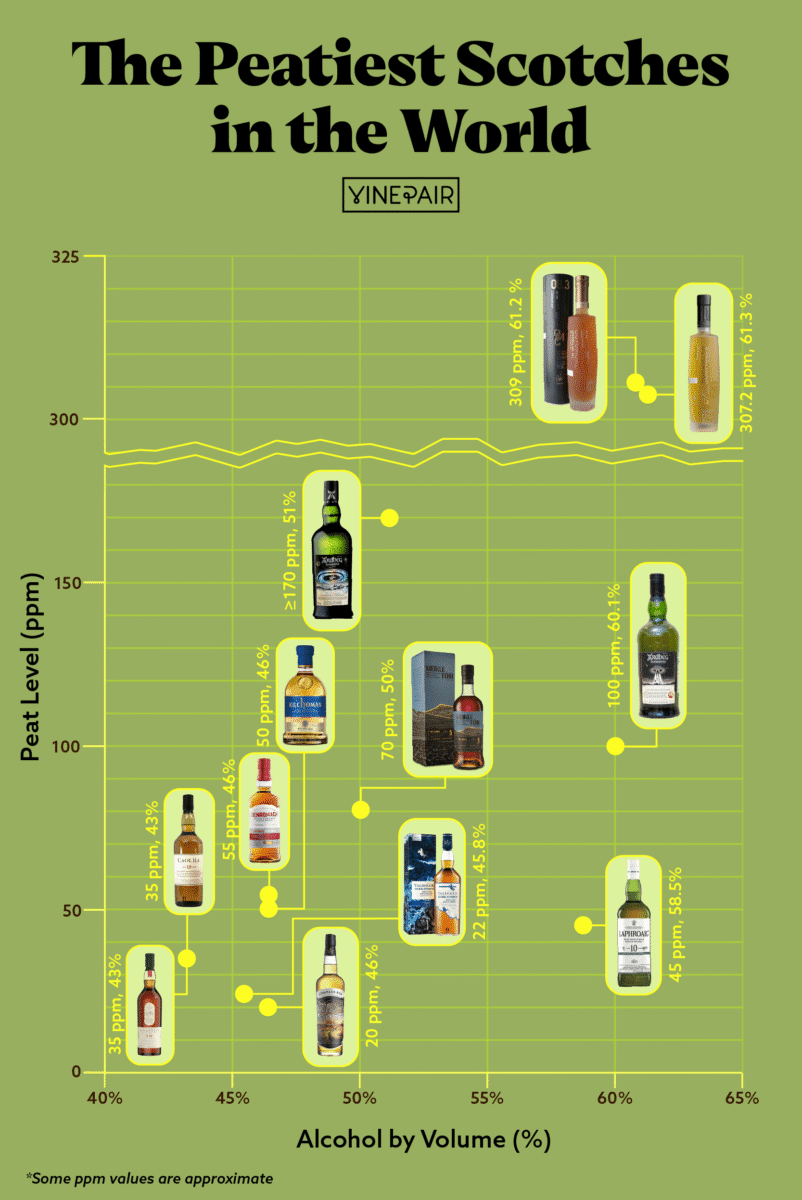
PPM stands for “Phenol Parts Per Million,” an indicator that measures phenol content in units of one millionth.
In the whiskey industry PPMWhen saying that, it generally refers to the phenol content of dried malt.
PPM measurement method
The phenolic content of malt can be measured in two ways.
1. Macfarlane's Method
It is a type of colorimetry that is fast and inexpensive but less accurate.
It is widely used as an industry standard and shows systematically lower values than HPLC.
2. HPLC (High Performance Liquid Chromatography)
High-performance liquid chromatography is more accurate but expensive.
Octomore records higher PPM figures by measuring using the HPLC method.
The malting company's laboratory analyzes the phenol, moisture, nitrogen content, and expected distillation yield of malt samples.
The PPM Trap: Malt vs. Distillate
There is one important fact here.
The PPM indicated on whiskey labels is mostly Phenol content of maltThis is not the actual phenol content of the whiskey in the bottle.
Reasons why phenol is lost during the distillation process
During the mashing stage, some phenol remains in the draft.
Some parts are changed or masked during the fermentation process.
During distillation, phenol is a large molecule with a high boiling point, so it comes out as vapor only at the end of the distillation cycle.
The amount of phenol to be captured is determined by the distiller's cut point setting.
Same PPM, different flavors
Lagavulin and Kaolila both use the same malt fitted to 35 ppm at Port Ellen Maltings.
However, Lagavulin feels much smoky.
| primary factor | Lagavulin | Kaolila |
|---|---|---|
| Fermentation time | short | 김 |
| distillation rate | slowness | speed |
| Cut point | Late (more phenol capture) | Early (mild phenol only) |
| steel shape | Short and wide | High and narrow |
| result | Heavy and smoky | Light and elegant |
As such PPM measurementIt is just one indicator and does not fully explain the actual smokiness of the whisky.
Generally, of the phenols present in malt Only the 30-50% remains in the New Make Spirit.
And phenol continues to decrease during the aging process.
Some evaporates, some is absorbed into the oak barrel, and some is chemically transformed.
The reason the Octomore Edition is primarily a 5-year aged line can be attributed to the fact that the content of specialized phenols decreases as the aging period lengthens.
Octomore's Secret: A Special Method to Achieve the World's Highest PPM

Octomore is an ultra-high-fitting single malt whisky produced by the Bruichladdich distillery.
The first distillation took place in 2002, and the first bottling was released in 2008.
The early Octomore 1.1 set a world record at the time with 131 ppm.
Since then, Octomore has been releasing new series every year and breaking PPM records.
- Octomore 6.3: 258ppm (Released in 2015)
- Octomore 8.3: 309.1 ppm (Released in 2017, all-time record)
- Octomore 15.3: 307.2 ppm (Released in 2024, 2nd all-time)
Octomore's unique manufacturing method
Then, how can Octomore achieve such a high PPM?
1. Use “Uncut” for the first batch
Generally, distilleries achieve a consistent PPM by blending the most heavily pitted malt from the first pitting run with less pitted malt.
However, Octomore uses only this first batch.
Adam Harnett, Head Distiller at Bruichladdich, explains, “Because Octomore uses uncut raw materials, it cannot precisely control a specific PPM.”.
2. Collaboration with Bear's Malt
Bruichladdich Distillery ordered “malt that is as strongly fitted as possible” from Bears Malt in Inverness.
The Bears are known to burn 8 tons of feet over 5 days for a 50-ton batch of malt.
All factors, such as the moisture content of the pit, the firing speed, and the ventilation of the kiln, affect the final PPM.
3. Use of HPLC measurement method
Octomore measures phenol using the HPLC method, which shows more accurate and higher values.
When measured using the standard colorimetric method, even the same malt yields a lower value.
Octomore's Unique Flavor Profile
When many people taste Octomore for the first time, they find it surprisingly soft.
Instead of the overwhelming smokiness expected from the figure of 309 ppm, it displays a sweet, fruity, and elegant flavor.
The difference created by Bruichladdich's production method
• Long fermentation time (60-105 hours): Produces sweet and fruity washes
• Slow Distillation: Delicate and Refined Spirit
• Narrow cut point: Captures mainly light phenols
• Tall and narrow steel: Increased reflux
As a result, despite the high malt PPM, Octomore is a balanced whisky with a lower-than-expected phenolic content in the actual spirit.
Most Octomores are bottled as 5-year-olds to minimize phenol loss during aging.
Why don't other distilleries produce ultra-high PPM peat whisky?
Looking at Octomore's success, a question naturally arises.
Why don't other distilleries make whisky with over 300 ppm?
Technical problems and economic problems
1. Impact on equipment
According to data from the Bruichladdich distillery, high phenol content affects all equipment and connecting piping.
Octomore is produced in short batches only, and the entire system must be flushed to prevent phenol from contaminating the bifed spirit.
Octomore accounts for only 101 TP3 T of Bruichladdich's total production (approximately 150,000 liters per year).
2. Inefficient manufacturing method of ultra-high PPM malt
Manufacturing ultra-high PPM malt is economically inefficient and technically difficult.
The experience and know-how of specialized companies like Bear's Malt are needed.
Most commercial molten metal companies prefer to work within a standardized PPM range.
This is also completely economically disadvantageous because malt must be dried in a different way than other malts that are hot-air dried, as malt can no longer absorb smoke once it is completely dried.
It is said that while typical Islay whisky is fitted for 20 to 30 hours while slowly cold smoking at a low temperature of 50 to 80°C, the malt used in Octomore is fitted for 120 hours using the cold smoking method.
If the malt becomes excessively dry, a very long time must be invested in misting the malt with water again. This lowers the kiln turnover and creates an opportunity cost of being unable to process 2-3 batches in the same amount of time.
The amount of peat used at this time is also said to be about 8 tons for a 40-ton malt batch, which is 3 to 4 times that of regular whiskey.
3. Consistency Issues
Adam Harnett of Octomore said, “We cannot control the exact PPM because we use uncut raw materials.”.
Octomore's first batch started at 80.5 ppm, but subsequent batches easily exceeded 100 ppm.
Such variability is a burden for most distilleries pursuing consistent products.
Philosophical Choice and Marketing Strategy
1. Philosophy on Balance
Many distilleries do not want peat to be the entirety of whisky.
Laphroaig uses about 45 ppm of malt, but the final whisky features a harmony of peat, vanilla, iodine, and sweetness.
Ardbeg uses 50-55 ppm, believing that this allows the flavors of the base spirit and oak cask to balance with the peat.
2. The Meaning of PPM Competition
Ardbeg's Mickey Head stated, "When making Supernova, we do not use only ultra-high fitting malt, but select specific casks.".
In other words, simply increasing the malt PPM is not the best method.
Brooklady's Adam Harnett also says this:
“We are not intentionally trying to make the world's most heavily pitted whisky, but rather to create a special Dram that demonstrates the perfect alchemy of peat, aging, barley variety, and cask type.”
Market and consumer preferences
Ultra-high PPM whisky is a very niche market.
Even Octomore is a product for a tiny minority of enthusiasts in the entire whiskey market.
Most distilleries target a broader consumer base.
In addition, the Octomore is also expensive (the 15.1 is about 200,000 won, and the 15.3 is over 400,000 won).
This high price is partly due to the inefficiency of the manufacturing process, and it contributes to the assessment that while Octomore is an excellent whisky, its price is excessively high.
In conclusion, the reason other distilleries do not produce ultra-high PPM is that most distilleries believe that a PPM of around 50-60 is sufficient to express a strong peat character. This is because traditional Islay whiskies like Laphroaig and Ardbeg fall within this range, and a higher PPM does not necessarily result in a better whisky.
Octomore is a special entity created by Bruichladdich’s philosophy of “an experiment pushed to the extreme possible.”.
The True Appeal of Peated Whisky
The fun of peat whisky is formed over thousands of years. feetIt seems to lie in understanding how it breathes a smoky soul into the malt, the complexity that time brings, and the difference in terroir.
Octomore is satisfying consumers full of curiosity about peat by consistently releasing experimental lineups that demonstrate just how far peat can influence whisky, such as ultra-high PPM whiskies exceeding 300 ppm.
next time peat whiskyWhen you drink it, feel the time of nature and the craftsmanship contained in that single sip. From the peat grown for centuries in the marshes of Islay, the gray smoke rising from the kilns, the distiller's careful determination of the cut point, to the slow transformation within the oak barrels, all of these come together to create the smoky flavor of the peaty whisky we love.


