
The refreshing bitterness felt when drinking beer, the citrus or herbal aromas that tickle the nose. At the starting point of all this is 홉There is a small plant called.
Hops are called Hops in English, and the scientific name is Humulus lupulusIt is called a climbing perennial plant belonging to the Cannabaceae family. Depending on the hop variety and region, it produces a surprisingly diverse range of aromas, from citrus, pine, rose, pepper, to tropical fruits.
Hop is It refers to the female flowers (pine cone-shaped cones) of a plant used to impart bitterness and aroma to beer and to enhance its shelf life. In English, it is written as the singular form "Hop" and the plural form "Hops," but in the brewing industry, the plural form is almost always used.
In Europe, hop extract has long been used to relieve insomnia and anxiety, and the prenylflavonoid component in hops is known to be effective for sedation and sleep-inducing effects.
index
1-1. Appearance and Structure of Hops
1-2. Major Hop-Producing Regions
2. How did hops come to be added to beer?
2-2. The Emergence and Spread of Hops
2-3. British Resistance, and Hop's Final Victory
3-1. Bitter Taste — Alpha Acids and Isomering
3-2. Fragrance — Hop Essential Oil
3-3. Preservatives — Natural preservatives that prevent beer contamination
What is a hop?
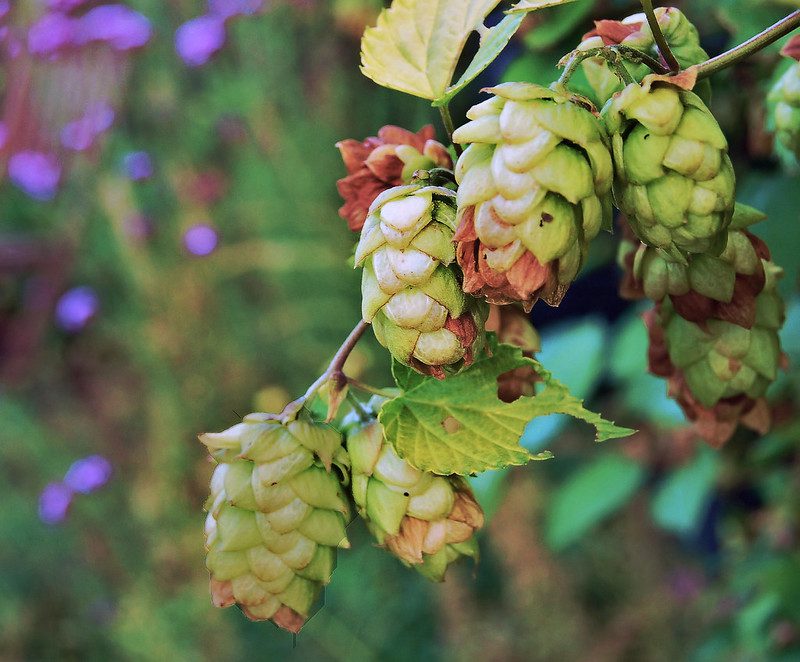
Appearance and structure of hops

Hops are climbing perennial plants belonging to the Cannabaceae family, the same family as cannabis. They are also closely related to nettles.
The part used for brewing beer is the pine cone-shaped strobiles that grow only on female plants. Although commonly referred to as 'flowers,' 'strobiles' is the more accurate botanical term.
If you split a hop cone in half, you will find a small stem called a strig inside, densely packed with a yellow, waxy substance around it. This is precisely lupulinam.
Lupulin is a key substance containing the bitter resin and essential oil that brewers value so highly.
Hops have the characteristic of climbing up by wrapping their stems around supports. Here is an interesting fact: hops are not vines that attach to supports by sending out tendrils, but rather vines that wrap around the stem itself as they climb.
It grows very fast, and at its peak, it can grow up to about 30 cm per day. When cultivated commercially, it climbs up to over 9 meters.
Hops are dioecious plants with separate male and female plants. Only female flowers are used for beer brewing, and male plants are thoroughly removed in commercial cultivation because fertilized seeds are undesirable for beer.
Major hop producing regions
Hops are demanding in terms of growing conditions. Since more than 15 hours of sunlight per day are required to trigger cone production, commercial cultivation is generally possible in regions between latitudes 35 and 55 degrees.
It prefers a dry climate but simultaneously requires a lot of moisture and is vulnerable to various pests and diseases. Due to these conditions, the world 홉 More than 851 TP3 T of production is concentrated in four countries: Germany, the United States, China, and the Czech Republic.

The Hallertau region in Germany is the oldest hop-producing area in the world, with records of hop cultivation dating back to 736, and in the United States, the Yakima Valley in Washington State boasts an overwhelming production volume.
Hop varieties display completely different characteristics depending on the soil and climate of the mountainous region.
Saaz hops grown in the orange soil of Bohemia, Czech Republic, are known for their clean and sophisticated spiciness, while Hallertau hops from northern Bavaria, Germany, are characterized by their herbal aroma.
East Kent Golding from the Kent region of England has been used as a premium pale ale for over 200 years due to its unique green spicy aroma.
Recently, Australia and New Zealand are attracting attention as new hop producing regions.
New Zealand hops can be grown without chemicals because there are almost no pests or diseases harmful to hops within the country, and varieties such as Nelson Sauvin and Motueka are attracting the attention of winemakers around the world with their unique tropical fruit aromas.
As there are so many different varieties, the style and character of the beer change completely depending on which hops the brewer chooses.
The fact that a completely different beer can be produced by changing just one hop, even with the same recipe, is also the most attractive characteristic of hops.
How did hops come to be added to beer?

The Pre-Hop Era — Gruit
Before 1000 AD, almost all beer in Europe was made without hops. Instead, brewers GruitA herb mixture called [name] was added to the beer.
The main ingredients of Gruit are bog myrtle (sweet gale) and yarrow, which grow in wetlands., 蓍草It included ), and wild rosemary, etc.
In medieval Europe, the exclusive right to sell gruit, known as 'Gruitrecht,' was held by the church or lords, and brewers were obligated to purchase this herbal mixture. It effectively amounted to a tax on beer.
The exact combination of Gruites was a strict secret. The seller, the Gruiter, sold the herbs mixed with ground grains, which was also a means to conceal the precise recipe.
The composition of groutes varied by region and era, and sometimes included exotic spices such as juniper, caraway, anise, and even cinnamon and nutmeg.
Does Gruit contain hallucinogenic components?
Some Gruit included psychoactive plants such as henbane or nightshade. Because of this, there are records indicating that Gruit beer provided effects of intoxication and excitement beyond mere drunkenness.
Since hops were actually a plant with a calming effect, the switch to hops was also an event that changed the very 'nature of the alcohol'.
The Emergence and Spread of Hops
People knew of the plant called hops long before they were added to beer.
Roman naturalist Pliny the ElderHis book around 78 AD Natural History (Naturalis Historia)He mentioned hops, but what he was interested in was not the beer, but the young shoots of the hops. He called the hop shoots 'Gaul's asparagus'.

For reference, the name of this Roman naturalist also appears in the history of craft beer in the 2000s. The name of the Double IPA created in 2000 by Vinnie Cilurzo, a brewer at Russian River Brewing in Santa Rosa, California, is 'Pliny the Elder'.
True to its name, which is dedicated to the person who first recorded hops in beer, this beer is famous for its extreme hop character with an explosion of pine and grapefruit aromas.
Despite having an alcohol content of 81 TP3T and 100 IBU, it maintains a surprisingly light and dry body, and is regarded as a legendary beer that changed the very course of American craft beer.
The first clear record of hops being added to beer appears in the monastic rulebook left by Adalhard, the abbot of the Corby Abbey in France, in 822. Although expressed somewhat indirectly, it is a document that clearly mentions the use of hops in beer brewing.
Interestingly, after Adalhardt's records, literature on hops almost disappears for about 300 years. It is not until the 12th century that hops make a spectacular reappearance in documents, but what happened during this gap remains a mystery of history.
12th century, Bingen's Hildegard of Bingen The Mother Superior's natural science book Physica SacraAlong with the brewing uses of hops, it was described that hops 'prevent spoilage' of beverages.
Although Hildegard is often cited as the first person to use hops in beer, Adalhard actually predates her by more than 300 years.
Commercially Hop beerIt was around 1200 in Bremen, Germany, that it achieved full-scale success.
Bremen, a trading city of the Hanseatic League, had easy access to the North Sea via the Weser River, and thanks to the preservative effect of hops, it was able to export beer to the Netherlands, the Baltic states, and Scandinavia. This was the world's first 'international beer'.
At that time, there were two lineages in the beer world. The 'white beer' brewers' guild, which used hops, and the 'red beer' brewers' guild, which still used gruit, were completely separate.
Each city was known for one of two traditions, and competition between guilds was fierce.
British Resistance, and Hop's Final Victory
The spread of hops was not without its difficulties. In particular, Britain was one of the last countries to adopt hops and the one that resisted them the most strongly.
Hop-infused beer was first introduced to England around 1400 through the Netherlands. However, records show that even in 1519, hops were still referred to as a "wicked and pernicious weed.".
In 1483, London ale brewers persuaded the city authorities to pass an ordinance banning the addition of hops or herbs to ale.
At the time in the UK, beverages without hops were distinguished as 'ale', and beverages with hops were distinguished as 'beer'.
Ale was a British tradition, while beer was a strange drink from a foreigner on the continent.
Nevertheless, hop beer eventually prevailed. Around 1500, hop culture was introduced on a large scale with immigrants from Flanders, and it was difficult to ignore the benefits of the preservative effects provided by hops.
By around 1600, hops were being added to almost all ales and beers in England. And by the early 1700s, hops had completely conquered England.
How the Introduction of Hops Changed Beer
Before hops were introduced, beer was sweet, weak, and spoiled quickly. Although other herbs added flavor, they could not balance the sweetness of the beer like the unique spicy bitterness of hops.
As brewers mastered hops, they became able to produce stronger, more consistent, and longer-lasting beer. The very essence of beer changed.
Hop's role

The role hops play in beer can be broadly divided into three categories: bitterness, aroma, and preservation.
As these three elements are combined, hops have become more than just a simple spice; they have become an ingredient that defines the very character of the beer.
Bitter taste — Alpha acids and isomers
The bitterness of beer comes from the hops alpha acidIt originates from. The formal name of alpha acid is humulone, and it exists in hop resin. However, an interesting fact is that this alpha acid itself has almost no bitter taste and does not dissolve in water.
For alpha acids to produce a bitter taste, chemical transformation is absolutely necessary, and this process isomerizationIt is called [this].
When hops are added to hot wort and boiled, the molecular structure of alpha acids is rearranged. iso-alpha acid (isohumulone)It changes into. Iso-alpha acid has a much more intense bitter taste than the original alpha acid and is highly soluble in water.
The longer the boiling time, the more alpha acids are isomerized, making the beer more bitter. Generally, boiling hops for one hour isomerizes about 25 to 301 TP3T of the total alpha acids. Even if boiled for more than 90 minutes, additional isomerization is only about 51 TP3T, so efficiency drops significantly beyond that.
The alpha acid content varies by hop variety. Aroma hops can be as low as 21 TP3 T, while high alpha acid varieties reach nearly 201 TP3 T. The higher the alpha acid content, the stronger the bitterness can be produced with a small amount, making it economical for bittering purposes.
Meanwhile, in addition to alpha acids, hops Beta acid (lupulone)There is also this. Beta acid does not isomerize even when boiled, but it begins to produce a bitter taste as it oxidizes during storage.
In beer styles that intentionally use old hops, such as Lambic, this oxidized beta acid becomes the main source of bitterness.
What is IBU?
IBU (International Bitterness Units) is an international unit that quantifies the bitterness of beer. The threshold at which humans begin to detect bitterness in beer is approximately 5 to 7 IBU, while typical lagers are 10 to 20 IBU, pale ales are 30 to 50 IBU, and extreme IPAs can exceed 100 IBU.
Fragrance — Hop essential oil
The second gift hops give is aroma. In the overall composition of Luplin essential oilsAlthough the proportion of this is only 1 to 41 TP3T, this small amount of oil has a decisive effect on the aroma of the beer.
To date, more than 500 chemical compounds have been identified in hop essential oils. Among these, four major oils account for 80 to 901 of the total scent.
| Oil components | Fragrance characteristics | Examples from other plants |
|---|---|---|
| Myrcene | Sweet carrot, celery, and green leaf scent | Bay leaf, thyme, ylang-ylang |
| Humulene | Herbal, woody, spicy clove scent | Cannabis sativa |
| Caryophyllene | Spicy, cedar, lime, floral scent | cloves, rosemary, black pepper |
| Farnesene | Woody, citrus, sweet scent | Gardenia |
The fragrance characteristics of essential oils show distinct differences depending on the region where hops are grown.
Traditional European hops are characterized by herbal and spicy aromas, British hops have herbal notes with added earthy and fruity notes, and American hops are distinguished by citrus and pine resin aromas.
Pacific varieties from New Zealand and Australia have a strong tropical fruit aroma combined with citrus and floral notes.

There are also various ways to maximize the aroma of hops during the brewing process. Since essential oils evaporate if the boiling time is prolonged, if you want to preserve the aroma, you can add the hops just before the boiling ends or add them after fermentation is complete. dry hopping Uses the technique.
Dry hopping was a traditional technique of British cask ale, but today it is frequently used by American craft beer brewers.
There is one unsolved mystery here. Essential oils are highly volatile and most of them evaporate when boiled, yet when actually drinking beer, the aroma of hops can still be clearly felt even in beer that has undergone the boiling process.
The aroma a brewer smells when rubbing hops between their hands is often similar to the aroma rising from the glass, even though the oil has already disappeared while the aroma remains. Hops contain over 400 types of aroma compounds, some of which are believed to withstand boiling and become reactivated during the fermentation process.
Preservatives — Natural preservatives that prevent beer contamination
The most decisive reason why hops were historically able to completely replace gruit is precisely this. Conservative poweram.
Thanks to this natural preservative effect, even beer of the same alcohol content can be stored for much longer without spoiling if hops are added compared to if they are not.
Beer in the pre-hop era had to be consumed within a few weeks. However, beer containing hops could last for several months, which revolutionized the commercial distribution of beer.
It was thanks to the preservation power of hops that Hanseatic League beer from Bremen and Hamburg could spread across the North Sea to all of Europe, and that Britain could export beer to all its colonies.
It is no exaggeration to say that the India Pale Ale (IPA) beer style itself originated from the ability of hops to preserve flavor. This is because the origin of IPA lies in strong beer made with large quantities of hops to withstand the long voyage from England to India.
Hops Beyond Beer — Medicinal History and Benefits
In Europe, there is a long history of using hops as a medicinal plant.
In European folk medicine, hops have been used as sedatives, antispasmodics, analgesics, and stomach tonics. In Germany and the Czech Republic, hop tea was drunk to soothe the stomach, and there was also a tradition of putting dried hops inside pillows to help with sleep.
Methylbutenol extract found in hops is known to have sleep-inducing and sedative effects.
Recent studies have confirmed that the prenylflavonoid components of hops exhibit sedative and sleep-inducing effects. Additionally, the polyphenols and flavonoids abundant in hops have powerful antioxidant properties and contribute to slowing down cell oxidation.
In particular, studies have reported that 8-prenylnaringenin, a plant-based estrogen found in hops, is also effective in alleviating menopausal symptoms.
Meanwhile, hop oil is also utilized in the herbal industry for aromatherapy, air fresheners, and bath products. Although it is known only as an ingredient in beer, it is actually a versatile plant with a medicinal history spanning hundreds of years.
In the 11th century, almost no beer was made with hops. Now, a thousand years later, there is hardly any beer made without hops. This single sentence clearly demonstrates the status of hops in the history of beer.
Hops gave beer a bitter taste that balanced the sweetness of the malt, endowed it with infinite character through hundreds of aromatic compounds, and enabled beer to spread beyond local regions to the world through their antimicrobial properties. Without hops, the beer as we know it today would not exist.


