
Rose fragrance

The rose is the oldest and most beloved ingredient in the history of perfume. From the palaces of ancient Persia to modern luxury perfumes, the rose has always maintained the dignity befitting the title of 'Queen of Flowers'.
In Greek mythology, the rose is deeply connected to Aphrodite, the goddess of love. The Iliad mentions that Aphrodite protected Hector's body with 'immortal rose oil,' demonstrating how precious rose oil has been since ancient times.
It is said that an Arab Caliph remarked, “I am the King of Sultans, and the rose is the King of fragrant flowers; we are worthy of each other.” In this way, rose fragrance, regardless of East or West, A symbol of authority and beautyIt has established itself as.
In modern perfumery, rose oil is known as an extremely complex ingredient containing over 400 chemical components. In his book, Jean-Claude Ellena classified the scent of the rose as a “floral family characterized by phenylethyl alcohol and geraniol.” These two molecules create the characteristic sweet yet green fragrance of the rose.
There is an interesting fact. Even within the same rose bush, the scent changes depending on the time of day. The fragrance becomes stronger before a storm, and roses harvested at dawn, before the buds fully open, have the sweetest scent.
Rose fragrance extraction method

Extracting fragrance from roses is by no means a simple task. Only about 1 kg of absolute can be obtained from approximately 4 tons of rose petals, and the yield for essential oil is even lower. Considering that 30 to 50 roses are needed to obtain just one drop of Rose Otto, it is easy to understand why rose oil is so expensive.
Steam Distillation
This is the most traditional extraction method. When rose petals are placed in a copper still with water and heated, the steam bursts the cell walls of the petals, drawing out fragrance molecules.
When this mixture is cooled, the water and oil naturally separate, and the oil obtained from this is Rose Auto or AttarIt is an essential oil called [name].
The water remaining from the distillation process becomes rose water, which is used in cosmetics and cooking. This method was developed on a large scale in 16th-century Persia and was later transmitted to Europe via Turkey.
Solvent Extraction
First introduced at the 1873 Vienna International Exhibition, this method revolutionized the perfume industry. By soaking flower petals in a volatile solvent such as hexane to dissolve the fragrance components, and then evaporating the solvent, a semi-solid state of wax and essential oil mixture is produced ConcreteThere is a remaining part.
If this concrete is treated again with ethyl alcohol to remove the wax, highly concentrated AbsoluteIt is born. Solvent extraction has a higher yield than distillation, and because it proceeds at low temperatures, there is less alteration of the fragrance due to heat, making it closer to the original floral scent.
Supercritical CO2 extraction method
A relatively recently developed method uses carbon dioxide in a supercritical state at a pressure of 73.8 bar or higher and a temperature of 31°C or higher as a solvent.
This method has the advantage of causing no environmental pollution and yielding oils closest to the original floral scent. However, due to high equipment costs, it is used only for expensive raw materials.
Enfleurage
It is the oldest extraction method, originating in ancient Egypt. When flower petals are placed on refined animal fat, fragrance molecules permeate the fat over time. Absolut is obtained by extracting the pomade produced in this way with alcohol.
As depicted in Patrick Süskind's novel *Perfume*, this method is an extremely sensual process.
However, due to its labor-intensive nature and low yield, it is currently rarely used commercially.
Characteristics of Rose Varieties and Production Areas
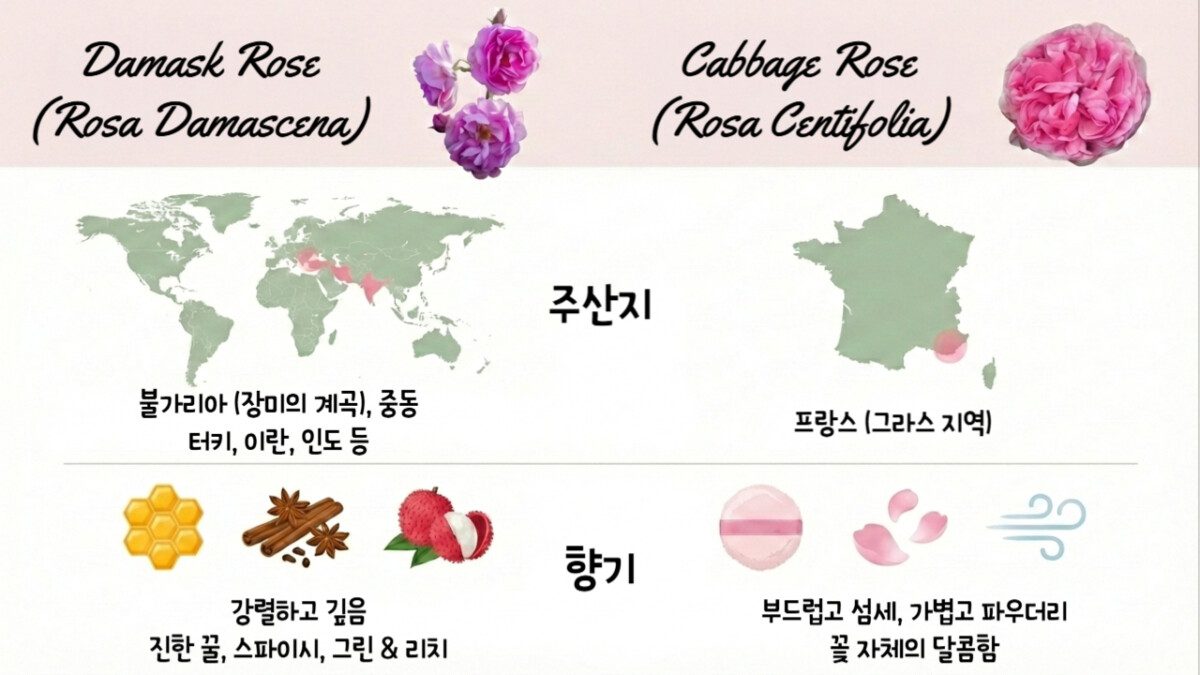
Although there are over 5,000 varieties of roses, only two varieties are actually used in the perfume industry. Rosa damascena와 Rosa centifoliaThat is the main character.
Rosa Damasquena (Damasque Rose)
As its name, derived from Damascus, suggests, this rose originated in the Middle East and spread to Bulgaria, Turkey, Iran, and India. The Kazanlak region of Bulgaria, also known as the 'Valley of Roses,' accounts for approximately 751 TP3 T of the world's rose oil production.
The scent of Damask Rose is intense and deep. A rich, honey-like sweetness coexists with spicy elements, blended with green and fruity notes. Especially LycheeIt is characterized by subtle nuances reminiscent of... This variety is known as the only rose from which the essence can be extracted by steam distillation.
Bulgarian roseThe Bulgarian rose of the Rosa damaskena variety features the richest, velvetiest texture. Characterized by its warm, honey-like sweetness, it is considered the most luxurious rose oil in the world. Records of its cultivation in Bulgaria date back to 1652.
Rosa Centifolia (Cabbage Rose)
It is a variety that has been cultivated in the Grasse region of France for centuries. Like its name, which means "a hundred layers of leaves," it is also called the Cabbage Rose because its layered petals resemble a cabbage. Since it blooms in May... Rose de MaiIt is also known by the name.
The scent of Centifolia is softer and more delicate than that of Damask. It has a lighter, powdery feel, emphasizing the natural sweetness of the flower rather than honey. The absolute is primarily produced using solvent extraction, and it remains a precious ingredient still favored by prestige perfume houses.
Other characteristics by production region
| production site | Major varieties | Characteristics of the scent |
|---|---|---|
| Bulgaria | Damasquena | Rich, round, and honey-like sweetness |
| Türkiye | Damasquena | Slightly sweeter and softer |
| Morocco | Centifolia/Damascena | Complex, yet bright and radiant |
| France (Grass) | Centifolia | Delicate and powdery |
| India | Damasquena | Relatively light |
| Egypt | Damasquena | Richer and richer |
Mandy Aftel said in her book: “Russian roses are soft, Indian roses are light, Egyptian roses are rich, Turkish roses are sweet, Bulgarian roses are round, and Moroccan roses are bright.”
Even the same rose displays completely different characteristics depending on the place of production.
Rose scent profile

What comes to mind when you smell the scent of roses? It feels sweet yet spicy, green yet honey-like warm. This complex fragrance is the result of the harmonious blending of over 400 chemical components.
Overall impression of the rose scent
Rose fragrance is intense and rich. It is floral yet fruity, with a contrast between sweet and spicy notes. It also has a powdery aspect, so it is traditionally classified as a feminine note.
In perfumes, roses are mainly Middle note (heart note)It is used as such. Jean-Claude Ellena, the former exclusive perfumer for Hermès, described the rose as the “ultimate heart note.” It is said to pair well with any other fragrance ingredient, and that adding a little more rose often resolves the problem even if there is a mistake in the blending process.
Fragrance that pairs well with roses
JasmineThe combination of these is the foundation of classic floral perfumes. When the two floral scents meet, they amplify each other and form a rich heart note.
sandalwoodIt is a woody base that gently supports the sweetness of the rose. The combination of sandalwood and rose smooths out each other's rough edges.
BergamotIt is often used as a citrus top note to lightly lift the heaviness of the rose. In chypre fragrances, the rose-bergamot-oakmoss combination has become a classic.
In addition to that Ylang-ylang, geranium, patchouli, amber It also creates excellent synergy with the back.
Recommended perfumes representing roses

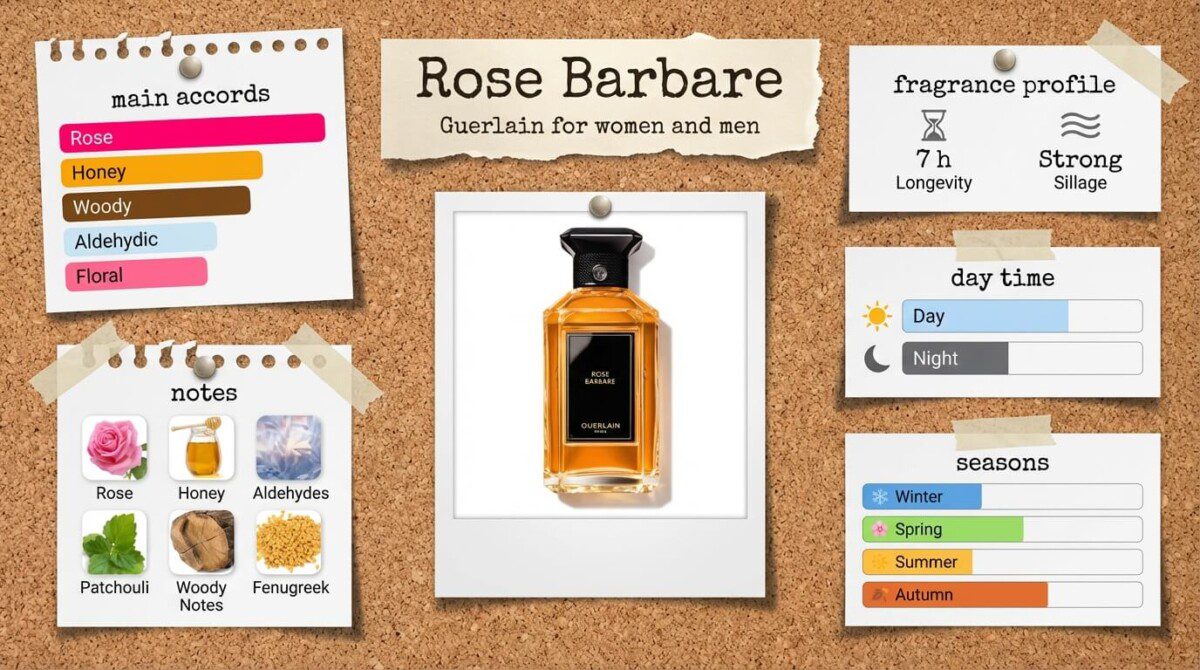
Guerlain “Rose Barbare” (Rose Barbare, 2005) This fragrance, created by Francis Courtdjian, offers a modern reinterpretation of the amber rose.
It is a clever creation reminiscent of the fluorescent and woody Damascene roses of Sinan, Montana Perfumes de Poe, and Estée Lauder Knowing. As a women's fragrance, it is recommended for those seeking an elegant yet deep rose.
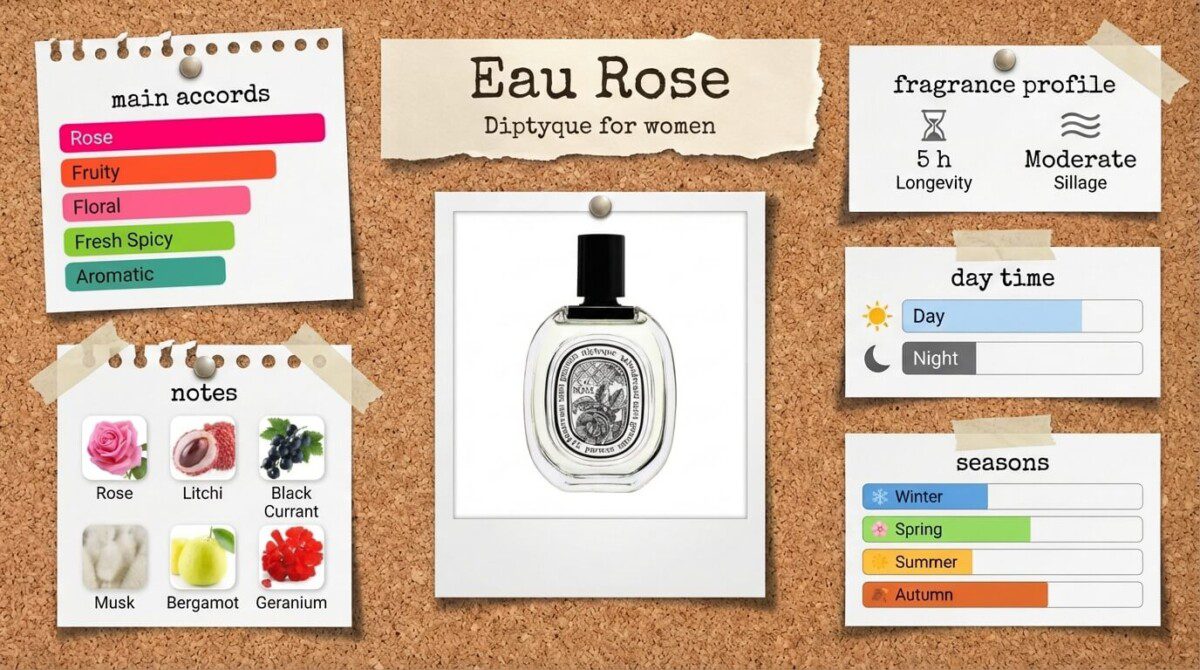 Diptyque “Eau Rose” (2012) – It is a light rose fragrance that can be enjoyed effortlessly in everyday life. Using both Damask rose and Centifolia rose, it gives the feeling of standing in a fresh rose garden.
Lychee and bergamot form bright top notes, while musk provides a soft finish. Suitable for both men and women, it is a good choice for those new to roses.
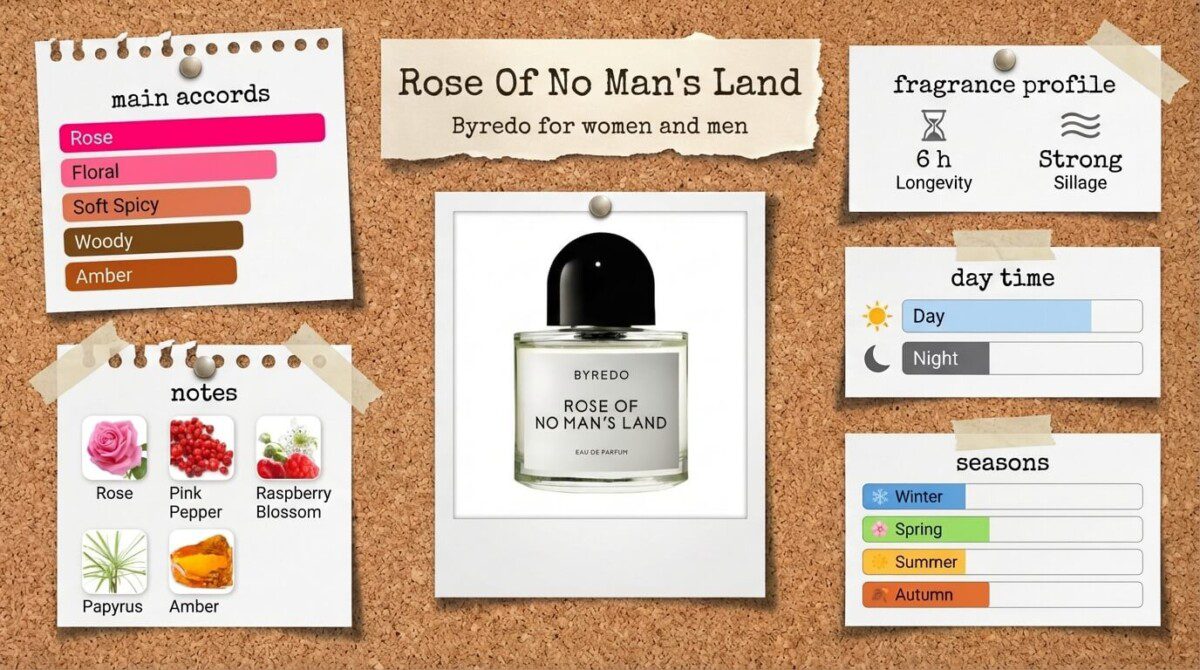 Byredo “Rose of No Man's Land” (2015) – This is a work that is currently very popular in the niche perfume market. It is a perfume dedicated to the nurses on the battlefield during World War I.
Turkish rose petals and raspberry blossoms meet to express a spicy yet warm rose. Papyrus and an amber base add unique depth. Unisex.
Components that make up the rose scent
The chemical composition of rose essential oil varies depending on the variety, growing environment, and extraction method, but the key components appear consistently.

Main fragrance ingredients
| Ingredient name | Content range | Fragrance characteristics |
|---|---|---|
| Citronellol | 20-40% | Sweet rose, floral |
| Geraniol | 15-25% | Sweet Floral, Rosy |
| Nerol | 5-10% | Fresh floral |
| phenylethyl alcohol | 1-3% | Hyacinth, green |
| Rose Oxide | a very small amount | Green, Dry Rosy |
| Damascenone | a very small amount | Fruity Floral |
| Methyl eugenol | Max 3.5% | Spicy, clove |
In the early 20th century, only eight components of roses were known, but 20 were identified in the 1950s, 50 in the 1960s, and over 400 by the end of the 20th century. Even components present in trace amounts play a decisive role in the overall fragrance.
Key molecules that determine scent
The main components of rose oil are as follows.
Rose OxideIt is the most characteristic molecule that distinguishes roses from other floral scents. Two isomers exist, cis-rose oxide and trans-rose oxide, both of which contribute to dry and green rosy top notes. This molecule alone has such a strong signature that it evokes the scent of a rose.
CitronellolIt is the component that makes up the highest proportion of rose oil. It produces a sweet and rosy scent and is also used to replicate the fragrances of lily of the valley, hyacinth, and daffodil.
GeraniolIt is responsible for the characteristic sweet and floral scent of roses. According to Jean-Claude Ellena, it is a key molecule that, along with phenylethyl alcohol, defines the 'rose flower family'.
DamascenoneIt exists in trace amounts but has a significant impact on the fragrance. It adds fruity and floral nuances and contributes to enhancing the complexity of rose oil.
Phenylethyl AlcoholIt is one of the main components of rose oil and is associated with the scents of hyacinths, lily of the valley, and peonies. Interestingly, this molecule is also recently being used to represent the smell of sake or cooking rice.
CAS number
The official CAS numbers for rose-related fragrances are as follows.
- Rose Oil CAS 8007-01-0
- Rosa Damaskna Absolute (Bulgarian Damask Rose Absolute): CAS 90106-38-0
- Rose de Mai Absolute: CAS 84604-12-6
Safety and IFRA regulations
Rose oil is a safe fragrance that has been used for thousands of years, but caution is needed regarding some of its ingredients.
Allergenic substances
Among the 26 fragrance allergens specified in the EU Cosmetic Directive, there are ingredients found in rose oil.
- Geraniol
- Citronellol
- Linalool
- Eugenol
- Limonene
- Farnesol
- Benzyl Alcohol
If these ingredients are contained above a certain concentration, they must be indicated on the product label.
For those with sensitive skin, a patch test is recommended.
Methyl eugenol regulation
Rose oil can contain up to 3.51 TP3 T of methyl eugenol. The IFRA (International Fragrance Association) imposes strict limits on methyl eugenol. For Category 4 (fine fragrances), the maximum permissible concentration of methyl eugenol is based on the finished product. 0.01% (100ppm)am.
Due to this regulation, the amount of rose oil used may be limited, and when blending, it is necessary to calculate the total amount with other methyl eugenol-containing ingredients.
General precautions for use
Recommended dilution ratio
When applied to the skin, it is recommended to dilute Rose Absolute to a maximum of 2.51 TP3 T or less. Pregnant women are advised to consult a medical professional before use.
Avoid contact with eyes and mucous membranes, and keep out of reach of children. There are no IFRA restrictions on rose oil itself, but usage is indirectly controlled by restrictions on individual components contained therein (geraniol, citronellol, methyl eugenol, etc.).
When manufacturing cosmetics, it is generally recommended to use a total of 11 TP3 T or less of essential oils for facial products and 21 TP3 T or less for body products.


