
With a sip, the spicy and pungent broth fills your mouth, and the seafood, crunchy vegetables, and chewy noodles blend together, bringing out the scent of the sea as you chew.
Jjamppong, along with Jjajangmyeon, is one of the two pillars of Korean Chinese cuisine and has represented Korean dining-out culture for over 100 years.
Nutritional Information for 1 Serving of Jjamppong (Based on approximately 900g)
Calories : 약 662~690kcal (Double portion approximately 900kcal or more)
Carbohydrate approx. 100g / Protein approx. 30g / Fat approx. 19g
Sodium approx. 4,000mg (twice the WHO daily recommended intake of 2,000mg) / Sugars approx. 3g
JjajangmyeonAlthough it is lower in calories than (about 800kcal), its sodium content is the highest among restaurant menu items. The average price of a bowl of Jjamppong is around 8,000 to 10,000 won, while Samseon Jjamppong is priced at 12,000 to 15,000 won.
index
What would you call it in English and Chinese?
2. The Origin and History of Jjamppong
Two-branched roots — Chomamyeon and Tangyuksamyeon
Incheon and Gunsan, the Era of Choma-myeon
Gunsan, The Birth of Red Jjamppong
The difference between regular Jjamppong and Samseon Jjamppong
Jjamppong

Jjamppong is a Korean-style Chinese dish made by stir-frying seafood, meat, and various vegetables in oil over high heat, then pouring in broth made from pork or chicken bones and boiling it, and finally adding boiled thick Chinese noodles.
It is considered one of the three major menu items at Korean Chinese restaurants along with Jajangmyeon and fried rice, and is a representative dining-out dish that has been loved by ordinary people for over 100 years since it was introduced by ethnic Chinese people living in Korea in the early 20th century.
The characteristics of Jjamppong as we know it today are its intense red broth and spicy taste, but in fact, in the early days, it had a clear broth that was not spicy.
The spicy Jjamppong of today was perfected starting in the 1960s with the addition of chili powder and chili oil, and in this process, the clear broth style, which was closer to the original form, became the current Oyster JjamppongIt continues its legacy with white jjamppong.
The etymology of Jjamppong
There are several theories regarding the origin of the name Jjamppong. The most prominent mainstream theory is that it is of Chinese. foodThe Fujian dialect pronunciation of *chipan* ('to eat rice') was transformed into 'chanpon' in Japan, and this then entered Korea and became established as 'jjamppong'.
Another theory suggests that it originated from the Malay and Indonesian word 'campur,' meaning 'to mix' or 'to blend.'.
‘The word 'Jjamppong' has now gone beyond being a food name and has taken deep root in everyday Korean. It is widely used as an expression referring to a state where different things are mixed together, such as “I drank alcohol in a jjamppong manner” or “The genre is jjamppong.”.
The word 'Jjamppong' with this meaning also comes from the Japanese word 'chanpon' (to mix), meaning that food and linguistic expressions share the same root.
When expressing Jjamppong in English, use the proper noun as is. JjamppongIt is written as such, or translated descriptively as Spicy Seafood Noodle Soup. On menus at Korean restaurants overseas, both expressions are often listed side by side.
In Chinese, it is Choma-myeon, which corresponds to the origin of the food itself (炒碼麵-It is called Chaomamen. However, the noodles sold under this name in modern mainland China and Korean Jjamppong are quite different in taste and appearance.
In Japan, it is called Nagasaki Champon, or Chanpon, and it is a dish distinctly different from Korean Jjamppong because it has a white broth style without spicy chili peppers.
The Origin and History of Jjamppong
Jjamppong is a bowl of noodles that originated in China, gained a name in Japan, and was perfected in Korea, and it fully embodies the food cultures of the three East Asian countries.
Two-pronged root — Choma-myeon과 Tangyuksa Myeon
There are two main theories regarding the origin of Jjamppong.

The first one is Theory of the origin of Choma-myeon in Shandong ProvinceIt is. Choma-myeon, which was eaten in the Shandong province of China (炒碼麵It is said that this was directly transmitted through overseas Chinese from Shandong Province who settled in Korea.
The original form is a noodle dish made by stir-frying vegetables, meat, and seafood in oil, then pouring in pork bone broth and boiling it with noodles; compared to Jjamppong, it is a bit thicker and closer to a stir-fry dish.
It is said that Chinese immigrants who settled in open port cities such as Incheon and Gunsan began selling this Choma-myeon, and as it was modified to suit the taste of Koreans, it became today's Jjamppong.

The second one is Theory of the origin of Tangyuksa Myeon in Fujian ProvinceIt is. In 1899, Chen Pingshun, an overseas Chinese from Fujian Province, China (陳平順, 1873~1939) opened a Chinese restaurant called Shikairo in Nagasaki, Japan.Four seasOpening ) the hometown dish Tangyuksamyeon (boiled riceNagasaki Champon originated from a variation of ).
Tangyuksamyeon is a noodle dish with a light broth containing pork, shiitake mushrooms, and green onions, but Chen Pingsun has reinterpreted it by adding local Nagasaki seafood, fish cakes, and cabbage.
It is said that the purpose was to provide a cheap and hearty bowl of food for poor Chinese international students who were skipping meals at the time.
The gist of the second theory is that this Nagasaki Champon was reborn in a Korean style as it was passed from the Chinese diaspora living in Japan to the Chinese community in Korea.
In fact, the fact that the name 'Jjamppong' itself comes from the Japanese word 'chanpon' supports this theory.
Both theories share the same broad framework that "noodle dishes from mainland China were introduced to Korea through overseas Chinese," but they differ in the route taken—whether they came directly from Shandong Province or passed through Japan from Fujian Province.
Either way, what is certain is that Jjamppong is a dish that was perfected through the hands of various cultures.
Incheon and Gunsan, the Era of Choma-myeon
In Korea, Chinese immigrants from Shandong Province who settled in Incheon following the Imo Mutiny in the late 19th century brought their hometown dish, Chomamyeon (炒碼麵, The history of Jjamppong in Korea began with the introduction of Chaomamen.
Chomyeon is a Chinese dish called Tangrousimian, which consists of noodles served in a broth made with pork, shiitake mushrooms, bamboo shoots, green onions, etc.boiled riceIt was a dish derived from ), in which seafood or meat and vegetables were stir-fried in oil, broth was poured in and boiled, and then placed on top of noodles to be eaten.
The Choma-myeon of this period had a clear broth without chili peppers, and was lightly flavored with black pepper.
It appears that the name Jjamppong began to replace Chomyeon around the mid-to-late 1960s, and that the Japanese word 'Janpon' was introduced to Korea and naturally came to be attached to the similar-looking Chomyeon.
Meanwhile, around the same time, a large number of overseas Chinese from Shandong Province settled in Gunsan and began selling Choma-myeon, which later became the decisive stage for the history of Jjamppong as it met with the abundant seafood unique to a port city.
Gunsan, The Birth of Red Jjamppong
Until the 1960s, Korean Jjamppong took the form of a clear broth topped with thin red chili peppers, similar to today's Baek Jjamppong. It was more commonly known as Chomyeon and was a dish far removed from the red Jjamppong we know today. The port city of Gunsan was the place that completely changed this landscape.
It is said that in 1969, a Chinese restaurant in Yeonghwa-dong, Gunsan, tried serving red Choma-myeon to customers by adding chili peppers to counteract the greasiness of the Choma-myeon.
Customers who were initially reluctant gradually began to like this spicy flavor, and on every return visit, there was an increasing number of cases where they would order, “Give me that mixed-up Jjamppong you used to give me.”.
Thus, the name 'Jjamppong' first appeared on the menu in 1972, and from 1974, Chomyeon completely disappeared from the menu and was replaced by Jjamppong.
There are also geographical reasons why Gunsan became the birthplace of red Jjamppong. Since the late 1890s, overseas Chinese from Shandong Province had settled there, giving it deep roots in Chinese cuisine, and as a port city, it was abundant in fresh seafood.
This spicy Jjamppong gained explosive popularity among the citizens of Gunsan who were looking for a spicy hangover cure, and spread nationwide throughout the 1980s and 1990s.
At some point, the original clear Choma noodles disappeared, and red Jjamppong became synonymous with 'Jjamppong'.
Even now, famous Jjamppong restaurants in Gunsan remain intact, including Bokseongru, which has been around since the 1940s, Binhaewon, designated as Registered Cultural Property No. 723, and Jirinseong, known for its intense chili Jjamppong.
In 2019, a 'Jjamppong Specialty Street (Jjamppong Sidae-ro)' was established on Dongnyeong-gil near the Museum of Modern History, and in 2020, the 'Gunsan Jjamppong Festival' was held.
‘The city has a special connection with Jjamppong, to the extent that people say, "When you think of Gunsan, you think of Jjamppong; when you think of Jjamppong, you think of Gunsan.".
Types of Jjamppong
The difference between regular Jjamppong and Samseon Jjamppong

Chomyeon, the prototype of Jjamppong, was originally a pork-centered dish. It consisted of stir-frying meat and vegetables and adding noodles to broth, and seafood was not a primary ingredient.
However, until the mid-20th century, pork was a fairly expensive ingredient, whereas seafood was actually cheap.
Naturally, Chinese restaurants began adding more and more seafood to lower costs, and this consequently changed the identity of Jjamppong.
Samseon Jjamppong三鮮The 'Samseon' in Jjamppong originally meant delicacies from the sky, land, and sea.
However, in modern times, it is used to mean “Jjamppong with plenty of more premium seafood than regular Jjamppong.” The distinguishing feature of Samseon Jjamppong is the addition of ingredients such as shrimp, abalone, and scallops, or the much more generous portions of the same seafood.
The problem is that as seafood jjamppong has become mainstream, even regular jjamppong now comes to include mussels, squid, and clams as standard ingredients. Consequently, the boundary between regular jjamppong and samseon jjamppong is becoming increasingly blurred.
Speaking by current standards, the difference in the type and quality of seafood can be said to be the criterion distinguishing the two.
White Jjamppong
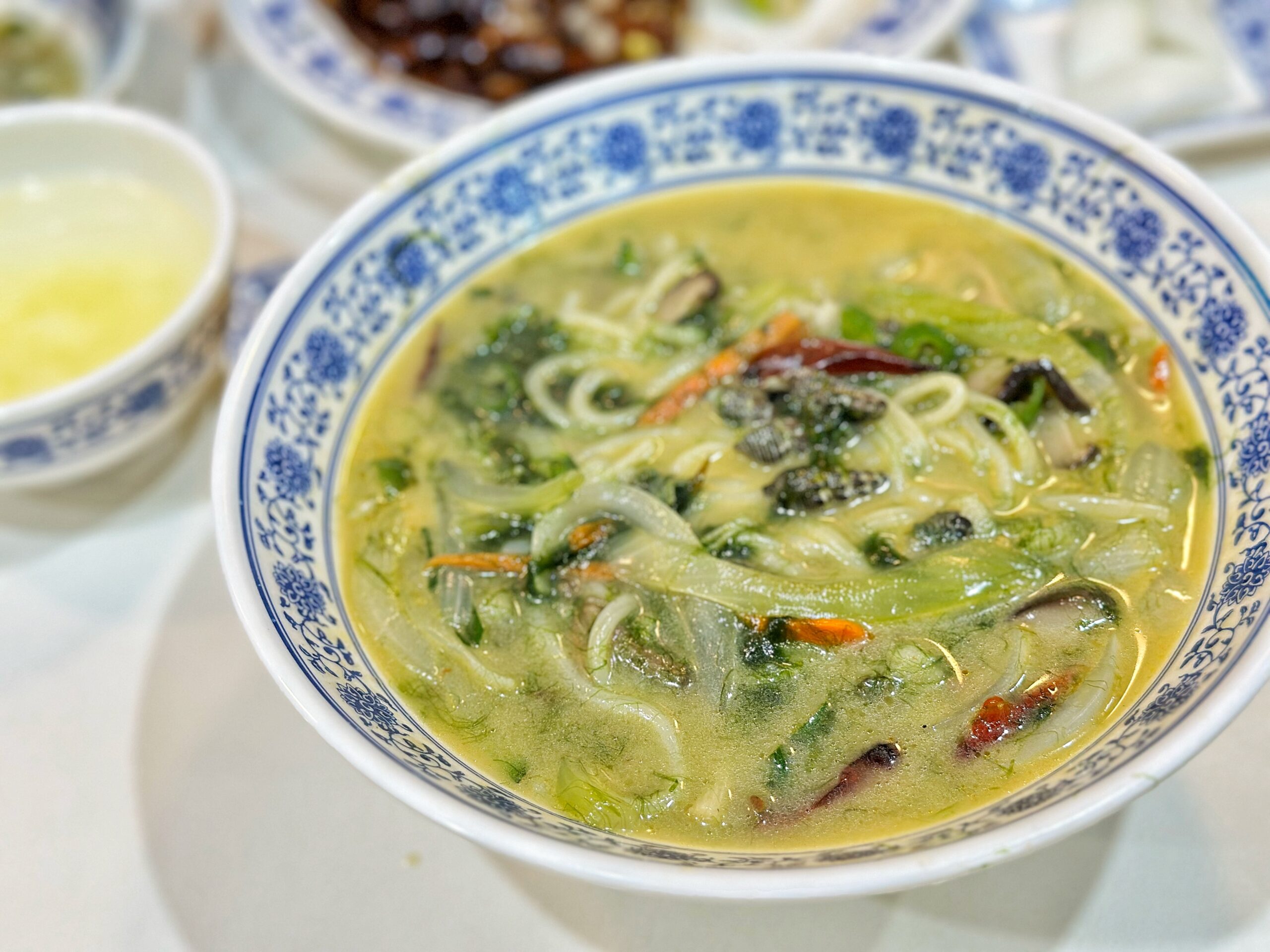
It is a Jjamppong made by omitting chili oil and chili powder, and boiling seafood and vegetables in a clear broth made from pork or chicken bones.
As previously discussed, prior to the 1960s, Korean Jjamppong consisted of a pale broth topped with red chili peppers. In other words, Baek Jjamppong retains the form closest to the original Chomyeon that existed before the red Jjamppong.
Although it looks similar to Nagasaki Champon, there is a significant difference in the consistency and flavor of the broth when you actually eat it.
Nagasaki Champon uses a milky white and rich broth base made by simmering pork and chicken bones for a long time, so it has a savory oiliness similar to Tonkotsu Ramen.
On the other hand, Korean white jjamppong features a broth centered on the refreshing umami flavor derived from seafood, making it an option sought after when one wants to enjoy the natural coolness and umami of seafood broth without spiciness.
Stir-fried Jjamppong
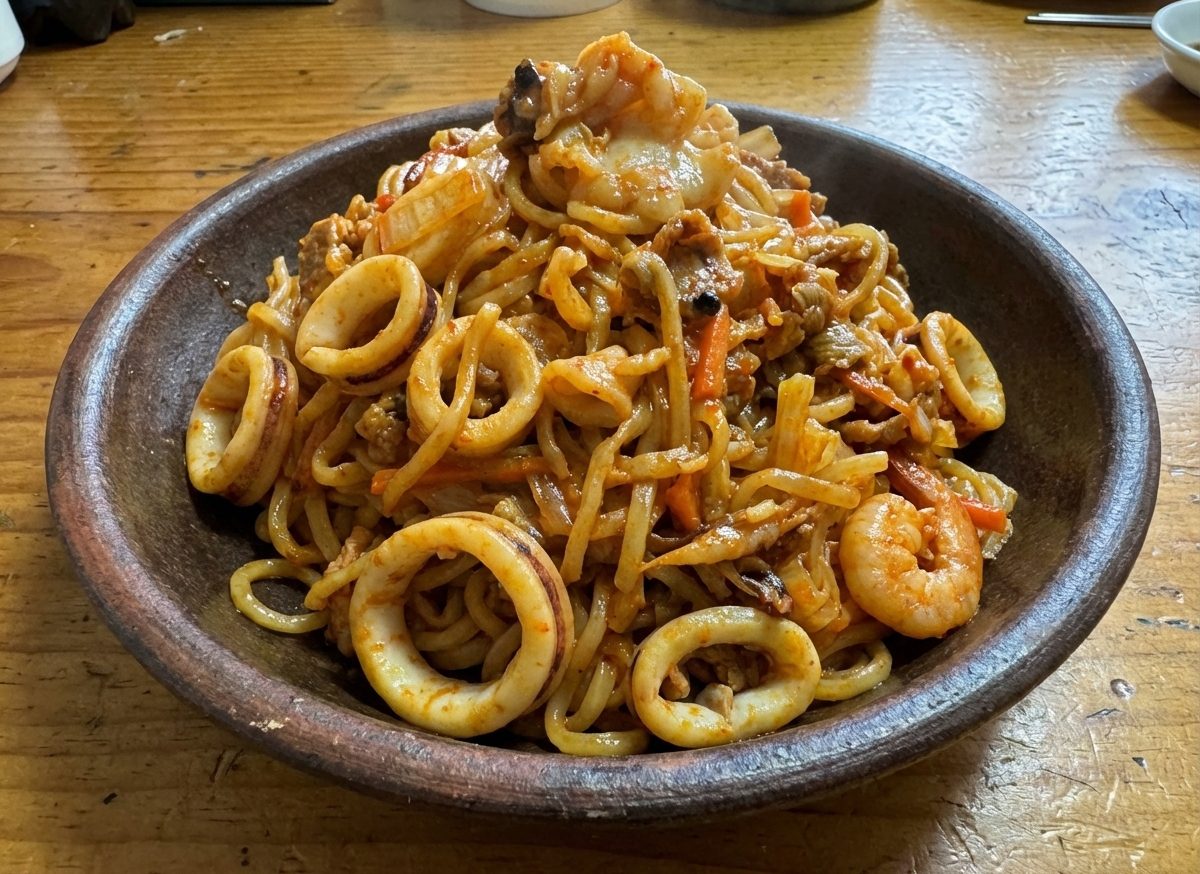
It is a dish where the ingredients of Jjamppong are used as is, but the broth is reduced to a thick consistency or almost completely evaporated and stir-fried with noodles over high heat.
Choma-myeon (炒碼麵)'s 'cho(炒')' means 'to stir-fry.' Since the original Chomyeon was a dish closer to a stir-fry with much less broth than the current Jjamppong, in a way, stir-fried Jjamppong might be the form most faithful to the original cooking method of Chomyeon.
Since there is no broth, the smoky flavor and seasoning are directly absorbed into the noodles, allowing you to enjoy the chewy texture of the noodles and the intense stir-fry aroma at the same time.
Various other variations
There are also various variations that enhance specific ingredients on top of the basic Jjamppong framework.
Cockle Jjamppong or Oyster Jjamppong maximizes the refreshing umami flavor of the broth by adding plenty of seasonal shellfish, while Chili Jjamppong further heightens the intensity of the spiciness by adding Cheongyang chili peppers or dried chili peppers.
Chadol Jjamppong is a relatively recent variation designed to create a flavor where the savory fat of beef brisket harmonizes with the spicy broth.
As such, Jjamppong is a dish that branches out endlessly depending on which ingredient is placed at the center. It is thanks to this scalability that every neighborhood Chinese restaurant features its own signature Jjamppong.
The Secret to the Smoky Flavor of Jjamppong
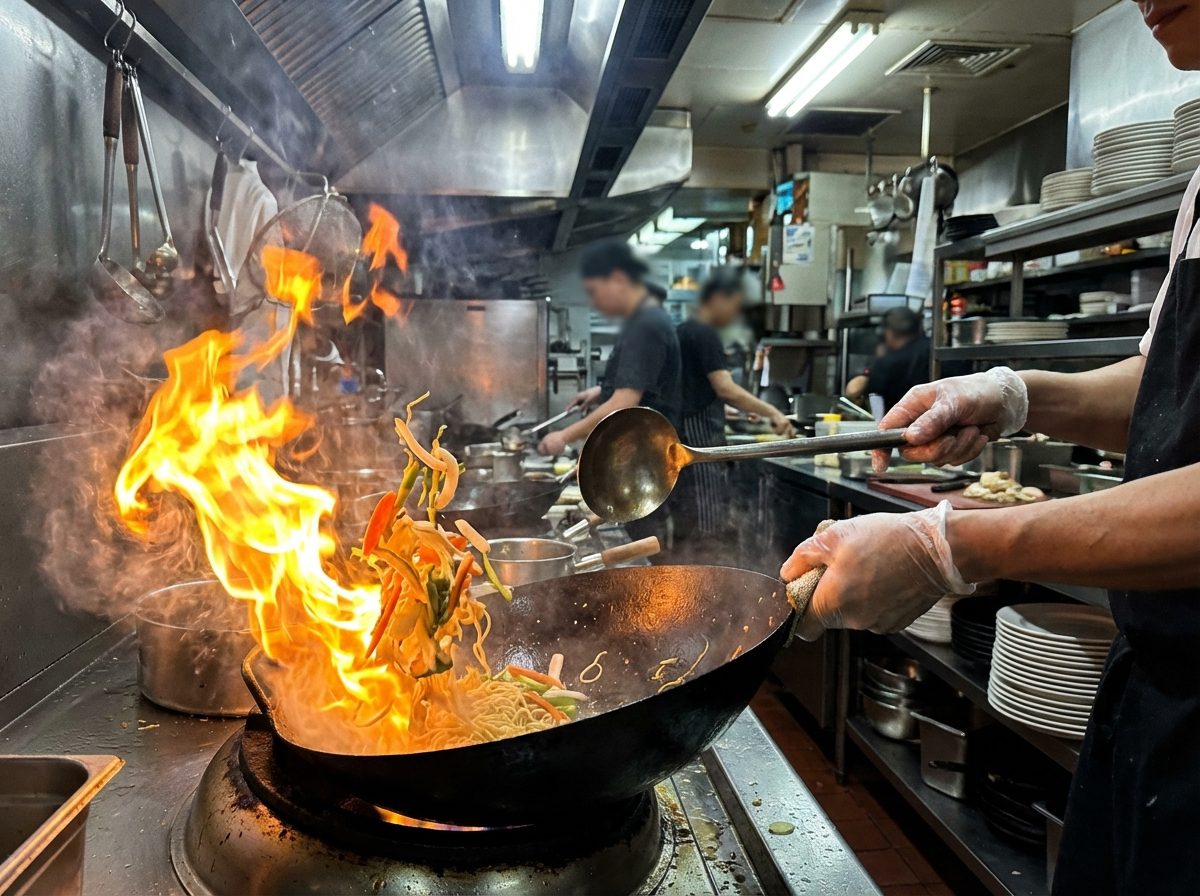
The flavor of a bowl of Jjamppong is largely composed of three axes: the smoky flavor created instantly at high temperatures, the umami flavor extracted as the seafood boils, and the spiciness provided by chili oil. Scientifically examining the principles behind how these three elements operate changes the depth of one's understanding of Jjamppong's taste.
The biggest reason why it is difficult to replicate the taste of Chinese restaurant Jjamppong at home is precisely this smoky flavor. In food science, this phenomenon is explained by two mechanisms.
First is Maillard reactionIt is the Maillard Reaction. This reaction proceeds in earnest at temperatures above about 120°C and is based on the same principle as creating the flavors of bread crusts, chocolate, coffee, and roasted meat.
This is the reaction that occurs the moment vegetables and meat come into contact with high heat in a Chinese wok, and it is here that the savory and complex aroma unique to Jjamppong is born.
The second is in Chinese cuisine Wok Hey(鑊氣, It is a phenomenon called Wok Hei. Wok Hei is explained as a unique aroma created as oil droplets burn on the surface of a wok. It is a distinctive burnt scent that is applied to the surface of food as cooking oil instantaneously vaporizes and burns in a wok heated to a high temperature.
The main aromatic compounds produced at this time are aldehydes such as decadienal, which is also the source of the savory smell characteristic of fried food.
Why is it difficult to get that smoky flavor at home?
The maximum heat output of a household gas stove is approximately 2,000 to 3,500 kcal, whereas the commercial burner in a Chinese restaurant reaches 15,000 to 50,000 kcal.
This is because the Maillard reaction and wok hail are reactions that must occur within a short period of time at high temperatures, so the difference in heat directly leads to the difference in smoky flavor.


