
index
3. Differences in Iris Varieties by Production Region
4-1. Flavorings Suitable for Blending
5. Recommendation for Orris's Signature Perfume
What is Iris fragrance?

If you are a perfume lover, you have probably heard the name 'Orris' at least once. Orisiris, of certain irises (mainly Iris pallida) RhizomeIt refers to the fragrance obtained from.
Here, let's clarify the difference between 'Iris' and 'Oris'. Irisis a name referring to all plants of the genus Iris, and, OrrisIt refers to a fragrance obtained by drying and aging the rhizome of the iris.
In fact, the iris flower itself has a scent, but it is very faint, belonging to the light and sweet honey floral category.
Because the yield from flowers is too low for commercial extraction, a flavoring called 'Iris Flower Absolute' does not exist on the market.
Ultimately, in the perfume industry, valuable scents come solely from the roots. It is even defined as “an extract of the rhizome.”.
Since there are no competing 'flower products,' iris and orris naturally came to be used interchangeably, and in perfume note notation, 'iris' and 'orris' refer to virtually the same scent.

Freshly harvested iris roots have no scent. The triterpenoid precursors in the roots ‘Iridal’Oxidatively decomposed over this long period of time ‘Iron’Only when it transforms into a fragrance molecule does the unique, elegant powdery scent bloom.
The industry generally believes that one must wait at least six years—three years of cultivation and three years of drying—to obtain the best Oris.
The ancient Greek botanist Theophrastus also testified to this 'aesthetics of time' by recording that "iris roots have the best scent only after being aged for three years after being dug up.".
The yield of Orris Butter obtained after such a long wait is merely around 0.21 TP3 T relative to the dried root. From this, after removing impurities ‘Oris Absolute’The price per kilogram commands tens of millions of won, ‘The gold of the spice world’It is called [this].
In fact, as its price per weight is often higher than that of pure gold, natural orris is a precious commodity used in minute quantities only in high-end niche perfumes or luxury fragrances. The total amount of orris absolute produced worldwide each year is merely a few kilograms.
The history of the orris runs parallel to the history of the human perfumery. In ancient Egypt, it was used in sacred rituals, and in medieval Europe, aristocrats placed it in linen wardrobes to infuse their clothes with fragrance. This is what is known today as the scented sachet. ‘Sachet’It became the origin of.
Even in the modern perfume industry, iris is irreplaceable. Not only does iris produce an attractive scent on its own, but it also possesses an excellent ability to hold other fragrance ingredients together. Fixative It plays a role in completing the longevity and depth of the perfume.
Oris's extraction method

The extraction of iris fragrance undergoes a process that is fundamentally different in duration from other natural fragrances. Unlike most floral fragrances, which are extracted immediately after harvesting while still fresh, iris roots... ‘The preliminary stage called 'maturation'It is absolutely necessary.
Harvest and ripening
After planting, irises For at least 3 years It must grow in the ground and accumulate sufficient nutrients before it can be harvested. The harvest season is usually July to August, and the dug-up rhizomes are peeled, washed, and then undergo a long drying process.
In the traditional Tuscany, Italy, the root bark is completely peeled off by hand, leaving only the white flesh. ‘White Iris (Decorticated)’It produces. On the other hand, it is thinly sliced by machine and dried ‘Black Iris’It is advantageous for mass production, but its fragrance delicacy does not measure up to that of white iris.
Store dried roots in a cool place at least 3 to 5 years Store for a while. During this waiting period, the Iridal inside the root gradually oxidizes. IronIt is converted to.
ancient Rome PlinyIt has long been considered that irises from the Illyricum Mountains (present-day Dalmatia) are the finest, and the fact that the longer they are aged, the better the scent becomes has been passed down for thousands of years.
Distillation and extraction
The matured roots become flavorings through two pathways.
First is steam distillationis. If volatile components are captured by passing steam through crushed roots Orris butterA pale yellow semi-solid substance called [name] is obtained.
In addition to iron, it contains large amounts of myristic acid and fatty acid esters, giving it a unique physical property of solidifying at room temperature. The iron content in the essential oil is approximately 13–171 TP3T, and the remaining 83–861 TP3T is made up of fatty acids.
The second one is Solvent extractionis. After dissolving the fragrance components of the roots with a solvent such as hexane or ethanol, if the solvent evaporates Oris ConcreteWhat remains. If this is subjected to ethanol extraction again... Oris AbsoluteThe result is complete, and Absolut’s iron content reaches 55 to 851 TP3T, giving it a much more concentrated flavor than Orris butter.
Recently Supercritical CO₂ Extraction (SFE) This method is gaining popularity. Despite high equipment costs, it produces no residual solvents and minimizes fragrance degradation due to heat, so in the recent high-end perfume market The purest Orris scentIt is used as a standard commercial method to obtain.
Differences in iris varieties by production region

There are three main varieties of iris used in the perfume industry. Iris pallida, Iris germanica, and Iris Florentina.
The three varieties differ in appearance, but above all, the texture of the aroma emanating from their roots is different.
Iris pallida
Pallida is a variety that produces pale lavender-purple flowers and is native to the Eastern Mediterranean. Italy Tuscany, especially near Florence San Polo in Chianticultivated for hundreds of years Top-quality varietiesam.
Orris oil extracted from this variety Dextrorotatory iron It has a high proportion of isomers, producing the most delicate and sophisticated purple scent. 'The Perfume Handbook' also describes Pallida as ‘a variety that produces the highest quality aris.“.
PowderyWhile doing so, the floral aspect remains alive, and the base note is subtle Bark-like woody nuancesIt is characterized by sensitivity.
Iris germanica
Germanica blooms with deep purple-indigo flowers and is also known as the 'Flag Iris'. Currently MoroccoStarting with, as a variety mass-cultivated in China and India, Most of Oris's global productionOccupies.
Germanica's orris oil is Levorotatory ironIt mainly contains [element], so the nature of the scent is different from Pallida. A bit more EarthyIt is strong and heavy, carrot rootsA soil-like nuance reminiscent of [something] stands out.
Although it is rated lower than sold in terms of quality, Price accessibilityThis is the most widely used in modern commercial perfume formulation.
Iris Florentina
Florentina is a variety that produces pure white flowers and has the beautiful nickname 'White Flower de Luce'. It is native to Southern Europe and has a long history in Italy and France.
This white iris flower is the coat of arms of the French royal family. Fleur-de-lisIt is known as the origin of. FlorenceThe city's coat of arms also originated from this white iris, and the city name Florence itself ‘City of Flowers’It means.
Its fragrance characteristics lie between those of pallida and germanica. While not as delicate as pallida, it possesses a softer, powdery tone than germanica, and in the past, it was cultivated alongside pallida in the Tuscany region. However, its current proportion in commercial fragrance production is low. Significantly reduced compared to beforeall.
Key comparisons by variety
| division | Iris sold | Iris Germanica | Iris Florentina |
|---|---|---|---|
| Flower color | Light purple (lavender) | Dark purple to indigo | white |
| Major production areas | Tuscany, Italy | Morocco, China, India | Southern Europe (small scale) |
| Iron optical properties | dextrorotatory | Levorotatory | Mixed type |
| Scent character | Delicate violet, powdery, woody | Earthy smell, carrot, heavy powder | Soft powdery, medium tone |
| price range | highest price | relative low price | Medium (scarce) |
| Quality evaluation | Finest (fine perfumery standard) | Commercial Standard | historical value |
It is not easy to define the scent of Orris in a single word. Calling it purple is too simplistic, and describing it merely as powdery is only saying half the story. Its charm lies precisely in this complexity.
When you first smell the scent, the first thing you detect is cool and dry. Powdery notesA soft, fluffy sensation, reminiscent of an old powder puff or the scent of well-ironed linen, touches the tip of the nose. The true identity of this powderiness is the iron.(Irone), especially cis-γ-ironam.
This molecule, which accounts for 30 to 401 TP3T of the iron in Orris butter, is the key to the distinctive violet-powdery scent of this fragrance.
What is felt underneath is soft Woody-Earthy notesThis earthy scent, reminiscent of roots just pulled from wet soil, is what perfume critics commonly ‘Carrot root’ or ‘Geosmin’This is the part that is likened to.
This soil-like aspect is the decisive factor that distinguishes this raw material from simple floral fragrances. Over time, the scent gradually Creamy and buttery Shift the center of gravity in the direction.
Large amounts contained in butter Myristic acidThe oily softness produced by fatty acid esters gradually emerges on the skin, giving the entire fragrance a velvety texture.
This ingredient is mainly used in perfume manufacturing. Middle noteat Bass notesIt is used across. Excellent Fixative Thanks to this, it acts as an anchor that extends the longevity of other fragrances and adds depth and texture to the framework of the perfume.
탑 — Cool green, with a slight citrus nuance
Middle — Violet, powdery, floral
base — Woody, Earthy, Creamy, Musky
Flavorings suitable for blending
This fragrance ingredient has a very wide range of blending possibilities. Because its scent is soft and rounded, it pairs well with various fragrance notes.
The most classic combination is Violet LeafIt is a pairing with. By highlighting its powdery aspects, it completes an elegant purple bouquet, GuerlainIt is a combination often found in classic perfumes.
Cedarwood와 sandalwood It also creates excellent synergy with other woody scents. When the powdery quality of this fragrance meets the dry texture of wood, a calm yet deep scent is born. Dior Homme The series is a prime example of this combination.
BergamotIna lemon The same citrus notes remove the heavy aspects and lead in a bright direction. Prada Infusion d'IrisThis is a good example of creating a clean and sophisticated iris scent using this approach.
besides Amber, musk, incenseBlending with maximizes its mysterious aspects, and, rose나 Jasmine When used with the same floral fragrance, this ingredient acts as a base for the entire floral bouquet, adding rich depth.
Recommended Oris perfumes
If you want to fully experience the fragrance, it is best to smell the perfume centered around it directly.
The three perfumes below are each creations that interpret this ingredient in a completely different way.
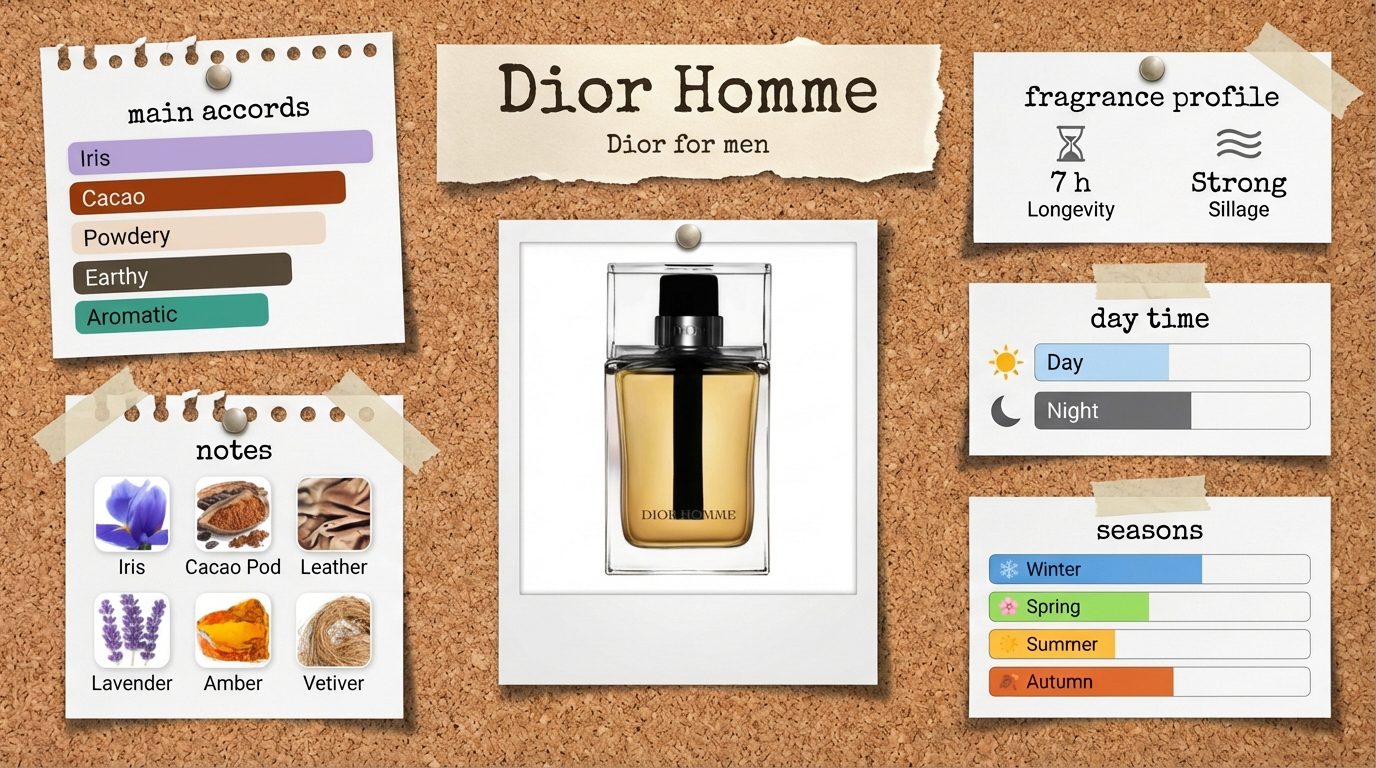
Dior “Dior Homme” (Dior Homme, 2005) Created by perfumer Olivier Polge, this fragrance was an innovative work that brought this ingredient to the forefront of men's perfumery. It introduced a new aesthetic of "powdery masculinity" to a market that had previously been dominated by woody and spicy scents.
With a structure where cocoa and amber add a creamy texture over the powdery softness of iris butter and dry cedarwood provides a background, it is a fragrance that is soft yet never weak. It is a modern classic with a wide fan base among both men and women.
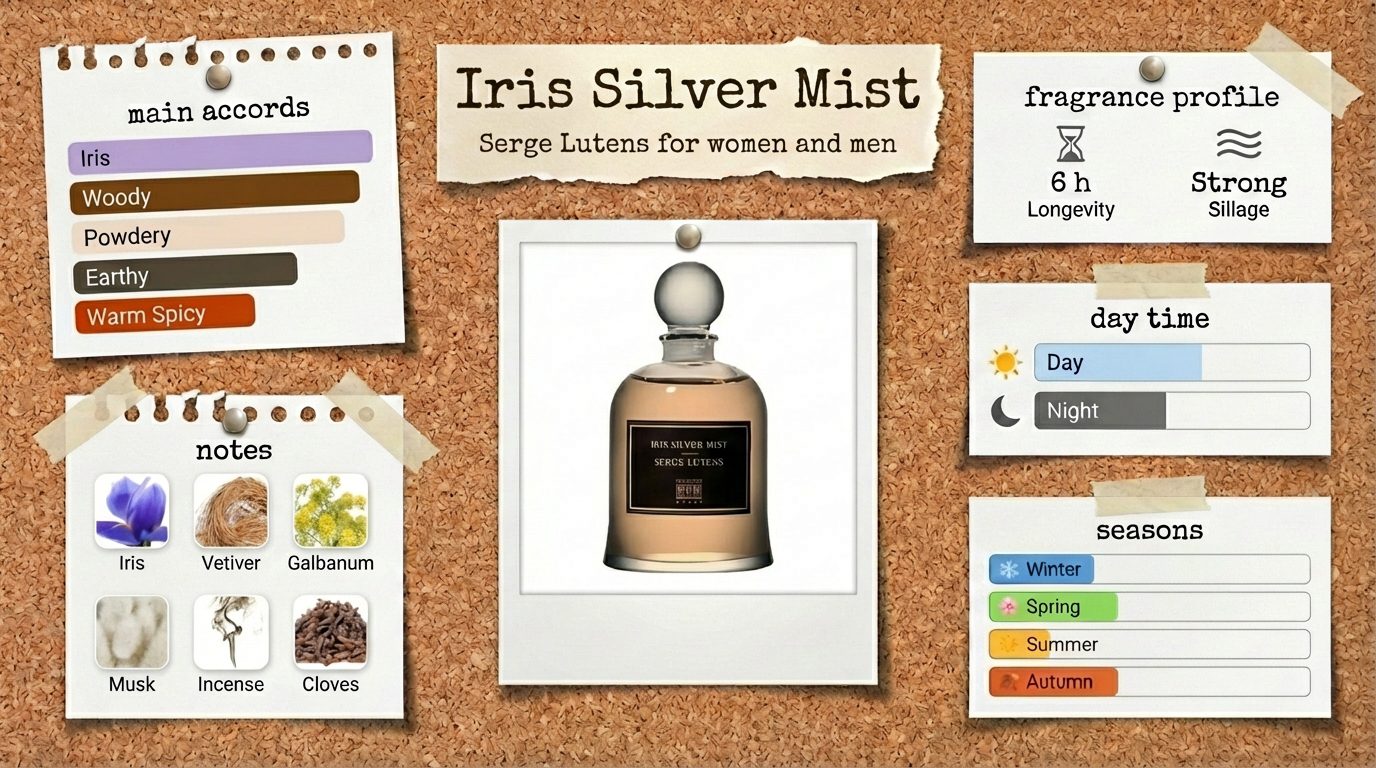
Serge Lutens “Iris Silver Mist” (1994) — Created by perfumer Maurice Roucel, this fragrance reveals the rawest aspects of the scent. Although notorious for its wicked iris, it is regarded as the "pureest and most uncompromising iris soliflore.".
The moment you spray, wet earth and raw iris roots captivate the nose. The cool green notes of galbanum and the spiciness of clove dramatically highlight the earthy aspects of the orris roots, spreading out like a silver mist over a base of vetiver, sandalwood, and benzoin.
It is beautiful yet challenging and polarizing, making it a sort of rite of passage for perfume enthusiasts. Since it holds strong symbolic significance rather than being a recommended scent, I strongly recommend that you try it out before making a decision.
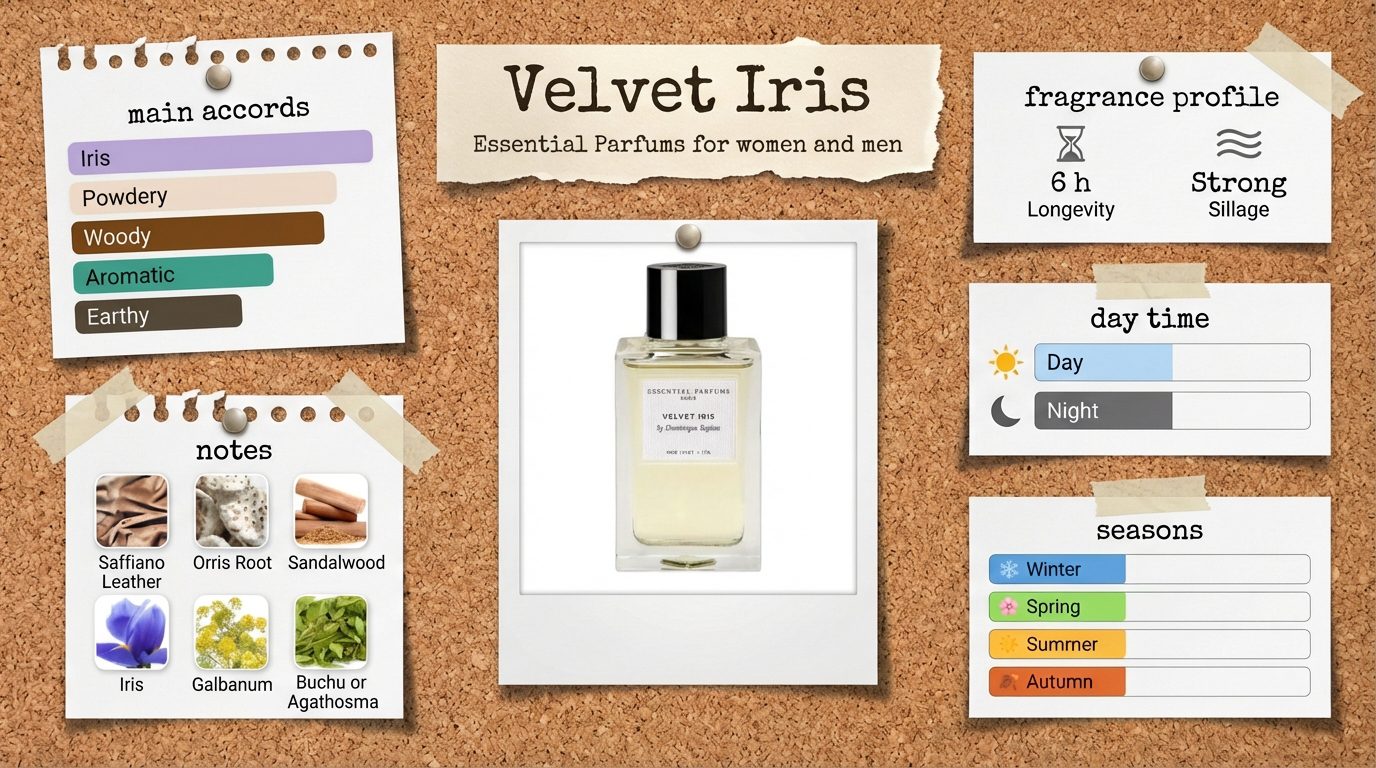 Essential Perfume “Velvet Iris” (Velvet Iris, 2025) — This is the latest creation by legendary perfumer Dominique Ropion. In this fragrance, iris combines with the vivid green notes of galbanum and the turpentine nuances of mastic resin to express a very natural and vibrant iris.
Buchu and pink pepper signal a fresh start in the top notes, while Saffiano leather and sandalwood provide a warm finish. With almost no sweet elements, this fragrance captures the essence of 'Green Iris,' and its charm lies in its naturalness, reminiscent of the scent of soil in a grandmother's garden.
The components that make up the iris scent
The essential oil of this fragrance is in academic and industrial classifications CAS No. 8002-73-1It is registered as.
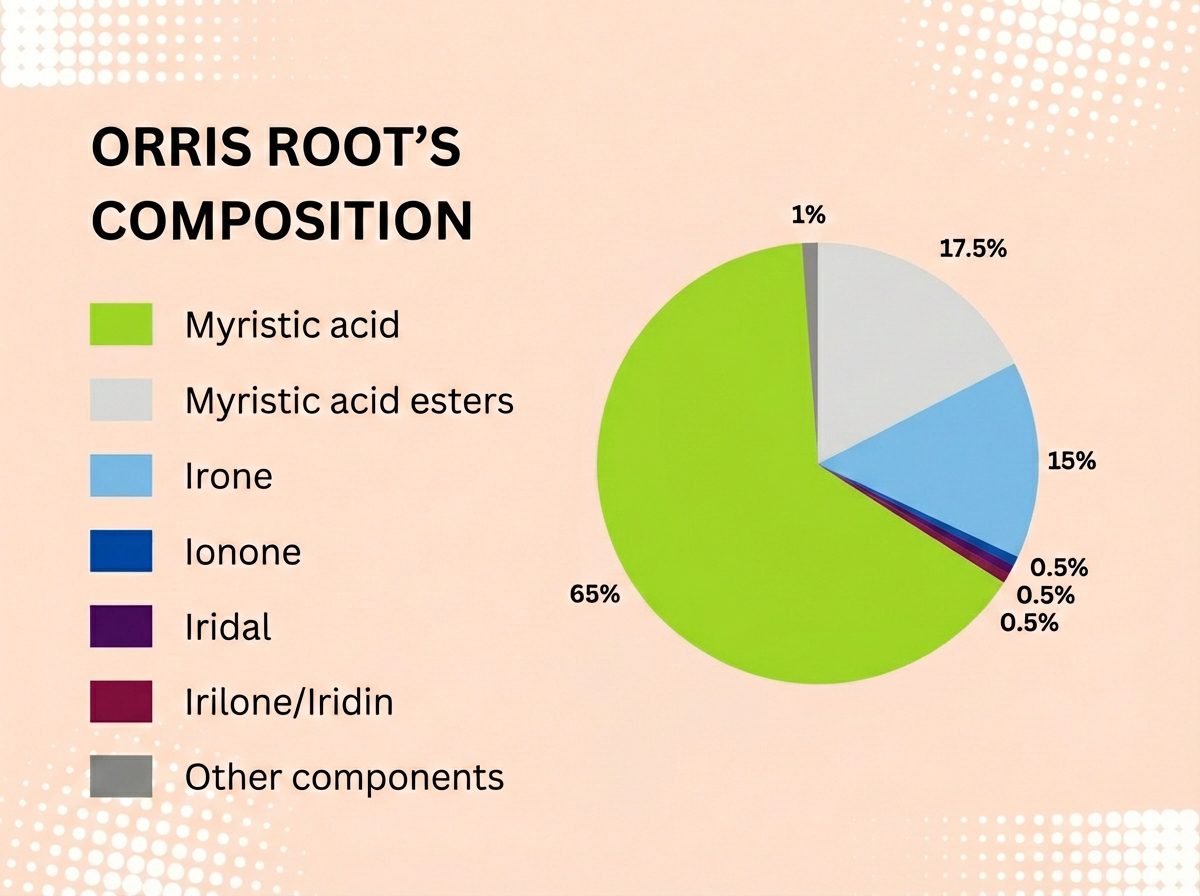
Based on Orris butter, 83–861 TP3T of the total is occupied by fatty acids centered on myristic acid and their esters, while the remaining 13–171 TP3T of ketone fraction is the key region that determines the flavor. In Absolut, this ketone (iron) ratio rises to 55–851 TP3T.
Main components of iris
The signature molecule that characterizes the scent of this fragrance is undoubtedly ironIron exists in three isomers, α, β, and γ, and among these, the one that contributes the most to the scent is cis-γ-ironIt accounts for 30~40% of the total iron. cis-α-ironThis is followed by 20~30%.
Iron is chemically related to ionone, the fragrance molecule of violets. The synthesis of ionone from citral by Tiemann and Kruger in 1893 was an important milestone in the history of fragrances.
Although iron and ionone have similar structures, iron is more complex and possesses a 'root-like' depth, so synthetic ionone cannot perfectly reproduce the scent of natural orris. The other key components that determine the scent are as follows.
| Ingredient name | Content range | Fragrance characteristics |
|---|---|---|
| Iron | 13-17% | Violet, Powdery — Oris's Signature Molecule |
| Myristic acid | 60-70% | Imparts a waxy, creamy texture |
| Myristic acid esters | 15-20% | Soft balsam, buttery body |
| Ionone | Trace amount (<1%) | Violet floral nuance auxiliary |
| Iridal | Trace amount (decreases upon aging) | Ironone precursor, conversion during maturation |
| Irilone / Iridin | a very small amount | Isoflavones and flavonoids contribute little to flavor |
The essence of the Orris scent is ironLed by a lead actor named, Mount MyristIt is an ensemble created together by supporting actors named ionon, esters, and terpene alcohols on the waxy stage that this creates.
IFRA Regulations and Safety
Orris root It is classified as a natural complex ingredient (NCI), and, IFRA (International Fragrance Association)There is no direct ban on the use of the Oris ingredients themselves or a total quantity limit. However, some of the individual chemical components contained within these fragrances may be subject to IFRA regulations.
For example, while iron itself is not included in the EU allergen list, caution regarding skin sensitivity is required for some components that may be produced during the extraction process.
In terms of actual use, this ingredient is so expensive that it is used in extremely small quantities, so safety issues are rarely highlighted. However, it is good to be aware of the following points.
- Iris root powderIt can rarely cause contact dermatitis. Caution is required when grinding it directly or using it for DIY fragrance blending.
- Since the amount of iris contained in perfume products is usually minute, allergic reactions in normal environments are very rare.
- If you have sensitive skin, when first sampling a perfume containing a high concentration of this fragrance, on the inside of your arm Patch testI recommend trying it.
- Regulatory information by specific ingredient IFRA Standards LibraryYou can check it at.
This fragrance has been with humanity for thousands of years. From the journey of a single iris root to becoming a fragrance. At least 6 yearsThe fact that this is necessary proves why this fragrance is so precious and beautiful.
When you smell the powdery whisper contained within a bottle of perfume, the one melting inside The weight of timeIt would be good to think of that.


