
Lavender (scientific name:Lavandula angustifoliaIt is a perennial plant belonging to the Lamiaceae family. It is a shrub that grows up to 1 meter in height and is beloved for its beautiful purple flowers and fragrance. Since ancient Roman times, it has been used to add scent to bathwater or treat wounds, and it is said to have been widely utilized for medicinal and fragrance purposes in medieval Europe. It is primarily native to the Mediterranean region, with Bulgaria, Spain, and France being particularly famous. It is utilized in various fields, including perfumes, aromatherapy, cosmetics, and medicine. In particular, the Provence region of France is famous as a center of cultivation and production and is highly regarded globally.

Lavender oil extraction and production methods
The main production area is the aforementioned Provence region of France, where the harvest takes place annually from late June to early August, and festivals are held during this period, attracting many tourists. In addition, it is also cultivated in Bulgaria, Spain, and the United Kingdom, but the aroma and quality vary depending on the climate and soil of each region.
Lavender essential oil is primarily extracted through steam distillation. Flowers are heated with steam to convert volatile fragrance components into vapor, which is then cooled to separate the oil and water. Absolute oil can be produced through extraction using solvents.
Various Lavender Varieties and Differences in Characteristics by Variety
Lavender is cultivated in various regions, and depending on the growing area, there may be differences in specific varieties or variations in characteristics even within the same variety. The most popular lavender varieties are Lavandula AngustifoliaEven within the same variety, lavender grown in regions such as Norfolk and Hampshire in the UK grows slowly and produces a soft, light floral scent due to the cool, humid climate, whereas lavender from the Provence region of France or Bulgaria is renowned for its deeper, more intense floral fragrance and high quality resulting from the dry climate and abundant sunshine. On the other hand, lavender primarily cultivated in the Andalusia region of Spain, particularly in Seville, Lavandula stoechas This variety has a higher 1,8-cineole content compared to common lavender, possessing a unique scent that is spicy yet strong herbal, giving it a different feel from traditional lavender. This lavender is said to be highly effective for respiratory diseases.
If you want a soft, light, and hypoallergenic scent, it is best to choose English lavender; if you want a deep and rich floral scent, choose Bulgarian lavender or Provence lavender; and if you want a special therapeutic effect or an intense herbal scent, choose Spanish lavender.
Scent and fragrance notes of lavender oil
Lavender is a floral scent known for possessing delicate floral notes and pungent herbal and medicinal undertones along with a slightly sweet aroma, while simultaneously delivering a refined and clean fragrance. It is primarily used as a top and middle note.
Fragrances that blend well with lavender oil
Lavender harmonizes well with citrus, herbal, woody, and floral scents. In particular, labdanum is a good combination for reinforcing the base notes of perfume and acting as a fixative to increase the longevity of lavender.
- Citrus family When sweet and floral scents are combined with citrus scents such as lemon, bergamot, and orange, they create a light, refreshing, and lively fragrance.
Examples of flavorings: Bergamot, Lemon, Orange, Grapefruit, etc. - Herb family Combination with herbs can emphasize a fresh and natural herbal scent while adding a warm and soft feeling.
Fragrance examples: rosemary, thyme, clary sage, peppermint, etc. - Woody series When combined with woody fragrances, it forms a deep and warm lingering scent. It can add weight and richness to the fragrance, and when combined with soft floral notes and woody notes, it can create a comfortable and calm atmosphere.
Examples of fragrance ingredients: Cedarwood, sandalwood, patchouli, vetiver, etc. - Floral When combined with other floral notes, it forms a rich and elegant bouquet. It is used when emphasizing sweetness and highlighting the floral scent. It emphasizes a romantic and sensual fragrance.
Representative commercial perfumes using lavender

- Jo Malone London – Silver Birch & Lavender This fragrance offers a modern reinterpretation of the classic lavender scent, creating a unisex vibe that can be enjoyed by both men and women. Smoky woody notes of silver birch further highlight the freshness of the lavender and add a refreshing touch. It is a perfume that leaves a clean yet sophisticated impression.
- L'Occitane – Lavande Eau de Cologne It offers a comfortable and natural scent inspired by the lavender fields of Provence. Bergamot and lavender harmonize to create a refreshing and crisp sensation, while chamomile and musk are added to leave a warm and soft lingering scent.
- Chloé – Lavanda Chloé This lavender fragrance focuses on freshness and freshness, creating a clean and elegant atmosphere with a combination of green apple and jasmine, while cedarwood and musk are added to provide a soft and cozy lingering scent. It is a perfume suitable for those who prefer a feminine and romantic vibe.
Main ingredients of lavender oil
Although the main components of lavender essential oil vary slightly depending on the species, linalool and linalyl acetate make up the majority of the composition. In addition to linalool (20-35%) and linalyl acetate (30-55%), components such as terpinen-4-ol, camphor, and lavandulyl acetate combine to form the multi-layered scent of lavender.
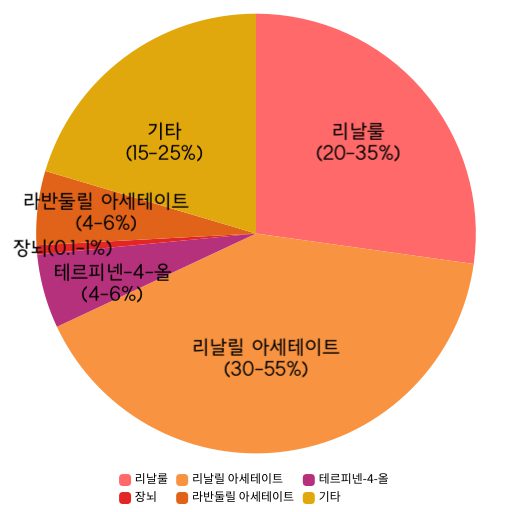
| scientific name | Lavandula angustifolia |
| CAS number | 8000-28-02 |
| Main ingredients | role |
| Linalool | A refreshing and sweet floral scent |
| Linalyl acetate | Sweet floral scent mixed with fruit scent |
| Terpinen-4-ol | Refreshing herbal and spicy scents |
| Camphor | Cool with a slight minty sensation, refreshing herbal scent |
| Lavandulyl Acetate | Soft and powdery lavender scent |
Precautions for using lavender oil and allergens
Lavender essential oil is generally safe, but it can cause allergic reactions in some people. It is advisable for pregnant women, especially during the early stages of pregnancy, to avoid using it, and it is recommended that breastfeeding women consult a doctor before use. For infants and toddlers under the age of two, the oil must be diluted to a very low concentration because children's skin is more sensitive than adults'; it is also best to avoid applying it directly to areas close to the nose, as this can cause respiratory irritation.
Caution is required regarding the ingredients linalool, linalyl acetate, and terpinene-4-ol, as they can cause allergic reactions in a small number of people. Since linalool can oxidize and trigger allergic reactions when exposed to air, it is recommended to store the product in a sealed container to avoid prolonged exposure. In the case of linalyl acetate and terpinene-4-ol, as they can cause skin irritation in some individuals with sensitive skin, it is advisable to perform a patch test before using a new product by applying a small amount to the inside of the wrist or behind the ear and observing the reaction for about 24 hours.
Aromatherapy effects of lavender oil

Lavender (Lavandula angustifolia) is one of the most widely used essential oils in aromatherapy. It is known to have a particularly positive effect on the nervous system and possesses excellent efficacy in alleviating various psychological and physical problems. Lavender oil is used in a wide range of applications, including calming effects, stress relief, and sleep improvement.
- Stress and anxiety relief
- Improvement of sleep and relief of insomnia
- Pain relief and muscle relaxation
- Improvement of respiratory health
The main ingredient Rinalul과 Linaryl acetateIt stabilizes the nervous system and activates the parasympathetic nervous system, which is a stress hormone Cortisol It reduces levels. It also calms the nerves and Promotes melatonin secretionIt also improves sleep quality. Relieves insomniaIt is said to help with the task. Also Terpinene-4-ol The ingredient is said to have anti-inflammatory and analgesic properties, making it effective for pain relief. It is contained in small amounts in lavender. 1,8-Cineole The ingredients help reduce airway mucus and ease breathing, which is beneficial for respiratory conditions. When using lavender oil, you can put it in a diffuser or add a few drops to your bathwater. When using it as a massage oil, dilute it with a carrier oil (such as jojoba or sweet almond oil) to avoid irritating the skin.


