
index
What is Belgian Strong Ale?

Belgian Strong Ale is a general term for top-fermented Belgian beers with an alcohol content of 71 TP3T or higher. It is closer to a broad category that groups various Belgian ale styles rather than an exact style name.
Within this category, styles with completely different colors and flavors coexist, ranging from light straw-colored blonde ales to deep mahogany-colored Quadrupels. The biggest characteristic that distinguishes it from strong ales of other countries is Belgian yeastIt is the complex fruit and spice aroma that it produces.
British Barry Wine and German Doppelbock are also high-alcohol ales, but unlike them, Belgian Strong Ale tends to be light and dry despite its high alcohol content. Let’s explore the unique characteristics of Belgian beer.
Belgian Strong Ale Basic Specifications
Alcohol content: 7~121 TP3T ABV
Color: Straw Gold to Dark Mahogany
Fermentation: Top fermentation (Ale)
Carbonation: High, In-bottle secondary fermentation (bottle conditioning) standard
Belgian yeast, candy sugar, and the identity of Belgian beer
There is something people trying Belgian Strong Ale for the first time often say: “This is 9%?”
I was surprised by the higher-than-expected alcohol content, but it is because of the subtle, light, and floral scent.
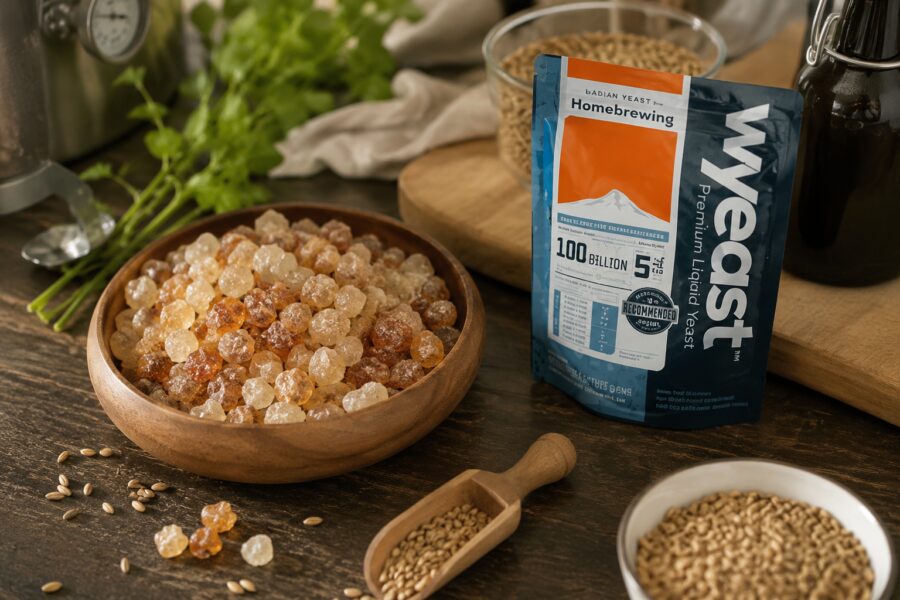
This is expressed through the characteristics of two Belgian beers. Belgian yeastThe characteristics of, and Candy SugarIt is the use of.
Belgian yeast
Belgian yeast ferments at high temperatures ester(Fruit scent) and phenolicIt produces a large amount of (spice flavor) compounds.
Esters manifest as fruity scents such as pear, apple, banana, and apricot. Phenolics are expressed as scents such as clove, pepper, and sometimes rose or honey.
Even when using the same yeast, the result varies completely depending on the fermentation temperature. Westmalle and Westvleteren are two monasteries that share the same yeast strain and produce their own beers, but the beers from these monasteries create significant differences.
Westmalle is known to produce a smooth, malt-centered beer by keeping the fermentation temperature low, while Westvleteren is known to produce a strong phenolic character by raising the temperature high.
Candy Sugar
If you produce an alcohol content of 9% or higher using only malt Beer The body becomes heavy like syrup. Think of British barley wine.
Belgian brewers this problem Candy SugarIt was solved with (Belgian candi sugar). Unlike malt, sugar is fermented by yeast, so it leaves only alcohol and does not contribute to the body.
In the case of the Tripel recipe, sugar accounts for approximately 201 TP3T of the total fermented ingredients. Thanks to this, the body is light and dry despite the ABV of 9.51 TP3T.
The contribution of candy sugar to flavor varies depending on its color. When boiled at high temperatures during the manufacturing process, the Maillard reaction occurs, and as the color becomes darker, different flavor compounds are produced.
| type | 색 | Flavor contribution | The style I usually use |
|---|---|---|---|
| White candy sugar | Colorless to light gold | Nearly neutral. The effect is virtually the same as regular sugar. | Tripel, Golden Strong Ale |
| Amber candy syrup | Amber | Caramel, toffee, vanilla, stone fruit | Double, Dark Strong Ale |
| dark candy syrup | dark brown | Dark chocolate, coffee, raisins, dark fruit | Quadrupel, strong dark ale |
In fact, white candy sugar, used to lighten the body in Tripel or Golden Strong Ale, is functionally almost no different from regular sugar.
In fact, most modern Belgian breweries have replaced traditional candy sugar chunks with regular sugar syrup (sucrose). While the name "candy sugar" may sound special, it is actually colored dark candy syrup that is the product truly different from regular sugar.
Bottle Conditioning
Most Belgian Strong Ales undergo a secondary fermentation inside the bottle by adding a small amount of yeast and sugar during bottling. This process creates high carbonation, fine bubbles, and complex flavors. Additionally, the taste deepens over time through bottle aging. It is recommended to store the bottle upright and take care to avoid mixing in any final yeast sediment when pouring.
Belgian Strong Ale and Trappist Beer
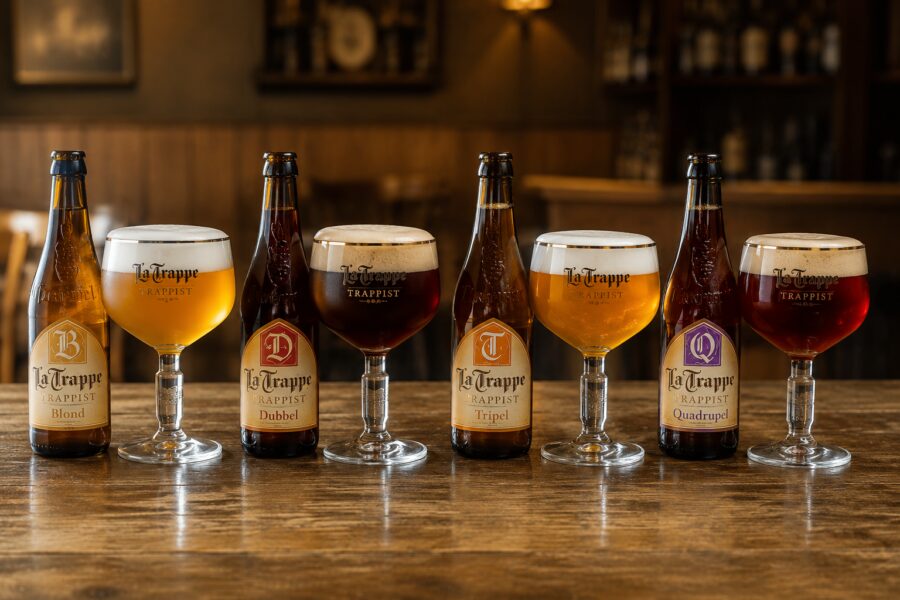
When drinking Belgian beer, you may encounter cases where beers of the same style have different style names. This is because the two classification systems—one for monastery-produced beers and the other for commercially produced styles—are intermingled.
Commercial Style Classification
This is a classification used in beer style guides (such as the BJCP). Styles are classified based on color, alcohol content, and flavor profiles.
There are three commercial style names commonly used in the Belgian Strong Ale category. Belgian Blonde Ale(Belgian Blonde Ale), Belgian Golden Strong Ale(Belgian Golden Strong Ale), Belgian Dark Strong AleIt is (Belgian Dark Strong Ale). Each style is explained further below.
Trappist system
This is a strength classification system that has been used internally by Trappist monasteries. Originally, strength was classified based on the amount of malt used.
Enkel (Single)It is a light beer brewed as a daily drink for monks. It is priced at 3 to 51 TP3T and is rarely distributed today.
DubbelIt is a dark brown ale with 6–81 TP3T, meaning it uses twice as much malt as an Enkel. Westmalle established the modern recipe in 1926.
TripelIt is a Pale Gold Ale with a 7.5–9.51 TP3T, meaning it uses three times the amount of malt. The Westmalle Tripel (the current recipe was finalized in 1956) serves as the benchmark for this style.
Quadrupel"Trappe" is a neologism created by the Koningshoeven Abbey in the Netherlands in 1991 for the La Trappe brand. It is a modern designation with no historical precedent and refers to a dark strong ale with a 9–121 TP3T.
What is the difference between Belgian Dark Strong Ale, Dubbel, and Quadrupel?
In fact, the two classification systems essentially divide the same beers based on different criteria.
| Trappist system | Commercial style system | 색 | ABV |
|---|---|---|---|
| Enkel | Belgian Blonde Ale | Pale Gold | 4~7% |
| Dubbel | Belgian Dark Strong Ale (weaker version) | Amber to dark brown | 6~8% |
| Tripel | Belgian Golden Strong Ale | Pale to Deep Gold | 7.5~9.5% |
| Quadrupel | Belgian Dark Strong Ale (Strong Version) | Amber~Mahogany | 9~12% |
The boundary between Tripels and Belgian Golden Strong Ales is particularly ambiguous. If I were to force an explanation, perhaps it would be that Tripels 'tend' to have a slightly richer body and a slightly darker color than Golden Strongs?
Likewise, Double and Quadrupel are not clearly distinguished from Belgian Dark Strong Ale. Both are dark ales, and Quadrupel is a relatively recent term coined in 1991. It is essentially a marketing-driven name that has become the industry standard.
Why is Double Dark and Tripel Golden?
There is no logical reason. It is a custom solidified by historical coincidence. Westmalle's first Double (1856) was a dark brown ale in accordance with Belgian tradition at the time, and the Tripel is the result of intentionally choosing pale malt to counter the golden Pilsner craze of the 1930s. The Quadrupel became dark as an extension of the Double, but today, the Golden Quadrupel has also established itself as a trend in the American craft beer scene.
Double, Tripel, and Quadrupel are not legally protected names. Only the “Authentic Trappist Product” logo is protected, and any commercial or craft brewery is free to use this name.
Types of Belgian Strong Ales
Belgian Blonde Ale

Belgian Blonde Ale is the most accessible style among strong ales.
The alcohol content is 6 to 71 TP3T, which is the lowest in this category, the color is straw gold, and the taste is sweet with balanced hops.
The most widely known example in the commercial market is Leffe Blonde. With an ABV of 6.61 TP3T, it features fruit and slight spice notes, with a sweetness that comes first and a smooth finish.
The blonde ales from Trappist monasteries each display distinct characteristics. Westvleteren Blond (5.81 TP3T) is dry and grassy, while La Trappe Blond (6.51 TP3T) has strong clove and fruit aromas.
Although it falls into virtually the same category as Enkel within the Trappist system, Enkel is used for the daily consumption of monks and is rarely distributed outside. Trappist Blondes distributed in the commercial market actually often have a higher alcohol content than Enkel.
Key Characteristics of Belgian Blonde Ale
Color: Straw to Gold / ABV: 5.5–71 TP3T / Flavor: Sweet malt, fruity esters, low hop bitterness / Body: Medium, dry finish / Signature Beers: Leffe Blonde, La Trappe Blond, Westvleteren Blond
Belgian Golden Strong Ale and Tripel

Belgian Golden Strong Ale looks light, but it is actually a style that weighs 7 to 91 TP3T.
The archetype of this style is DuvelMoortgat Brewery perfected the current golden recipe in the 1970s, and numerous commercial breweries followed suit.
The name Duvel (meaning 'devil' in Flemish) accurately captures the characteristics of the beer. The devil's power lies in its inconspicuousness. Despite having an ABV of 8.51 TP3T, it is easy to drink, feeling as if it has half the alcohol content; it is overflowing with carbonation and full of fruity and floral aromas.
The first strong golden ale was Westmalle Tripel (original in 1934, current recipe in 1956), and Duvel is a commercial successor to it from the 1970s.
| item | Belgian Golden Strong Ale | Tripel |
|---|---|---|
| Representative beer | Duvel, Delirium Tremens | Westmalle Tripel, Chimay Cinq Cents |
| 색 | Straw~Gold (3.5~5.5 SRM) | Pale to Deep Gold (3.5 to 6 SRM) |
| ABV | 7~9% | 7.5~9.5% |
| body | Super dry, very light | Dry but slightly richer |
| Hop character | Medium to High (25~45 IBU) | Medium (25~38 IBU) |
| Yeast character | Spicy aroma, clean finish | Spices + fruit flavors, slightly more complex |
| genesis | Commercial Brewery (Moortgat) | Trappist Monastery (Westmalle) |
In summary, Tripel has a slightly fuller body and a more complex yeast character than Golden Strong. Golden Strong tends to be drier and cleaner. However, this distinction is not always clear, as the boundary between the two styles has always been ambiguous.
Key Characteristics of Belgian Golden Strong Ale
Color: Straw to Gold / ABV: 7–91 TP3T / Flavor: Fruity esters, spice notes, dry and crisp finish / Carbonation: Very High / Representative Beers: Duvel, Delirium Tremens, Lucifer
Belgian Dark Strong Ale
[Image Replacement: Deep mahogany dark strong ale in a wide chalice glass with condensation, against a candlelit monastery hallway background]
Belgian Dark Strong Ale is not a single style, but a category encompassing strong, dark ales. As such, it has a wide spectrum.
Both the Trappist Double and Quadrupel fall into this category. Aside from differences in alcohol content and complexity, both share flavors of raisin, plum, chocolate, and caramel derived from dark malt.
Dubbel
Double is the modern archetype of Trappist dark ale. Westmalle Abbey began brewing dark brown ale in 1856 and refined the recipe in 1926, establishing the standard for the current Double style.
The alcohol content is 6–81 TP3T, the lowest in this category. The color is a ruby brown with red highlights mixed into a freshly inverted earthy hue.
The flavor is centered on sweet and rich dark fruit notes—raisins, plums, and figs—supported by banana and chocolate aromas. Hops are barely noticeable.
Quadrupel
The term Quadrupel has a shorter history than you might think. It was first used in 1991 by the Koningshoeven Abbey in the Netherlands for the La Trappe brand and has since become an industry standard term.
Paradoxically, strong and dark monastery ales already existed even before this name was given. Chimay Blue (Grande Reserve), Westvleteren 12, and Rochefort 10 are prime examples. These were called Dark Strong Ales without the name 'Quadrupel'.
With an alcohol content of 9–121 TP3T, it is the strongest among Belgian ales. It has a deep mahogany color and produces a complex flavor profile combining chocolate, caramel, dark fruit, and spices.
Aging ability is also a major characteristic of this style. Quadrupel, produced through secondary fermentation in the bottle, continues to develop its flavor like Port wine when stored at cool temperatures for several years.
| item | Dubbel | Quadrupel |
|---|---|---|
| Representative beer | Westmalle Dubbel, Chimay Rouge | Rochefort 10, Westvleteren 12, La Trappe Quadrupel |
| ABV | 6~8% | 9~12% |
| 색 | Amber to dark brown | Deep Amber~Mahogany |
| Main flavors | Raisins, plums, chocolate, bananas | Caramel, figs, dark fruit cake, spices |
| body | Medium to full, slightly dry | Grass, sweet and warming |
| Aging | It is recommended to drink it fresh. | Can be aged for several years, flavor further developed |
| Origin of the name | Westmalle, 1926 | La Trappe/Koningshoeven, 1991 |
Belgian Dark Strong Ale Key Characteristics
Color: Amber–Mahogany / ABV: 6–121 TP3T (Dubbel–Quadrupel) / Flavors: Dark fruit, caramel, chocolate, spices, alcohol / Warmth: High / Signature Beers: Westmalle Dubbel, Rochefort 10, Westvleteren 12, La Trappe Quadrupel
How to Drink Belgian Strong Ale

Glass selection
Belgian Strong Ale Tulip or Goblet/Chalice Glass suits it.
The tulip glass is wide at the bottom, tapers slightly toward the top, and then widens again. It retains rich aromas and keeps the foam fresh for a long time. It is particularly well-suited for Belgian Golden Strong Ales and Tripels. The tulip glass specifically designed for Duvel is famous.
Goblets and chalices have a wide bowl shape, allowing body heat from the palm to be transferred to the glass, gradually warming the beer while drinking. They are suitable for dark strong ales and quadrupels with complex flavors.
Serving temperature
If Belgian Strong Ale is drunk too cold, its complex flavors become blocked.
| style | Recommended temperature | reason |
|---|---|---|
| Blonde Ale | 6~8°C | Preserve the refreshing sensation, but enough to open up the fruit scent. |
| Golden Strong / Tripel | 8~10°C | Balance of carbonation and aroma, esters are well-represented |
| Dark Strong / Double / Quadrupel | 10~14°C | Dark fruit, chocolate, and alcohol warming sensations fully develop |
Food Pairing
Belgium is a country with a developed culture of enjoying beer and food together. Belgian ale places great importance on food pairing, much like wine.
Blonde AleIt pairs well with light foods. It goes well with mussels, salmon, chicken, soft cheeses, and lightly spicy dishes like Thai food.
Golden Strong Ale / TripelIt pairs well with rich seafood such as roast pork and lobster, and creamy desserts such as crème brûlée.
Dark Strong Ale / Double / QuadrupelIt is complex enough in itself to be a full course. It pairs well with hearty foods such as aged cheese, dark chocolate, chocolate cake, steak, or lamb chops. In addition, Double and Quadrupel are considered to be drinks that pair well with food, showing good pairing with almost any dish.
Treatment method for yeast sediment in bottles
Belgian ales made using the bottle conditioning method have yeast sediment at the bottom of the bottle. If you stand the bottle upright in the refrigerator before drinking, the sediment will settle. When pouring, tilt the bottle slowly to leave the last 2–3 cm with the sediment, or if you prefer, pour it into a separate glass to enjoy it cloudy. While this is harmless to your health, it may make the taste cloudy and stronger in bitterness.


