
index
2. Extraction method of violet fragrance
3. Differences in violets by production region
4-1. Flavorings that blend well together
5. Recommended perfumes representing violet
Violet
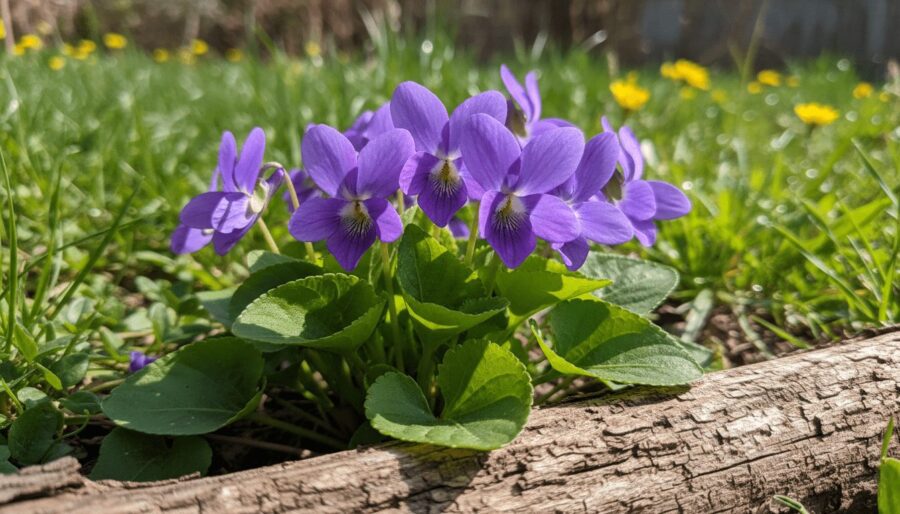 Violet, that is Sweet Violet(Viola odorataIt is a small perennial plant belonging to the family Violaceae, native to Europe, Asia, and North Africa.
This humble flower, standing merely 12 to 15 cm tall, has been... since ancient times rose, It has been considered one of the three most beloved fragrant plants, along with the lily.
The ancient Greeks regarded the violet as a symbol of fertility. In Greek mythology, the violet (IonThe name ) refers to Zeus's lover, who had to be turned into a cow due to Hera's jealousy IoIt is said to have originated from.
The legend that Zeus created this flower for Io out of pity for her having to eat only grass, or the story that it bloomed where Io's tears fell, seems to perfectly explain the somewhat sorrowful yet sweet scent of this flower.
The Roman naturalist Pliny ranked the fragrance of the violet second only to that of the rose and the lily, and recorded that wearing a wreath of violets prevents intoxication, headaches, and dizziness.
Both the Greeks and Romans enjoyed drinking wine flavored with violets, and the early Arabs, who developed perfume culture, also treated the violet highly, such as by steeping the flower in oil to extract its scent.
However, violets have a peculiar secret. The key component of the violet flower scent is IononeIt has the property of temporarily dulling human olfactory receptors.
Because of this, the moment you first smell it, you feel an enchanting fragrance, but within just a few seconds, your nose becomes numb, leading you to fall into the illusion that the scent has vanished.
A moment later, as my nose recovers, the scent washes over me again. It is as if the fragrance is repeatedly coming and going.
Because of these characteristics, Shakespeare described the violet as “a sweet scent, but one that cannot be smelled without stealing.”.
The major turning point for violet in the history of perfume was in 1893, when German chemists Tiemann and Krüger IononIt came about as they succeeded in artificially synthesizing it.
This discovery revolutionized the price of natural violet flower fragrance, which was more expensive than gold, and thanks to this, violet became the most popular scent during the 'Belle Époque' era at the end of the 19th century.
- Flower It produces a powdery and sweet candy-like scent. Because the yield is too low, it is almost always reproduced in modern perfumes using synthetic fragrance (ionone).
- Leaf It offers a cool and refreshing watery scent (Green Note) like a cucumber. Unlike flowers, natural fragrances can be obtained through solvent extraction, so they are used as precious natural ingredients in modern niche perfumes.
Extraction method of violet fragrance
Violet Flower Absolute
Violet flowers are ' in the perfume industry‘Mute FlowerIt is called a 'mute flower.' This is because even if attempts are made to extract fragrance directly from the flower, the yield is so low that almost no result is obtained. Historically, cold regions used to obtain fragrance from flowers Cold maceration (Enfleurage)This was used.
The method involves applying refined fat to a glass plate, placing flower petals one by one on it, waiting for the scent to permeate the fat for 3 to 4 days, and then replacing the withered flowers with new ones. This process had to be repeated dozens of times to obtain a pomade saturated with fragrance, from which the scent was separated again using alcohol.
Because this method was the pinnacle of manual labor, the price was astronomically high. The violet 'flower' scent used in commercial perfumes today is almost 100% Synthetic IononeIt was reproduced by combining them.
Natural violet flower absolute has virtually disappeared from modern perfumes, or is used only symbolically in a very small number of bespoke fragrances.
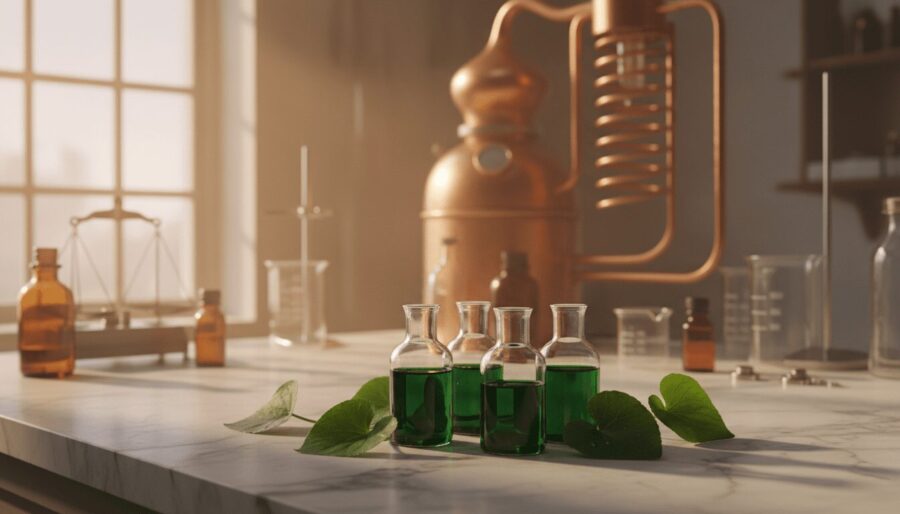
Violet Leaf Absolute
On the other hand, Violet's LeafIt is practically the only part from which extraction is possible. Most of what we call 'natural violet fragrance' today is extracted from this leaf.
Violet Leaf AbsoluteFresh leaves are extracted with a volatile solvent such as hexane to obtain a wax-like concrete, which is then purified with ethanol to finally obtain a dark green absolute.
The yield is still surprisingly low. Only about 1 kg (0.11 TP3 T) of concrete is obtained from 1 ton (1,000 kg) of leaves, and the amount decreases even further when refined into absolute.
Currently, the Nile Delta region of Egypt accounts for the majority of global production, and the leaf harvest is done by hand between May and December.
Violet is a perennial plant, so once planted About 3 to 4 years The leaves can be harvested. (It is not grown for 4 years; instead, it must be plowed under and replanted once its economic lifespan of 3 to 4 years is over.)
In addition, it is susceptible to pests and diseases, requiring careful management. Due to this labor-intensive process, high-quality violet leaf absolute is traded as a premium fragrance, commanding thousands of dollars per kilogram.
Differences in violets by production region
 There are two main varieties of violets mentioned for perfume. First Parma Violet(Parma Violet) has double flowers and a very rich and soft fragrance. Botanically, it is considered a variety of Viola suavis, which is slightly different from Viola odorata.
The name of this breed holds an interesting history. Napoleon's second wife Marie LouiseAfter becoming the ruler of the Duchy of Parma in 1816, he became fascinated by this small purple flower.
She fully supported the monks at the monastery in researching methods to extract the scent of violets, which became the beginning of the 'Parma Violet' industry.
one side Sweet VioletSweet Violet blooms as a single flower, and has large, lush leaves.
Compared to the Parma variety, the scent is slightly more distinct and sharp, and above all, it is easy to cultivate and resistant to pests and diseases.
The variety that is mass-cultivated in Egypt and other places today to obtain 'violet leaves' in the perfume industry is mainly this sweet violet variety (Viola odorata).
| division | Parma Violet | Sweet Violet |
|---|---|---|
| Flower shape | double-petaled | single-petaled |
| Characteristics of the scent | Soft and creamy powdery scent, richer | A clear and slightly sharp floral scent |
| Flavor evaluation | Preferred for higher grades and luxury perfumes | Mainly used in commercial production |
| Cultivation difficulty | Weak against pests and diseases and difficult to cultivate | Relatively easy to cultivate, high disease resistance |
| Major production areas | Parma, Italy, Southern France | Egypt, Southern France, China |
To explain the difference in scent a little more specifically, Parma VioletIt is characterized by a sweetness like candy and a powdery texture like tapping a powder puff.
the other side Sweet VioletIt has a strong clean and fresh aspect, like a cooler breeze. In modern perfumes, the characteristics of these two varieties are reproduced by adjusting the ratio of natural violet leaf absolute and synthetic ionone.
Violet scent profile
The scent of the violet reveals completely different faces in its flowers and leaves. Understanding this duality is the first step to properly understanding violet fragrances.
 The scent of violet flowersIt has a powdery and sweet character, sometimes reminiscent of candy. The key ingredients, alpha-ionone and beta-ionone, determine about three-quarters of the overall scent.
Capturing the scent of living flowers Headspace AnalysisAccording to [source], the composition of the violet flower scent consists of approximately 35.71 TP3T of alpha-ionone, approximately 21.11 TP3T of beta-ionone, and approximately 18.21 TP3T of dihydro-beta-ionone.
Here, a slight woody note and sweet nuances overlap, creating a warm scent reminiscent of a vintage cosmetics or candy store.
The scent of violet leavesIt has a personality completely opposite to that of flowers. It is dominated by cold and vivid green notes, and has a refreshing moisture reminiscent of freshly cut grass and cucumbers.
It starts with a slight earthy and metallic undertone, finishing with woody nuances. The identity of this unique scent is (2E,6Z)-2,6-Nonadienal, also known as ‘Violet leaf aldehyde’ Or, it is driven by a powerful component called 'eualdehyde'.
Violet leaf absolute is mainly in perfumes From top note to middle note It is used in between. As a representative green note, even a minute amount breathes vitality into the entire fragrance.
It is excellent for adding a masculine and fresh green touch to Leather, Fougère, and Chypre fragrances, and also plays a role in adding a natural grassy scent to white flowers such as tuberose.
On the other hand, violet flower (synthetic ionon-based) is mainly Middle note (heart note)It plays an active role. With a powdery and soft floral character, it blends with other floral scents to add depth and lingering impression to the perfume.
Flavorings that blend well together
Violet pairs well with a wide range of fragrances. Violet flower (ionone series) Iris (Oris)It forms the most classic combination. Since both fragrances share ionone-based ingredients, they are a natural match.
Here Rose, It blends well with floral notes like jasmine to create a 'lipstick accord,' while vanilla and tonka bean warmly embrace the powdery side of violet.
It also pairs excellently with soft woody notes such as sandalwood.
Violet Leaf Galbanum, It creates synergy with green notes such as cassis (blackcurrant bud), and when combined with earthy ingredients such as patchouli or oakmoss, it can produce a sophisticated chypre accord.
Recently Marine noteThe combination with it is also drawing attention, as the cucumber-like moisture characteristic of violet leaves makes the water scent more natural and modern.
Recommended Violet Perfumes
 Guerlain “Après-long diner” (Après l'Ondée, 1906) — Created by Jacques Guerlain, this perfume is a legend of violet fragrances that has survived for over 100 years.
In this work, said to express the moist floral scent lingering in the air after raindrops have passed, a dreamy powdery accord created by violet, iris, and anise aldehyde unfolds.
Melancholy yet beautiful, it is a work that demonstrates the power of perfume to move emotions. Although classified as a women's fragrance, it appeals to all genders and is a masterpiece frequently cited as the top choice on almost every violet perfume recommendation list.
 Serge Lutens “Bois de Violette” (Bois de Violette, 1992) — Created by perfumer Christopher Sheldrake, this work can be considered the starting point of niche violet fragrances. It features a composition in which violet flowers and leaves are layered on top of the cedar structure of Serge Lutens' masterpiece, 'Féminité du Bois'.
In the opening, the sweetness of candied violet meets sharp cedar, gradually transitioning over time to spicy aspects of cardamom and clove with a warm honey-vanilla base.
Although it is a unisex fragrance, its strong powdery woody character makes it suitable for those who appreciate a calm and contemplative atmosphere. The description that it resembles candy violets placed inside a cedar box best summarizes the nature of this perfume.
 Issey Miyake “Lo Disei Solar Violet” (L'Eau d'Issey Solar Violet, 2024) — This is the latest work that modernizes Issey Miyake's signature watery accord with violet.
It is a structure where warm sweet violet, as if bathed in sunlight, meets juicy pear, and powdery iris, cedar, and musk support it from behind.
It allows you to lightly experience the charm of violet without being heavy, making it recommendable as an introductory violet scent or as a daily fragrance for spring and summer. Released as a women's fragrance, it is a lineup that is garnering attention amidst the current trend of violet notes emerging.
Components that make up the violet scent
The chemical composition of violet fragrances differs distinctly between flowers and leaves. By examining the key components that make up each, one can understand why the same plant produces such different scents.
Violet Leaf AbsoluteThe CAS number is 8024-08-6It is a viscous liquid ranging from dark green to brown, with approximately 951 TP3T of the total composition consisting of odorless palmitic acid, linoleic acid, etc. fatty acidsThis occupies it.
The intense grassy smell we perceive comes from trace amounts of less than 5% of the remaining aromatic components, which is precisely why the yield is extremely low and the price is high.
Components that make up the violet scent
The chemical composition of violet fragrance is distinctly different in flowers and leaves.
If you examine the key components that make up each, you can understand why the same plant produces such different scents.
The CAS number of Violet Leaf Absolute is 8024-08-6am.
It is a viscous liquid ranging from dark green to brown, with about 951 TP3T of its composition being fatty acids and the remaining 51 TP3T of trace aromatic components determining its unique scent.
Violet's main ingredients
The components that determine the scent of violets are completely different in the flowers and leaves.
Violet Flower — Fragrance Component Composition
 This is the headspace analysis standard. It represents the proportion of fragrance molecules that actually reach the nose.
| Ingredient name | Content | Fragrance characteristics |
|---|---|---|
| α-Ionone | ~35.7% | Powdery, Sweet Violet — Signature Ingredient |
| β-Ionone | ~21.1% | Woody, dry violet, rose nuances |
| dihydro-β-ionone | ~18.2% | Soft floral, a soft variation of ionon |
| Linalool | ~7% | Fresh floral, top note contribution |
| Benzyl alcohol | ~5.7% | Mild Sweet, petal texture |
| Others (terpenes and sesquiterpenes) | ~12% | Woody and herbal supplements such as Cardinol, Globulol, and Viridiflorol |
α-ionone, β-ionone, and dihydro-β-ionone. These three components account for approximately 751 TP3T of the total floral scent. It is no exaggeration to say that the true identity of the violet flower is ionone.
According to research by Roman Kaiser, a pioneer in fragrance chemistry, ionone is a widely distributed component in nature, as evidenced by the detection of β-ionone in 16% and α-ionone in 4% among 1,250 species of aromatic plants; however, violet flowers are almost the only place where these three are concentrated in such high proportions.
Violet Leaf Absolute — Total Composition
 Leaf absolute is completely different from flower. About 781 TP3T of the total is odorless fatty acids, and the components that determine the scent are less than 51 TP3T.
| Ingredient name | Content | Fragrance characteristics |
|---|---|---|
| Total fatty acids | ~78% | Odorless. Linolenic acid, palmitic acid, linoleic acid, etc. Responsible for Absolut's texture and longevity. |
| (2E,6Z)-Nonadienal | ~1% | Green, Cucumber, Violet Leaf — Signature Ingredients |
| 2,6-Nonadien-1-ol | ~0.5% | Green, melon, moist freshness |
| Linalool | 0.2~4% | Fresh floral, significant variation depending on the region of origin |
| Cis-3-hexenyl acetate | ~0.5% | Green, freshly cut grass |
| Other fragrance ingredients | ~3% | Eugenol, hexenal, benzyl alcohol, Parmon, etc. Spicy and green auxiliary |
| Other waxes and alkenes | ~17% | Hexadecene, octadecene, pentadecenal, etc. Waxy, minimal contribution to scent |
The essence of Violet Leaf Absolute is paradoxical. It is less than 1% of the total nonadianal (CAS: 557-48-2) dominates the entire scent. Because the diffusion power characteristic of aldehydes is so strong, even a minute amount completes that vivid green-cucumber character.
There is one more substance that cannot be overlooked in the field of synthesis. It is a synthetic material widely used to mimic violet leaves. Methyl heptene carbonateMethyl Heptin Carbonate (MHC) was discovered by Moreau and Delange in 1903.
This substance, containing a carbon-carbon triple bond, transforms the pungent and gassy nuances characteristic of acetylene into a violet leaf sensation. Although the effect is intense even when using only 0.1%, its use is currently strictly regulated because it tends to cause allergies due to the reactivity of the triple bond.
IFRA Regulations and Safety
The safety of violet-related fragrances is continuously evaluated by IFRA (International Fragrance Association) and RIFM (Fragrance Ingredient Research Institute).
Violet Leaf AbsoluteThere are no separate IFRA prohibition or restriction standards established for the (natural) itself. However, the ingredients constituting this absolute and synthetic substitutes are strictly regulated. Particular caution is required regarding synthetic substances that mimic violet leaf.
having a similar structure Methyl octine carbonate(Methyl Octine Carbonate, MOC) and Methyl 2-octynoateMethyl 2-octynoate (IUPAC name for MHC) is extremely restricted in use in perfumes (Category 4) according to IFRA standards due to its strong skin sensitization.
According to EU cosmetic guidelines, the allergens commonly found in violet perfumes that require caution regarding ingredient labeling are as follows:.
| ingredient | INCI name | Types of regulation |
|---|---|---|
| Alpha-isomethyl ionone | Alpha-isomethyl ionone | EU mandatory labeling of 26 types of allergens (When leave-on exceeds 10ppm) |
| Methyl octine carbonate | Methyl 2-octynoate | IFRA Restriction: Consumer Products 0.01% (Risk of sensitization) |
| Yugenol | Eugenol | EU mandatory labeling of 26 types of allergens |
| Rinalul | Linalool | EU mandatory labeling of 26 types of allergens |
There is something to keep in mind when using violet fragrance directly. Violet Leaf Absolute is highly concentrated, so applying it directly to the skin without dilution can cause irritation.
It is typically used diluted to 101 TP3 T or less, and it is advisable to perform a patch test first if you have sensitive skin. Additionally, as it contains a small amount of salicylic acid, caution is required for those with an aspirin allergy.
Although the allergens contained in natural violet leaf absolute are present in small quantities on their own, they combine with allergens from other natural ingredients in the final perfume product; therefore, it is important to manage the total amount of allergens during the blending process.
The 51st amendment to the IFRA (notified in June 2023) organizes the contribution of these natural complex substances (NCS) in a separate appendix to enable perfumers and manufacturers to comply with regulations.


