
Behind the sizzling sound over the charcoal fire, the sweet scent of pork fat tickles the nose, and finally, a sausage, taut on the outside as if about to burst, is placed before my eyes. When I take a bite, a sweet taste spreads throughout my mouth. Distinctly different from Korean or German sausages, the unique sweetness created by sugar and sorghum liquor first envelops the tongue.
And soon after, the juices of coarsely minced pork, a subtle five-spice aroma, and the sharp freshness of raw garlic follow in succession. This is Taiwanese sausage, Xiangchang(香腸It is a sausage that no one in Taiwanese night markets is unfamiliar with.
Approximately per 100g 354 kcal (Based on Taiwanese-style pork xiangchang / Varies depending on fat content)
index
漂洋過海 Xiangchang, Taiwanese sausage

Sausages were originally preserved foods. As people from the coastal Fujian and Guangdong regions migrated to Taiwan during the Ming and Qing dynasties, they brought sausage culture with them to recreate the flavors of their hometowns and preserve food for long periods. In the days before refrigerators, sausages were made by adding large amounts of salt to inhibit bacterial growth, resulting in them being salty, hard, and having an unpleasant texture.
The decisive turning point was 1957. Hei Chaopai (black bridge) Founder Chen Yuanhui improved the salty taste of the sausage and 'Hongsuro' (烘束爐) developed. Thanks to this method of drying slowly over a long period of time using low-temperature charcoal, preservation became possible without a large amount of salt, and this became the foundation of the unique sweet and moist taste of Taiwanese xiangchang today.
Subsequently, Xiangchang quickly permeated popular culture. During the economic boom of the 1950s and 60s, bicycle vendors carrying sausage grills appeared in front of theaters and temples. The sizzling sound and smell of sausage grease dripping onto the charcoal attracted crowds, becoming a form of casual entertainment alongside dice gambling.
Even now, you can smell the aroma of grilled Xiangchang anywhere in Taiwan—night markets, tourist attractions, and baseball stadium stands. Because of the red color, Spring Festival couplets (春聯There is also talk that it resembles a porridge, and in fact, the custom of placing a plate of porridge on the table during the Lunar New Year holiday continues.
Ingredients and Spices of Xiangchang
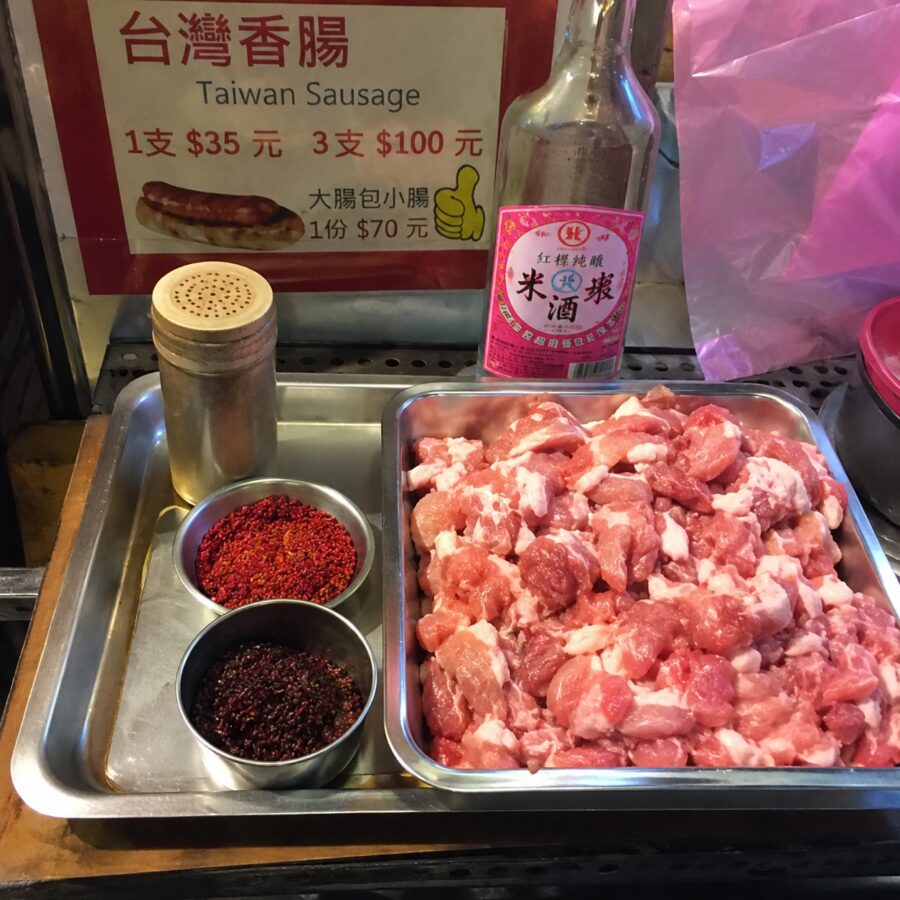
The basic ingredients of Xiangchang are pork, sugar, salt, alcohol, spices, and sauce. The unique feature is the mixing ratio rather than the ingredients themselves.
The ratio of lean meat to fat is usually 7:3 or 8:2That is the basic principle. If there is too little fat, it becomes dry after grilling, and if there is too much, it becomes greasy. Both methods are used, such as using the whole Maehwasal (neck area) which has fat evenly distributed like pork belly, or mixing finely chopped back fat into the hind leg meat.
What stands out is the ratio of sugar. Based on 1kg of lean meat, the sugar 150~200g The recipe used is close to the standards commonly used in Taiwan. On the other hand, the salt content is around 28 to 40 grams per serving. This means that sugar is used in amounts nearly 4 to 5 times greater than salt. This is the exact opposite of how German or Korean sausages are designed, which are centered on a salty taste.
Typically, about 120 to 240 ml of Kaoliang or Shaoxing liquor is added per kilogram of meat. The sugar rapidly caramelizes the surface during grilling, the fat keeps the interior moist, and the liquor eliminates gamey odors while adding aroma. It is a structure where the three elements each play their respective roles.
Kaoliang liquor
There are two reasons why alcohol is added to Xiangchang. The first is to remove off-flavors, and the second is to add flavor. Traditionally, Taiwanese Xiangchang contains rice wine (rice wine) or sorghum liquor (High-quality alcoholIt uses ). Kinmen Island 58-degree sorghum liquor is particularly popular, and the aroma of the liquor spreads in all directions during the roasting process, and the experience of the scent of the liquor seeping out between the teeth when you take a bite is what distinguishes it from ordinary shangchang.
Red yeast rice
The red color of Taiwanese Xiangchang is created by two factors. One is red yeast rice (紅麴One is a red yeast rice, and the other is a nitrite-based colorant. Red yeast rice is a traditional ingredient made by culturing red koji mold on rice, and brands like Taiwan Tobacco & Liquor (TTL) produce Xiangchang by blending their own red yeast rice with a 3:1 ratio of fat to a 7:1 ratio of lean meat. Red yeast rice also adds a distinctive fermented aroma.
Using natural red yeast rice allows you to produce a vivid red color without synthetic dyes or nitrites. This is why red yeast rice powder is used in homemade xiangchang recipes.
Five-spice, licorice, and cinnamon
The spice composition of Taiwanese Xiangchang typically consists of five-spice powder, licorice powder, cinnamon powder, and white pepper. Five-spice powder is a blend of star anise, cinnamon, fennel, cloves, and Sichuan peppercorns, serving as a fundamental spice base found throughout Taiwanese cuisine. Licorice complements the dish with a distinctive sweet aftertaste, while white pepper provides a light spiciness for a finish.
Home Baking Tips: If grilling in a pan, you do not need to add oil. The fat in the xiangchang itself is sufficient. The key is to cook it evenly over medium heat, turning it slowly. You must wait until the entire surface turns a deep brown.
Dachang Bao Xiaochang

There is something more unique than Xiangchang in Taiwanese night markets. Dachang Bao Xiaochang(large intestine), literally translated, means 'the large intestine wraps around the small intestine.' The name itself describes the structure of the food.
Dachangbaoxiaochang is grilled Nuomichang (糯米腸, It is a dish made by cutting a glutinous rice sausage in half with a knife, filling it with grilled xiangchang, brushing it with soy sauce, and topping it with raw garlic and Taiwanese-style pickled cabbage. Its appearance is similar to a hot dog, but it essentially uses glutinous rice instead of wheat flour.
This food originated from a snack eaten by the Hakka people of Hualien, Taiwan, when they went out, and began to gain popularity in night markets starting in the 1990s. It has now become a national street food that can be found throughout Taiwan.
There is also a story behind the names. It is widely accepted that the names were given because the large intestine of Nuomichang is made from a pig's large intestine and the small intestine of Xiangchang is made from a pig's small intestine, resulting in a structure where the large intestine wraps around the small intestine.
The way to eat it is also unique. You put it in a paper bag, roll it up into a long stick shape, and then twist the bag to take out as much as you want to eat. It tastes best when eaten hot and immediately.
Xiangchang and Lachang
| item | Xiangchang | Lachang |
|---|---|---|
| origin | Taiwan (origin of Fujian and Guangdong migrants) | Guangdong, China and Hong Kong |
| Direction of flavor | Sweet and moist, sweet and salty balance | Sweet, salty, and dry, a richer scent |
| Cooking method | Eaten grilled or stir-fried in its raw state | Steam and eat over rice, or use in stir-fries |
| Degree of dryness | Short-term dryness, relatively high moisture | Long-term drying, low moisture content, and firm texture |
| Main spices | Five-spice, sorghum liquor, licorice | Five-spice powder, rose wine (rose distilled spirit), soy sauce |
| Representative way to eat | Night market charcoal grill, Daejangpo Sojang | Steamed over rice, used in Luobogao |
Although the two sausages share the same roots, they have evolved in different directions. Chinese sausages are fundamentally made without starch to ensure long-term storage, whereas Taiwanese Xiangchang is produced with the premise of relatively quick drying and a shorter shelf life. Consequently, they are moist and tender. If Lachang is a dried jewel, Xiangchang is a fresh and instant food item.


