
Tofu is a mass of plant-based protein derived from soybeans. Its taste is mild and nutty, and its texture ranges widely from soft tofu to firm tofu that can be cut clearly with a knife.
Tofu is a representative low-calorie, high-protein food. Based on 100g, firm tofu is approximately 80kcal, Soft tofu contains about 47 kcal, and the higher the water content, the lower the calorie content. Protein content is around 9g per 100g based on firm tofu, and it tends to be more easily digested and absorbed than when eating whole soybeans. Although there have long been studies linking the low incidence of cardiovascular disease and cancer in East Asia, where soybeans are frequently consumed, tofu is viewed cautiously as being too early to definitively conclude its benefits.
Just as its history is long, tofu looks completely different from country to country and neighborhood to neighborhood, even though it is made from the same soybeans. Let’s find out where tofu comes from, how it is made, and how it is stored all at once.
index
The Birth of Tofu — Tofu, which originated in China 2,000 years ago

China is the home of tofu. The most widely known story is that it was first created about 2,100 years ago by Liu An, the King of Huainan during the Han Dynasty. In fact, in Huainan, Anhui Province, where his tomb is located, there stands a stele inscribed with "Birthplace of Tofu.".
However, it is difficult to pinpoint its exact origin. There are various theories, such as the idea that it was discovered accidentally while boiling soybean milk or that it was inspired by the cheese of northern nomads, and no single one has been established as the definitive theory.
What is clear is that tofu has been a widely distributed food since early times. Tofu was already well known around 500 AD, and by around 1300 AD, it had established itself as an everyday food.
A European monk who visited China in the 17th century recorded that tofu was a food eaten by the entire country, from the emperor to the poorest commoners. He seems to have been quite deeply impressed by the pure white mass made by solidifying juice extracted from soybeans to resemble cheese.
Tofu that crossed over to the Korean Peninsula
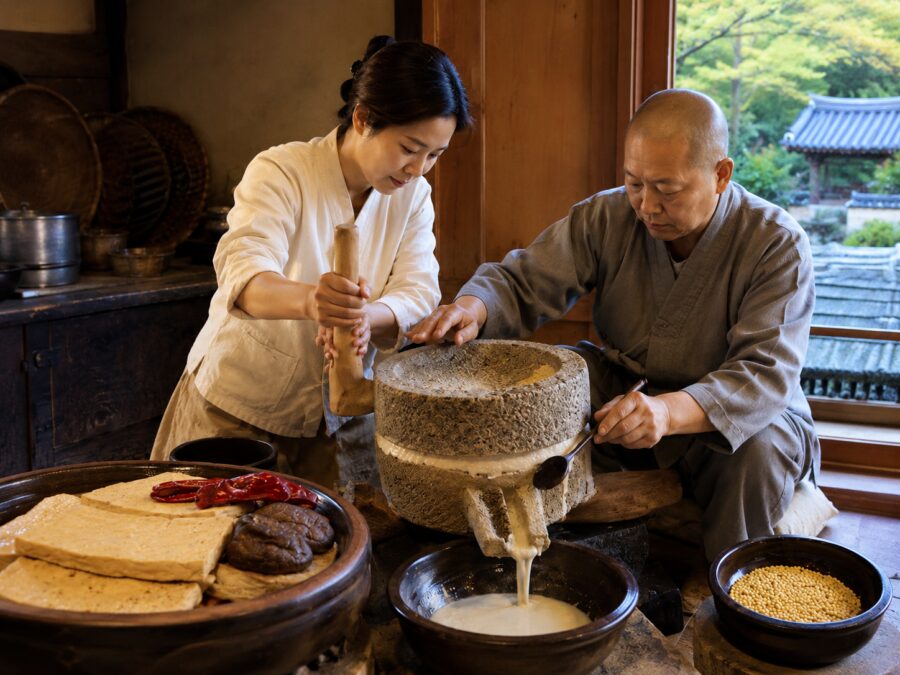
The exact time when tofu was introduced to our land is unknown. However, it first appears in historical records during the late Goryeo Dynasty, according to the Neo-Confucian scholar Yi Saek. MogeunjipIt is a poem published in [it].
Yi Saek praised tofu, noting that eating it instead of the tired vegetable porridge brought a fresh taste, and that it was a nourishing food suitable even for elderly people with weak teeth. It appears that tofu was already cherished as a precious food during the late Goryeo Dynasty.
It is presumed that tofu was introduced through the Song and Yuan dynasties, but Buddhism played a significant role in the particularly deepening of tofu culture on the Korean Peninsula. For monks who abstained from meat, tofu was an excellent source of protein.
With the advent of the Joseon Dynasty, tofu-making skills matured even further. The Annals of King Sejong even contain a record stating that the Emperor of the Ming Dynasty highly praised the tofu-making skills of the women sent from Joseon and requested that more such people be sent.
There was even a separate temple dedicated exclusively to making tofu for royal ancestral rites. This temple, located near the tomb, 造泡寺, It was called Joposa, and since 'Jopo' means making tofu, you can imagine how close to tofu and temples were.
There are also records stating that around the time of the Imjin War, a Joseon tofu craftsman crossed over to Japan and sowed the seeds for the development of tofu there. In a sense, the same soybean food traveled between countries, each following its own distinct path.
From soybeans to tofu, the process of making tofu
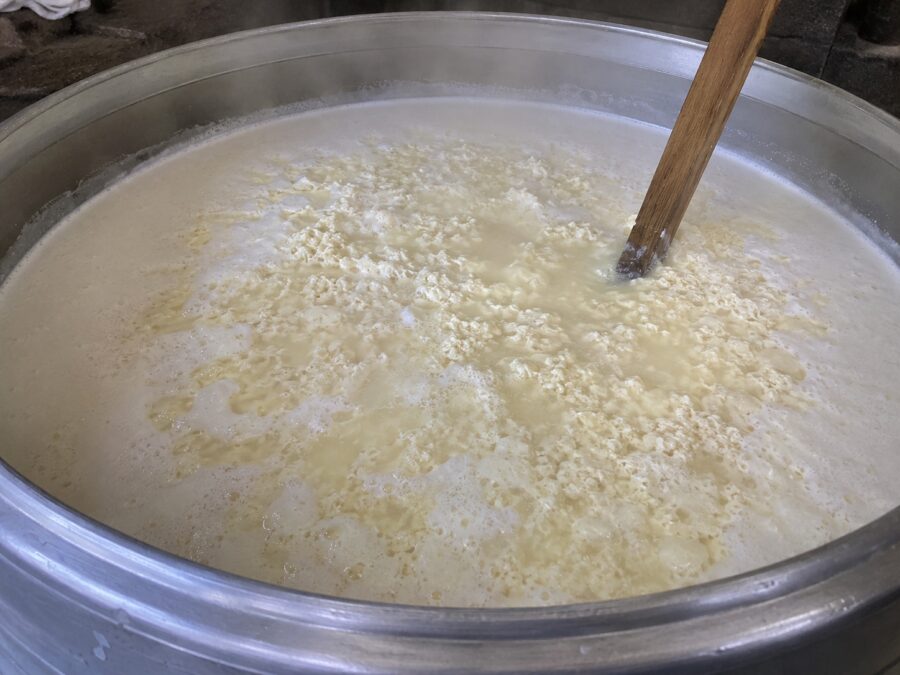
Making tofu is surprisingly simple. Soybeans soaked overnight are ground to make soybean milk, the pulp is strained out, and then the mixture is boiled. Up to this point, it is soy milk, or soybean liquid.
The key lies in what comes next. After cooling the hot soy milk to around 78 degrees, a coagulant is added, causing the scattered soy proteins to join hands and curdle into small lumps. These curdled masses are the core of tofu.
The types of tofu ultimately diverge into two variables. Which coagulantIt depends on whether you use it and how hard you press it.
Commonly used coagulants are brine (bitter water from which salt has been removed), calcium sulfate, and glucono-delta-lactone. Since brine coagulates quickly and tends to preserve the flavor of the soybeans, the taste and texture of the same soybean milk can vary subtly depending on the coagulant used.
The degree of pressing is more intuitive. If you press almost nothing, it becomes soft soft tofu; if you press lightly, it becomes tender stew or silken tofu; and if you press hard for a long time, it becomes firm tofu that can be cut with a knife. The harder you press, the more moisture is removed, and the more moisture is removed, the denser the protein becomes.
When enzymes come into contact with air while grinding soybeans, a so-called "bean odor" similar to the smell of grass or paper is produced. The trick to reducing this is to soak the soybeans thoroughly and then boil them quickly to neutralize the odor before the enzymes can work. This is the reason why commercially available tofu is clean and free of this fishy smell.
So, is it possible to make tofu at home? As long as you have soybeans and a coagulant, it is not as difficult as you might think. I will cover how to make it yourself, including quantities and the process, in detail in a separate post.
Types of Tofu – Korean Tofu, Chinese Tofu, and Japanese Tofu

Although tofu is a food enjoyed by the three East Asian countries, its characteristics differ significantly from country to country. Starting from the same point, divergence in food culture, coagulation methods, and water flavors has created distinct tofu landscapes.
Korean tofu is described as a 'spectrum of softness.' It is categorized by the degree of firmness, ranging from soft tofu to firm firm tofu, and regional tofu varieties such as Gangneung Chodang soft tofu and Jeju Doombi also occupy a place.
The diversity and fermentation of Chinese tofu are truly impressive. From dried, firm tofu and thinly sliced tofu skin to fermented tofu infused with flavor, the world that can unfold from a single ingredient like tofu is the widest.
Japanese tofu is distinguished by its precise texture and its individuality in fried and dried tofu. There is a clear distinction between soft Kinu (silk) tofu and firm Momen (cotton) tofu, and the culture of fried tofu and frozen tofu has also developed.
The types of tofu in each country alone are enough to tell a wealth of stories, so let's take a closer look by dividing them into Korean, Chinese, and Japanese sections.
How to Store Tofu Properly — Expiration Date and Freezing

Tofu is a perishable food, so proper storage is important. The shelf life of supermarket tofu is usually short, typically around 2 to 3 weeks from the date of manufacture.
It is often confusing, The expiration date is the 'selling date'‘The actual best before date is a little longer than that. However, once opened, it is safer to consume it as soon as possible.
If you want to keep leftover tofu for longer, pour enough water into an airtight container to submerge it and refrigerate. The key is to change the water every 2 to 3 days. Note that the cloudy water inside the packaging is for protecting the tofu, so it is fine to leave it as is.
If you want to keep it longer freezingThis is the answer. However, freezing tofu causes changes beyond simply making it last longer.
As ice crystals create spaces between the protein webs, those spots become porous like a sponge after melting. As moisture evaporates, the protein becomes denser, and the texture becomes chewy and meat-like.
Tofu that has been frozen and thawed in this way absorbs seasoning well, making it particularly suitable for braised or stir-fried dishes. The fact that its volume decreases and its protein density increases significantly is an added bonus.
Spoiled tofu emits a sour smell, turns yellowish or pinkish, and becomes slippery on the surface. It is best to discard such tofu without hesitation.


