
index
1. Ambrette Seed — Plant-based musk
2. Method of extracting ambrette seeds
3. Differences by Production Region — India, Ecuador, Madagascar
4. Aroma Profile of Ambrette Seed
4-1. Flavorings Suitable for Blending
5. Recommended perfumes representing Ambrette Seed
6. Components that make up the scent of ambrette seeds
Ambrette Seed — Plant-made musk
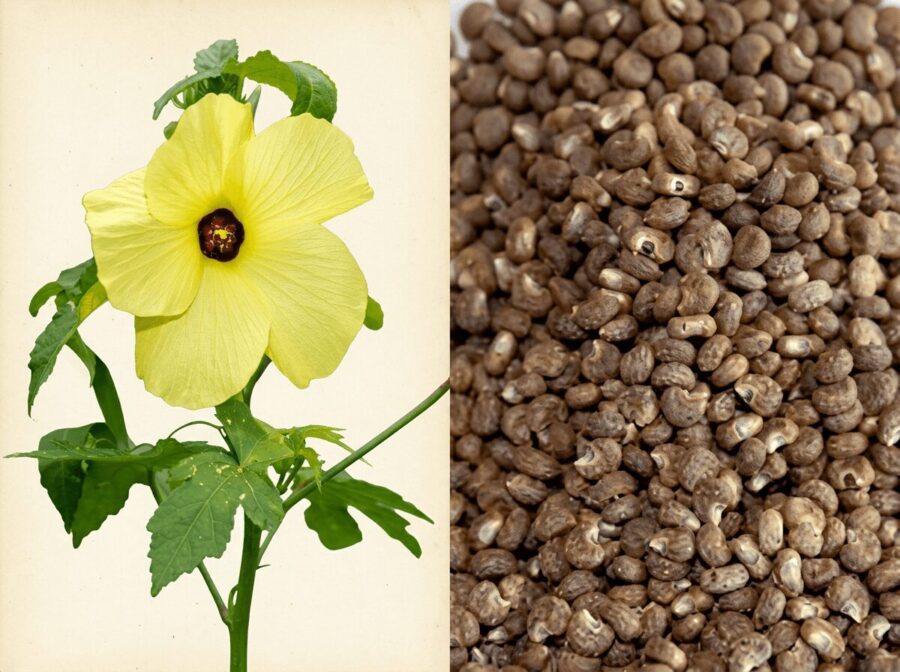
In the world of perfumery, animal musk derived from the secretions of musk deer has been the foundation of fragrances for centuries, but perfumers had to find a new path in the face of ethical issues and the threat of extinction.
One of the answers is precisely Ambrette SeedIt is (Ambrette Seed).
Ambretteis Malvaceae (錦葵科, Plants belonging to the Malvaceae Abelmoschus moschatus Medik.It is a flavoring extracted from the seeds.
The etymology of this scientific name is derived from the genus name 'Abelmoschus,' which comes from the Arabic 'Kabbel-Misk,' meaning 'musk seed,' and the species name 'moschatus,' which is Latin for 'musk-like.'.
It belongs to the same family as the hibiscus and okra that we are familiar with. It is essentially a cousin of the showy hibiscus flowers commonly seen in tropical gardens.
Although flowers with yellow petals and a deep purple center bloom, what the perfume industry focuses on is not the flower, but the seeds inside the fruit.
Ambrette seeds “"Vegetable equivalent of musk"”It is also called [this].
The fruit of the plant can be harvested about six months after planting, and when dried, it bursts open to reveal a large seed inside. When this seed is pressed, the musk oil contained within is extracted.
In 1705, German naturalist Maria Sibylla Merian recorded in her exploration of Suriname, South America, that indigenous women used these seeds strung on a thread as arm ornaments.
It was thanks to the subtle musky scent emanating from the seeds themselves. Arab merchants used these seeds to add fragrance to coffee, while in India and Malaysia, they were used to scent hair.
The annual global production of ambrette seed oil is less than 1,000 kg. With a price of over $5,000 (approximately 7 million won) per kilogram, it is among the most expensive raw materials for perfumery.
Ambrette Seed Extraction Method
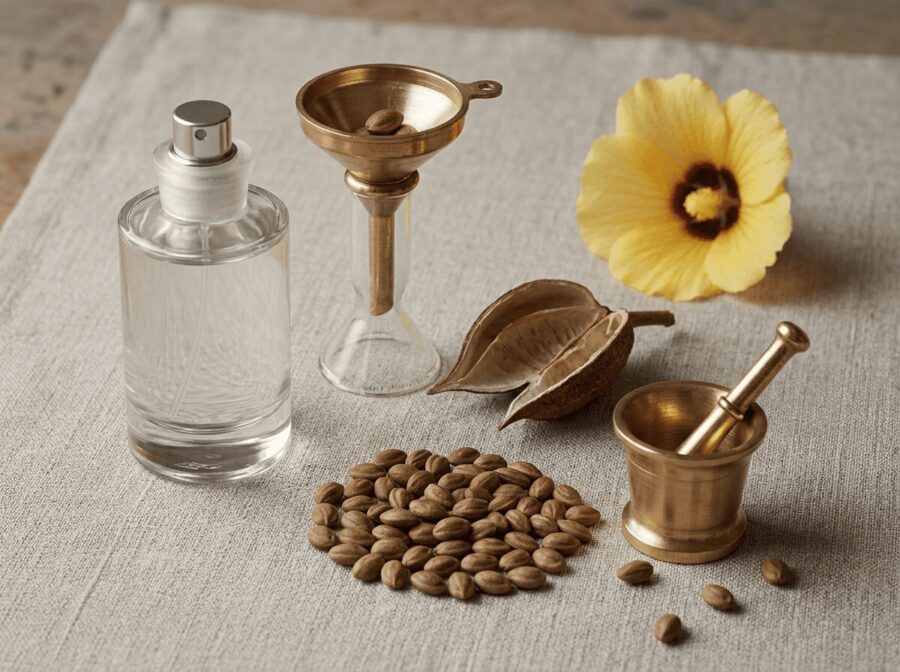
The extraction of ambrette seed oil involves grinding the dried seeds, and then Steam distillationObtaining oil through steam distillation is the basic method, but it does not end there.
Since seeds contain large amounts of long-chain fatty acids, including palmitic acid, the crude oil becomes a semi-solid state that hardens like wax immediately after distillation.
In the perfume industry, this is called 'Ambrette Beurre'. It is difficult to use directly in perfume manufacturing in this state.
When odorless fatty acids are removed by alkaline treatment, a transparent golden color finally appears. Ambrette seed oilThis is completed.
The final product obtained through this process is 'Ambrette Absolute'. Mandy Aftel described this oil as ‘a powerful and long-lasting oil whose scent improves over time.’.
Recently Supercritical CO₂ extraction methodIt is also utilized. Because it proceeds at a lower temperature than general distillation, there is less denaturation of components due to heat, and it is possible to obtain oils that are closer to the plant's natural scent.
However, due to high equipment costs, traditional steam distillation still remains the mainstream in small-scale production areas.
The extraction yield is extremely low, so the amount of essential oil obtainable from 100g of seeds is only 0.2 to 0.61 TP3T, and even this is lost in significant amounts during the fatty acid removal process.
Since the harvest itself relies on manual labor, high prices are an unavoidable reality.
Differences by production region — India, Ecuador, Madagascar
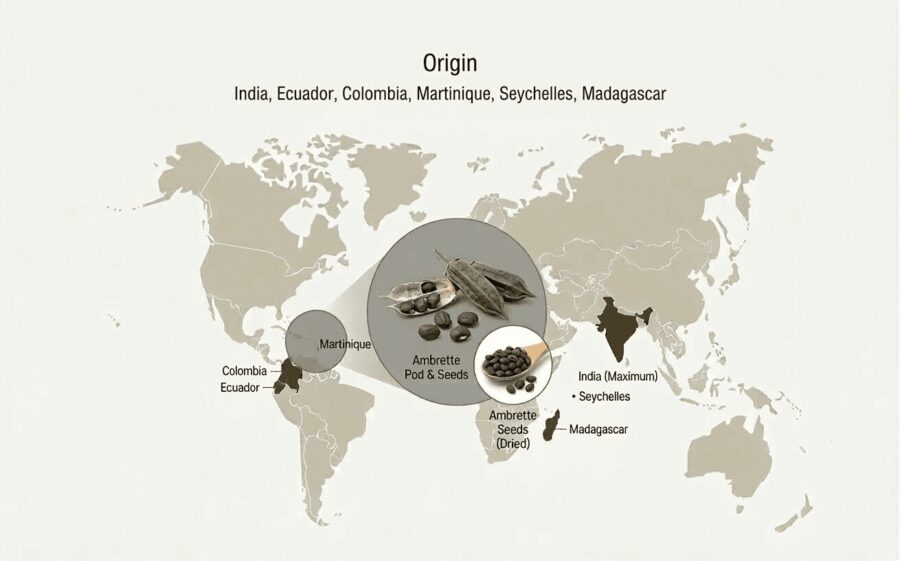
AmbretteIts place of origin is eastern India and Southeast Asia.
The major commercially grown regions currently include India (Deccan and Carnatic regions), Ecuador, Colombia, Madagascar (Nossie Be Island), Seychelles, and Martinique (Caribbean).
Ambrette seeds are not a fragrance ingredient whose scent profile varies dramatically depending on the region, unlike roses or jasmine.
Regardless of where it is grown, the GC-MS analysis results show that the core framework of farnesyl acetate (51–58%) and ambretolide (12–15%) is identical.
Differences by region appear as subtle fluctuations in this ratio and nuances of trace components created by soil and climate.
IndiaIt is the largest producer and has the longest history of cultivation. Research shows that high-quality oil can be produced even in the subtropical northern region, and it is the most stable source of supply in terms of production volume.
However, due to significant variations in processing infrastructure, oil quality can fluctuate depending on the supplier.
EcuadorIt is considered a major producing country along with India. The northern region of Guayaquil is the main production area, but the cultivation process is not easy.
To protect the crops from parakeets, which are particularly fond of ambrette seeds, workers carrying blanks must guard the fields during the harvest season from late May to late August.
In addition, a unique practice has been passed down in which harvested seeds are stored at an altitude of about 3,000 meters to prevent damage from pests.
MartiniqueThe mountain is a region that is uniquely mentioned separately in the literature. It is presumed that the warm maritime climate characteristic of the Caribbean has an influence, to the extent that it is recorded as “a particularly fragrant variety,” and although produced in small quantities, it is highly regarded in the luxury perfume industry.
Madagascar와 SeychellesIt is known that oil with a rich body is produced under the influence of the island climate. The two islands and South America (Colombia, Ecuador) are recorded as the major commercial growing regions for ambrette.
| mountainous district | production scale | significant |
|---|---|---|
| India | Largest producing country | Longest cultivation history and stable supply, but quality variations exist |
| Ecuador / Colombia | Major producing countries | Manpower deployment to prevent parakeet damage, high-altitude seed storage practices |
| Martinique | handful | Noted separately in the literature as a “variety with a particularly good aroma.” |
| Madagascar (Noji Be) | handful | Rich body influenced by the island climate |
| Seychelles | thimbleful | Small-scale production dedicated to luxury perfumes |
Ultimately, when it comes to ambrette seeds, the selection of the source is less about “choosing raw materials with completely different scents” and more about “listening to the subtle differences in the resonance of the same instrument.”.
As it is a rare raw material with an annual global production of less than 1,000 kg, securing a stable supply of oil of the desired quality is itself the biggest challenge for perfumers.
Scent profile of Ambrette Seed
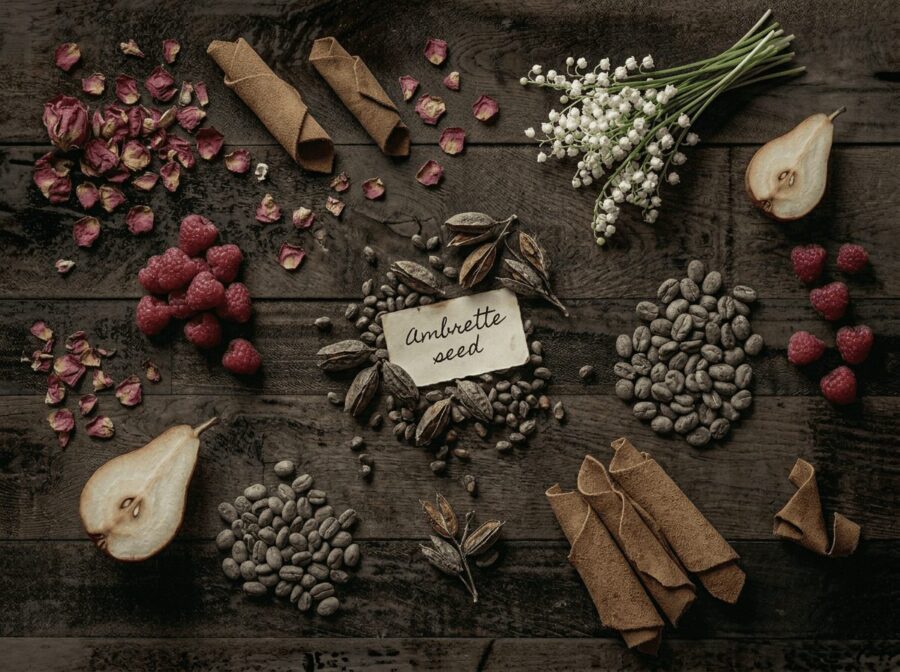
The scent of Ambrette Seed is difficult to define in a single word. It is musk, yet simultaneously floral, fruity, and sometimes becomes warm leather.
good quality Ambrette SeedIt has soft, rich, sweet, floral, and musky body notes. It is like brandy or overripe fruit.
At the same time, its persistence is astonishing, and a very small amount is sufficient; it requires the use of imagination and careful mixing.
The scent of this oil unfolds in the following layers.
At first, a slight fatty sensation emerges along with nuances of nuts and seeds. Soon, it becomes warm and enveloping. MuskIt is converted into, but the texture is different from the clean, laundry-like feel of synthetic musk.
It is much closer to animal musk, resembling the scent of body heat lingering on the skin. In the middle section, it evokes pear and raspberry. fruity scentIt rises gently.
This creates a unique transparency by overlapping with floral nuances like lily of the valley (muguet) from the Farnesol component.
As the fragrance progresses, soft animalic notes reminiscent of suede leather and tobacco leaves emerge, and this is precisely why Ambrette is called 'vegetable musk'.
In perfume Ambrette Seedis mainly Bass notesIt is used as.
Ambrettolide is one of the three natural key components of musk (muscone, sivetone, and ambrettolide), and thanks to its high boiling point, it exhibits excellent fixation that slows down the evaporation of other fragrance components.
It acts like an 'anchor' that keeps other notes on the skin longer.
Flavorings suitable for blending
This fragrance blends well with virtually all fragrance notes (Olfactory Family). The fragrances that pair particularly well with it are as follows:.
| Fragrance | Blending effect |
|---|---|
| Rose / Neroli / Orange Blossom | Adds depth and longevity to floral notes, and natural warmth. |
| Sandalwood / Patchouli | Creamy and sensual drydown formation with a woody base |
| Clary Sage / Lavender | Adding musky softness and sophistication to the herbal-aromatic family |
| Labdanum / Frankincense | Adding natural animalic depth to oriental-amber tones |
| Fruit Notes (Pear, Bergamot) | Emphasizes the unique fruit nuances of Ambrette Seed, forming a transparent musk. |
Basically, even a very small amount of ambrette seed — at a level of 0.021 TP3T of the total weight of the perfume — can remove the sharp smell of alcohol and add a soft radiance to the entire blend.
Due to these characteristics, it is also used as an alternative to Ambergris.
Recommended perfumes representing Ambrette Seed
I recommend three perfumes that allow you to experience the charm of Ambrette Seed across various genders and styles.
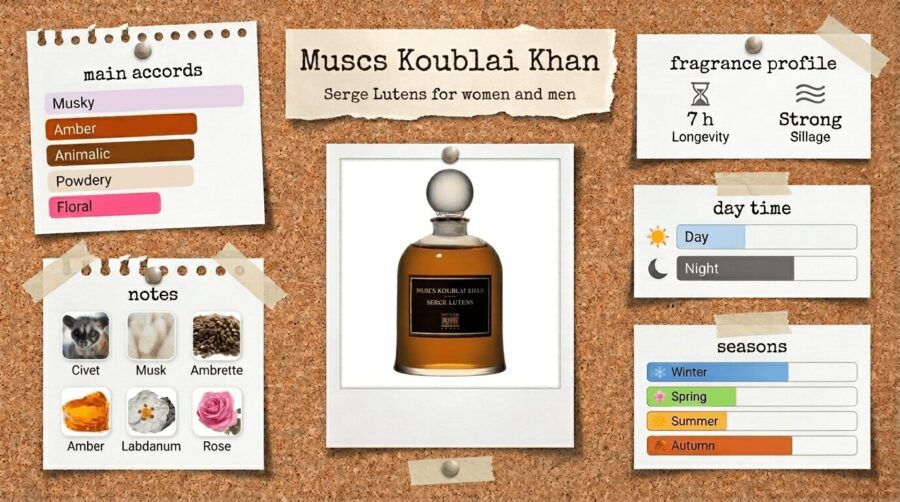 Serge Lutens “Muscs Koublaï Khän” (Muscs Koublaï Khän, 2000) — This is the work that most starkly displays the 'raw sensuality' of Ambrette Seed, created by the legendary perfumer Christopher Sheldrake.
The name is derived from Kublai Khan, the grandson of Genghis Khan, and embodies the image of the body heat and musk emanating from the skin of a mounted warrior who has traveled a long distance.
It is a work that embodies the essence of niche perfume, revealing Ambrette Seed's animalistic side without reservation while ultimately reaching a sensual beauty.
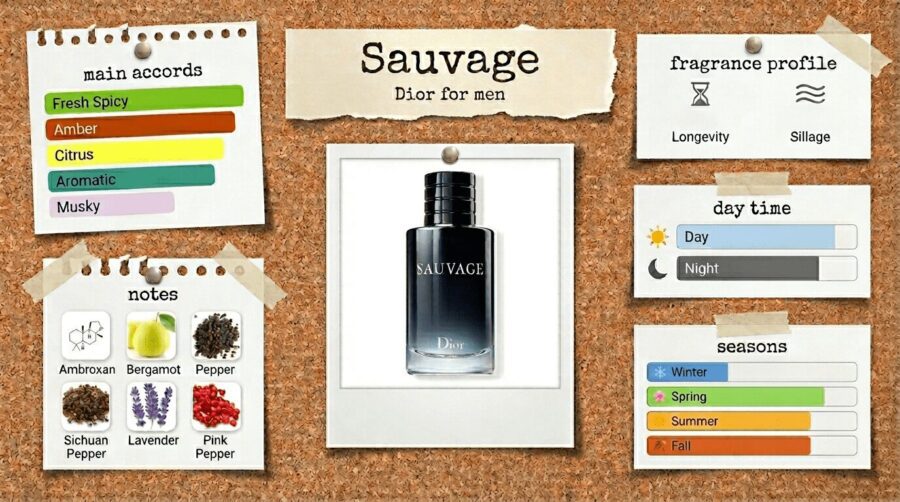 Dior “Sauvage” (2015) — Created by François Demachy, this fragrance is one of the best-selling men's perfumes worldwide since its launch.
The ambrette seed hidden in the middle notes of Sauvage forms a soft, natural musk veil together with the ambroseed behind the explosive opening of pepper and bergamot, which is the essence of Sauvage's signature 'clean yet masculine' lingering scent.
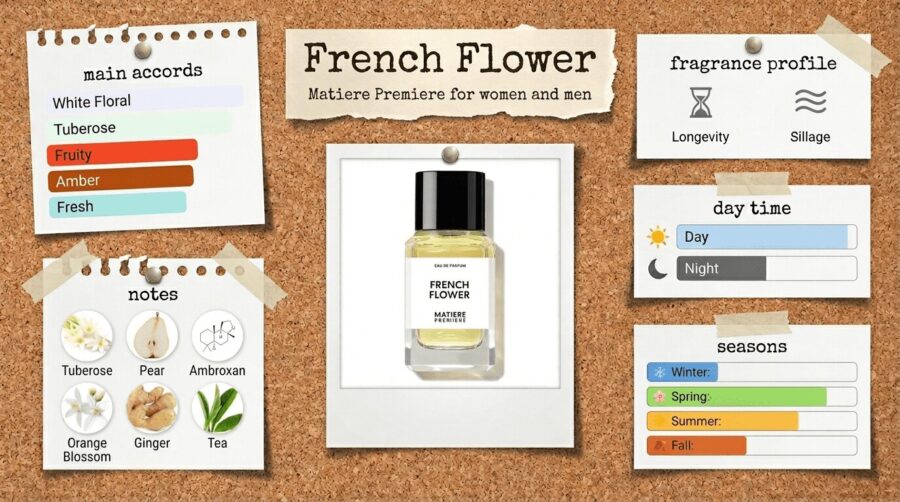 Matière Première “French Flower” (French Flower, 2019) — Matière Première, situated on the boundary between clean beauty and niche perfumes, is a brand that puts the finest natural ingredients at the forefront.
In this fragrance, Ambrette Seed is the protagonist itself, a work that offers the most modern interpretation of elegant and delicate aspects.
Blending with neroli and tuberose, a transparent floral scent and musk unfold on the skin like water droplets on silk.
The components that make up the scent of ambrette seeds

The CAS number of ambrette seed essential oil is 8015-62-1am.
GC-MS analysis revealed that approximately 35 types of compounds were identified in this oil.
Ambrette Seed Main Ingredients
The two most important components in the composition of ambrette seed oil are as follows.
Farnesyl acetate ((2E,6E)-Farnesyl acetate) — It is the most abundant ingredient, accounting for about 51 to 581 TP3T of the total.
It belongs to the sesquiterpene ester family, possessing a faint floral and grassy scent on its own, and provides the oil's overall body and floral nuances.
When broken down, it becomes Farnesol, which is also the key component of the lily of the valley.
Ambretolide ((Z)-7-Hexadecen-16-olide) — It accounts for about 12–151 TP3T of the total, but this is precisely the ambrette seed's Signature ingredientam.
The CAS number is 7779-50-2It is a macrocyclic lactone with a 16-membered ring structure.
Ambrettolide is classified as one of the three key natural musk ingredients, along with Muscone and Civetone.
The large ring structure of this molecule creates a distinctive sweet and soft musk scent, while its high molecular weight allows for slow evaporation, resulting in excellent fixative power.
Kerschbaum first determined the structure of this substance in 1927, and subsequently, the synthetic version iso-ambrettolide (CAS). 28645-51-4) has been developed and is widely used in the modern perfume industry.
Ambretolide is a very rare component in the plant kingdom. Aside from the seeds, it is found in the floral scent of some tropical orchids and European goldenrod (Trollius europaeusIt is found in only minute quantities in the essential oils of ). Other major ingredients include the following.
| ingredient | Content | Fragrance characteristics |
|---|---|---|
| (2E,6E)-Farnesyl acetate | 51~58% | Floral, herbal, oil body formation |
| Ambrettolide (Z)-7-hexadecen-16-olide | 12~15% | Signature Musk Note, the Key to Fixation |
| (2Z,6E)-Farnesyl acetate | ~3.5% | Floral nuance auxiliary |
| Decyl acetate | ~4.8% | Fruity scent (pear, citrus nuances) |
| (2E,6Z)-Farnesol | ~2.0% | lily of the valley (muguet) type floral |
| Dodecyl acetate | ~2.4% | Waxy, with a slight fruity scent |
| (Z)-Oxacyclopentadec-6-en-2-one | ~2.4% | Ambrettolide homolog, Bozo Musk |
IFRA Regulations and Safety
Ambrette seed oil itself is classified as a relatively safe natural fragrance, but there are regulations on its usage.
According to the IFRA (International Fragrance Association) 51st Amendment standards, ambrette seed oil is Category 4 (Perfume and alcohol-based products)Maximum based on finished product 1.1%Usage is permitted up to.
This regulation is mainly due to potentially allergenic ingredients such as farnesol contained in the oil.
Farnesol is under the EU Cosmetic Regulation (EC 1223/2009). 26 types of fragrance allergens It is included in the list, and separate notation is required on the product label when using.
However, the risk of skin sensitization from ambrette seed oil itself is assessed to be low.
Meanwhile, synthetic ambretolide (CAS 28645-51-4) has no specific usage restrictions under the 51st revision of IFRA, and is not classified as a hazardous substance by the European Chemicals Agency (ECHA).
It is also attracting attention as an eco-friendly fragrance ingredient due to its high biodegradability and low risk of bioaccumulation. If you are using ambrette seed oil directly, it is recommended that you dilute it and perform a skin test first.
It is especially advisable for pregnant women or those with sensitive skin to consult a professional before use.


