
Kyoto RamenIt is a collective term for the ramen eaten primarily in Kyoto City and the flow of ramen shops that originated in Kyoto. Unlike Sapporo's miso or Hakata's tonkotsu, there is no single fixed style.
| item | detail |
|---|---|
| region | Kyoto City, Kyoto Prefecture. The center is the Takabashi area east of Kyoto Station and the Kitashirakawa and Ichijoji areas of Sakyo Ward. |
| Background of establishment | It is believed to have originated at a food stall in front of Kyoto Station in 1938. It established itself as a cheap meal in a city with many students. |
| Local location | Contrary to the image of Kyoto cuisine's light flavors, rich broth is the mainstream, and light-flavored ramen is a minority. |
| Representative Type | Koikuchi soy sauce type, Seabura soy sauce type, Toripaitan type (chicken broth type) |
Takabashi's Koikuchi Shoyu style features chashu and green onions covering a broth with a distinct soy sauce aroma. The saltiness does not overpower the color of the broth, and the sweetness derived from the bone stock lingers afterwards.
The Seabura Shoyu style features white back fat granules floating in the soy sauce broth, mixing a savory sweetness with every sip. The Tori Paitan style has a thick, potage-like broth that clings thickly to the noodles.
Regardless of the style, there are many restaurants that generously top their dishes with Kujo Negi. Kujo Negi is a traditional Kyoto leaf green onion that is eaten even with its green leaves; the leaves are soft, and thanks to the smooth sap inside, it has a rich sweetness and aroma.
The representative lineages of Kyoto ramen are divided into three schools: the Koikuchi shoyu style (rich soy sauce style), Seabura shoyu style (light fat soy sauce style), and Tori Kotteri Paitan style (chicken white broth style) from Takabashi, and since the 2010s, Chintan style (clear broth style) shops have been creating a new trend.
The birthplace of Kyoto ramen, Takabashi food stalls
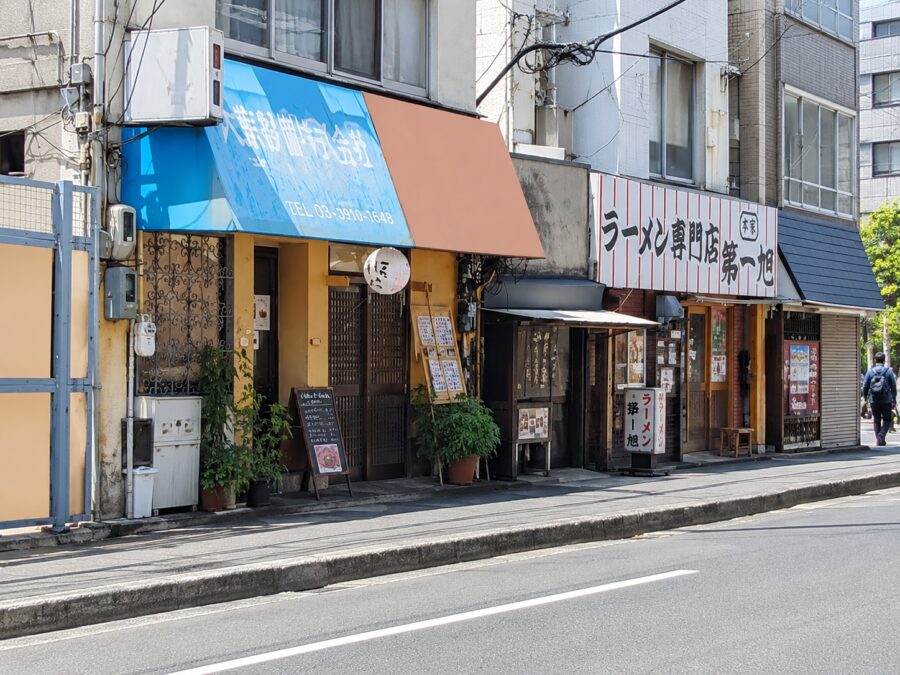
The place considered to be the starting point of Kyoto ramen is east of Kyoto Station. Shinpukusaikan(新福菜館It is Xu Yongti from Zhejiang Province.Seo-yeong 俤He came to Japan in 1924 and worked as a peddler selling glasses and fabrics, and around 1938, he set up a food stall in front of Kyoto Station with his wife.
In a 1993 interview with the Kyoto Shimbun, the shop owner at the time stated that his predecessor had already been running a food stall at the current location around the time the war ended.
The black broth that symbolizes this restaurant is not how it was when it was first founded. It is said that until around 1971, niboshi (dried anchovies) were used in the broth, and the color was lighter than it is now. When the founder's son-in-law took over the business, he removed the niboshi and increased the proportion of chicken and pork, and this taste became the current standard.
Right next to it Honke Daiichi Asahi(Chapter 1 of the main family) are adjacent. There is also a story that the founder of Daiichi Asahi leased land to Xu Yongti. The area where the two stores are located is the JR Takakura Overpass (High-speed railway bridgeIt is called Takabashi, after the common name of ).
Types of Kyoto Ramen, 3 Major Lineages
The criteria for classifying Kyoto ramen vary slightly depending on the medium, but the Koikuchi shoyu style (濃口醤油系, rich soy sauce type), sea-abura soy sauce type (背脂醤油系, backfat soy sauce type), Doripaitan type (鶏白湯系, The three classifications of chicken white broth are the most widely used.
Koikuchi soy sauce type (rich soy sauce type)
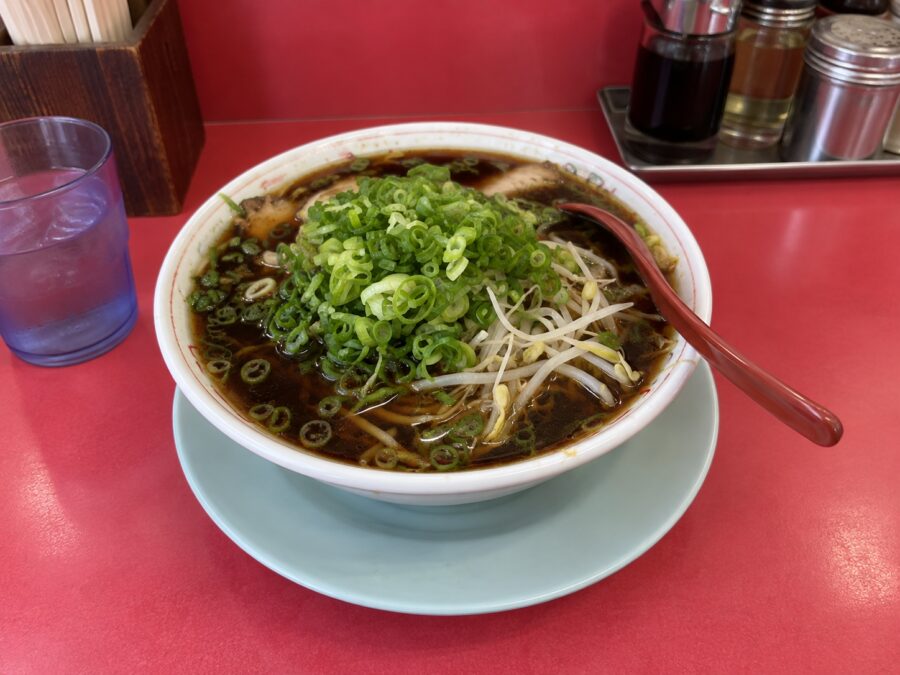
It is the oldest lineage in Kyoto. Shinpukusaikan and Honke Daiichi Asahi are grouped together as the representative establishments, but if you look at a bowl of each, the broth from the two shops differs starting from the color.
Shinfukusaikan uses a broth made primarily of chicken bones with added pork umami, and Kyoto's Koko soy sauce (Five light oilAging received from ) soy sauceWrite it as a tare.
As soy sauce is heated, its color deepens and its aroma, resembling caramel and cocoa, becomes richer. The broth at this shop, which uses plenty of dark soy sauce, is as black as ink, and a savory soy sauce aroma stands out.
Some people say that this shop created a trend in Kyoto ramen where, although it looks salty just by looking at the color, it is rich in appearance but refreshing when eaten.
Honke Daiichi Asahi features a clear, amber-colored broth. The official website explains that it is made by boiling only domestic pork bones, extracting the flavor just before the broth turns cloudy, allowing only the umami to fully develop. This is paired with fresh soy sauce brewed at a long-established shop in Fushimi, Kyoto.
Bone broth remains clear if simmered gently over low heat, but becomes cloudy as fat and protein particles mix into the broth if boiled vigorously. Clear even while using pork bones clear brothThis is coming out thanks to the fire control.
There are also differing descriptions regarding the ingredients for the broth. The Japanese Wikipedia and Kyoto regional information sites state that onions are added to this broth, but the restaurant officially stated that it is made of pork bones.
Toyama Black from Toyama Prefecture is more widely known as black soy sauce ramen. Originating from the practice of adding a thick layer of soy sauce to replenish the salt of workers engaged in post-war reconstruction, Toyama Black is characterized by its salty broth, generously seasoned with pepper and eaten with rice.
Unlike Toyama Black, which emphasizes a salty taste, Kyoto's Koikuchi shoyu is said to be milder than it looks.
Seabura soy sauce type (back fat soy sauce type)
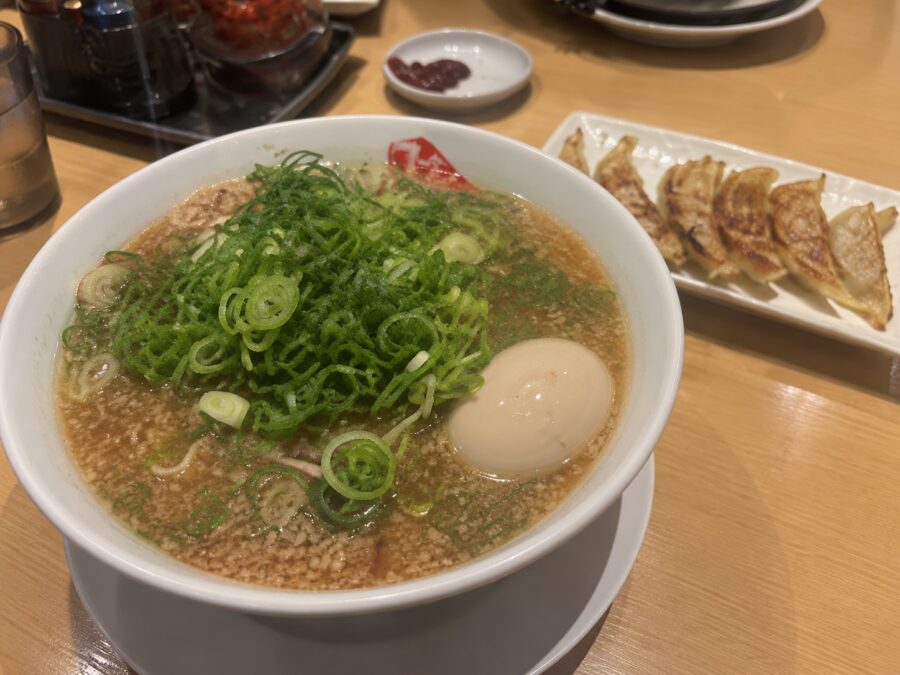
It is a style featuring pork back fat sprinkled over a chicken bone-based soy sauce broth. The starting point is Ginkaku-ji (Silver Gate Temple) nearby Kitashirakawa MastaniIt opened in 1948. An Asahi Shimbun article introduces this shop as the origin of regional ramen.
backThis fat is located just beneath the skin, so it is softer than fat deep inside the body and melts and spreads quickly when it comes into contact with hot broth. This type of fat, called se-abura soy sauce, is also commonly followed by chains that serve Kyoto ramen.
Ramen with smothered fat sprinkled over it is commonly referred to as Seabura Chacha-kei in Japan, and Kyoto's Seabura Shoyu-kei is also sometimes classified by this name. The term "Chacha" comes from the action of shaking and sprinkling smothered fat strained through a sieve over the bowl.
Even though they belong to the same tea-tea tradition, the broth base of Tokyo is pork bone. Hofken in Sendagaya, known as the originator of the Tokyo Seabura tea-tea tradition, perfected a pork bone soy sauce broth with back fat around 1962, which contrasts with the Kyoto tradition that uses chicken bone soy sauce broth.
The local ramen of Tsubame City, Niigata Prefecture, is referred to separately as Tsubame Sanjo-kei or Tsubame Se-abura Ramen, named after the region, rather than Chacha-kei. Koshu Hanten, considered the originator (杭州飯店The ) series uses extra-thick noodles in a rich soy sauce broth made with niboshi stock, topped with chopped onions.
Tori Kotteri Paitan-style (Chicken white broth style)
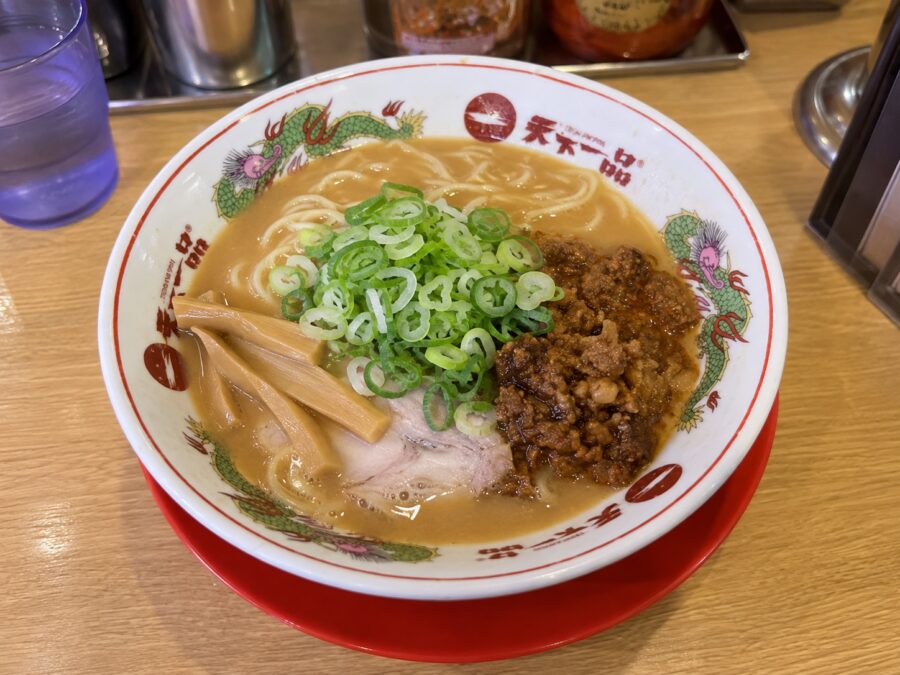
It is characterized by a thick broth made by simmering chicken bones and other ingredients for a long time until it turns milky white. The most famous shop started as a food stall in Kitashirakawa in 1971. Denkaitpin(One place under heaven)am.
After about four years of trial and error, founder Tsutomu Kimura perfected the Kotteri broth made from chicken bones and various vegetables, and opened the first store in August 1975. It is said that the recipe is known to only a few people within the company.
When the collagen in bones and skin is boiled for a long time, it breaks down into gelatin, giving the broth its structure, and if boiled continuously over high heat, the fat breaks down into small pieces and mixes into the broth. This is why the white broth is cloudy and thick like milk. With the addition of the texture created by melted vegetables in Denkaippin, it is said that the broth is so thick that it makes chopsticks stand upright.
Opinions are divided on whether Tenkai Ippin should be considered the sole originator of this lineage. It started as a food stall called Banraiken in Shugakuin in the same year, 1971, and changed its name when it moved to Ichijoji. Tentenyu(天天有This is because ) also made a milky broth with chicken.
In the 2000s, as the practice of calling broth made by boiling chicken bones until it turns milky white "Toripaitan" became widespread, the ramen from the two shops also began to be classified into this category.
Toripaitan-kei is not a name used only in Kyoto, but is a general term for chicken broth-based dishes that are commonly used nationwide.
Paitan (白湯The word comes from Chinese cuisine, and the same name, Toripaitan, is also used for chicken white broth ramen that has spread nationwide since around 2005.
Most of the Toripaitan specialty restaurants in Tokyo stated that they were inspired by Hakata Mizutaki hot pot. Toripaitan ramen, which has led a nationwide trend, emphasizes that it has less gamey odor and a lighter aftertaste than pork bone broth.
Also, the Awa-kei made by grinding the broth and foaming it (泡系There are also shops referred to as such (most notably Ore no Ramen). It differs in orientation from Kyoto's Kotteri, which emphasizes a rich broth.
Kyoto's Torikotteri Paitan is thick, so this type is also called the Dorodoro type, and Dorodoro is a Japanese onomatopoeia describing a thick texture.
The term "Doro-doro" is based on consistency rather than the ingredients of the broth, so even if they are called Doro-doro, the ingredients vary; therefore, the Toripaitan style and Doro-doro style cannot be equated. After all, there is also the pork bone Doro-doro style, which produces a thick broth using only pork bones and water.
Gyofu Ramen and Trends Since the 2010s
Gyofu Ramen (Kyoto-style ramen)
Gyofu ramen with a light soy sauce flavor in Japanese-style brothkyung styleRamen (Kyoto-style ramen) is a concept-based ramen that originated at Akasata Na, which opened in the Hankyu Department Store in Shijo Kawaramachi, Kyoto in 1976.
It was a system where light ramen and sweet desserts were sold as a set in a restaurant decorated to evoke Kaiseki cuisine. It started as a franchise in 1979, became hugely popular after opening a branch in the Nomura Building in Shinjuku, Tokyo, and served as a catalyst for attracting female customers to the ramen market.
Even major restaurant corporations opened Gyofu Ramen chains, but they all closed down. The last remaining store in Akasatana, Gifu, also ceased operations in July 2024.
Locally in Kyoto, this is generally not considered Kyoto ramen. The Kyoto lifestyle guide *Kyoto Rule* assesses that it merely imitated the Kyoto-esque image, while a ramen critic cites the failure to assert a distinct definition or individuality in ingredients and preparation methods as the reason for its decline.
Chintan-gye (clear broth type)
In the 『Michelin Guide Kyoto & Osaka 2016』, ramen shops in Kyoto were named to the Bib Gourmand for the first time, and many of the selected establishments were newly opened Chintan-style (清湯系It was a ) store. The representative one Menya Inoichi(麺屋猪一) opened in Shijo Teramachi in 2013.
Inoichi's signature dish, Dashi Soba, features a seafood broth made with a mixture of various fish flakes, seasoned with either white or black soy sauce. By actively incorporating ingredients used in Kyoto cuisine, such as accompanying yuzu and tororo konbu, the restaurant has been named to the Bib Gourmand for nine consecutive years, starting from the 2016 edition.
Clear broth ramen is Danrei style nationwide.unclean foodIt is more often grouped under the name ). The Ramen Museum concludes that while there are various definitions of Danrei-kei, the widely accepted interpretation is that it is a clear chintan broth that carefully extracts the umami of the ingredients.
In Kanagawa, a style standing opposite to Iekei was given the separate name Kanagawa Danrei-kei. Kyoto's Chintan-kei also belongs to the same clear broth trend, but it is sometimes introduced as Neo-Kyoto Ramen because it incorporates Kyoto cuisine ingredients and a restaurant-like atmosphere.
Kyoto's Ramen Battleground – Ichijoji Ramen Road (Ramen Street)
Ichijoji, extending north from Takano Intersection in Sakyo Ward (一乗寺This area is Kyoto's representative ramen district known as Ramen Kaido. Among the three major Kyoto ramen schools, the main branch of Dentenyu is located here, and the main branch of Tenkai Ippin and the main branch of Kairikiya are also nearby.
Although there are over 20 shops gathered here, not all of them are of the Kyoto style. Alongside Takayasu, known for its milky broth made by simmering pork and chicken bones for over 20 hours, and Menya Gokkei, known for its super-rich Toripaitan, there are styles from other regions mixed in, such as the Jiro and Iekei styles.
It is commonly explained that this street grew due to the large number of university students boarding nearby. Rather than a place that follows the lineage of Kyoto ramen, it is a neighborhood where you can compare various styles in one place.


