
When sitting at a silbijip in an alley in Daegu, you cannot leave out a plate of large chunks of raw meat. The moment you chew, you feel a slight elasticity before it softens and melts away, filling your mouth with the nutty aroma of sesame oil and the pungent scent of garlic.
In other pubs in Jeolla or Gyeongsang provinces, thinly sliced raw meat arranged neatly like sashimi might be served. Both dishes raw beefThey are similar in that respect, but the texture is somewhat different.
On the other hand, there is a raw meat dish that is most familiar to us. It is yukhoe served with pear and egg yolk. The appearance of thinly sliced lean meat mixed thoroughly with soy sauce and sesame oil seasoning is distinctly different from the previous two dishes.
as soon as Yukhoe와 Beef sashimi, Mungtigi It is a story. They are all raw beef, but what exactly makes them different?.
Approximately per 100g of raw beef 130kcal (Based on data from the Ministry of Food and Drug Safety). Since Mungtigi and Yuksashimi use the same lean cuts of meat, there is not a significant difference in calorie content.
index
Yukhoe, Yuksashimi, Mungtigi
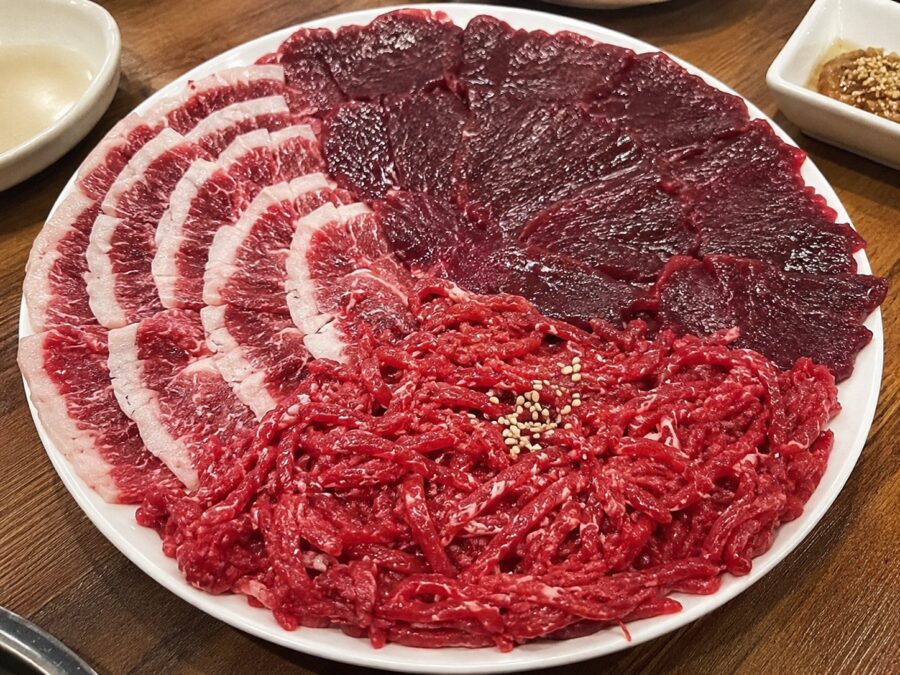
Yukhoe is the raw meat dish most familiar to us. Lean meat with little fat is thinly sliced and mixed with soy sauce, sesame oil, garlic, pear, egg yolk, and other ingredients.
The roots of yukhoe, as confirmed by records, go quite deep. The 1795 royal court protocol, the Wonhaeng Eulmyo Jeongni Uigwe (園幸乙卯整整理儀軌It was originally a royal court dish that has already appeared several times in ).
19th-century cookbook Siuijeonseo (The complete bookThe recipe is also preserved in detail in ). It describes soaking thinly sliced lean meat in water to remove the blood, then cutting it into thin strips, and mixing it with green onions, garlic, black pepper, sesame salt, oil, and honey.
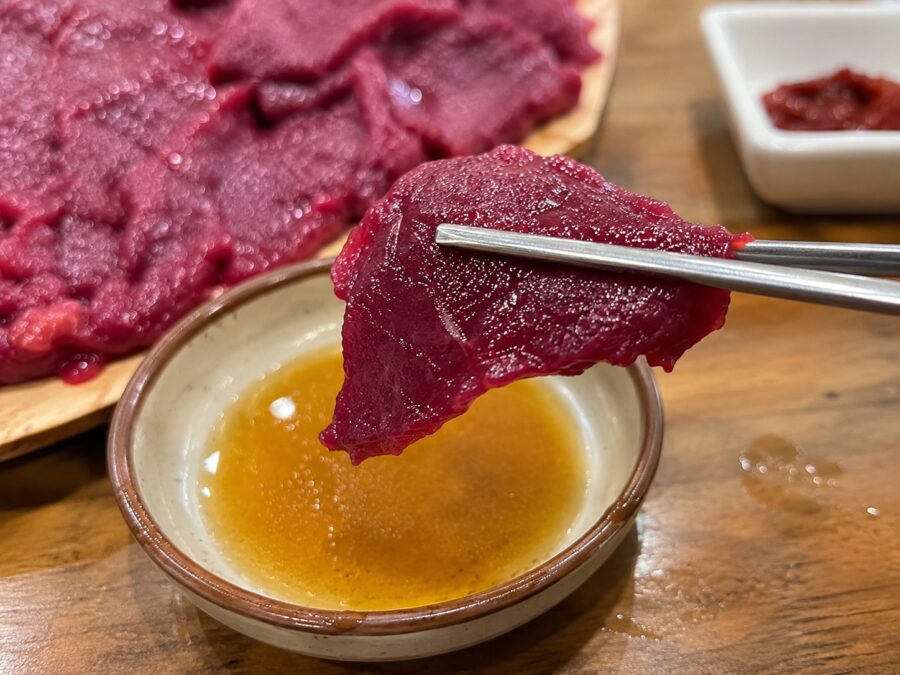
Mungtigi is a Gyeongsang-do dialect term. The name comes from the meaning of raw beef cut into large chunks about the size of a thumb joint, and it is a unique regional menu name used only in Daegu and Gyeongbuk.
Yuksashimi is a name used across a wider region. In Jeolla Province, it is commonly called 'saenggogi,' while the name yuksashimi has become established in Jeonbuk and other areas.
The key difference between the three dishes is ultimately whether or not they are seasoned. Yukhoe is a dish mixed with seasoning, whereas Mungtigi and Yuksashimi are eaten by dipping them in a sesame oil dressing without being mixed.
Interestingly, if we strictly adhere to the definition of 'hoe' in the Standard Korean Dictionary, yuk sashimi—which consists of raw meat sliced without seasoning—is actually more fitting to the term 'hoe'.
However, the name 'yukhoe' has long been established as a term referring to raw meat in the form of a salad, so the name and the actual cooking method are at odds.
The controversy surrounding this name has been going on for quite a long time. In the past, there were even instances where viewers complained after the term 'sashimi' appeared in broadcast subtitles because it is a Japanese word. However, since there is no distinct Korean equivalent and the intuitive term 'yukhoe' refers to a different dish, most restaurant menus still use the name 'yuk-sashimi' as is.
What is even more unique is that within Daegu and Gyeongbuk, Mungtigi and Yuksashimi are often treated as completely separate menu items. In this case, raw meat from the day of slaughter is called Mungtigi, while raw meat that is at least one day old is called Yuksashimi. The slicing methods also differ subtly.
Royal court cuisine Yukhoe and Silbijip Mungtigi
Throughout the Joseon Dynasty, yukhoe was not a dish that just anyone could enjoy. This was because, in Joseon, an agrarian nation, cattle were a means of production that could not be slaughtered indiscriminately. Since obtaining fresh beef itself was rare, yukhoe remained a precious dish served only at special occasions, such as royal banquets.
This dish became an everyday delicacy following the development of the beef distribution industry in the modern era. Now, it has become a popular menu item that can be found anywhere in the country.
Mungtigi took a very different path. In fact, it is not a very old dish. It is a dish that originated independently in Daegu during a time when raw beef was popular nationwide as a drinking snack.
According to records, the origin is widely traced back to the late 1950s to Mr. Jeong Jae-in, the founder of a casual eatery called "Neoguri" in Hyangchon-dong, Jung-gu, Daegu. The prototype of Mungtigi was receiving fresh meat from a nearby butcher shop, removing the fascia and cutting the tendons, and then slicing it into large chunks to serve to customers.
It is said that it was initially eaten wrapped in aged kimchi. Later, it evolved into the current method of dipping it in a heavily seasoned sesame oil sauce. This coincides with the period when Daegu was growing into an industrial city. Mungtigi spread as a representative drinking snack enjoyed by factory workers on their way home from work.
It was named 'Mungtigi,' a Gyeongsang dialect word meaning 'chunk' or 'lump,' after its sliced shape, and is now a representative dish of Daegu. local food It is considered one of the ten famous dishes of Daegu.
On the other hand, yuk sashimi has no single distinct origin. It is more accurate to view it as a raw meat sashimi culture that has taken root in various regions of the Yeongnam and Honam areas, each in its own way.
Even today, several slaughterhouses are located in the suburbs of Daegu. This is the reason why the practice of receiving cattle less than a day after slaughter and serving them immediately without aging continues to this day.
Thanks to this, Mungtigi remains one of the few raw meat dishes that allows you to experience the unique taste of freshly slaughtered Hanwoo beef without undergoing freezing or aging processes.
The cuts and preparation methods of Yukhoe, Mungtigi, and Yuksashimi
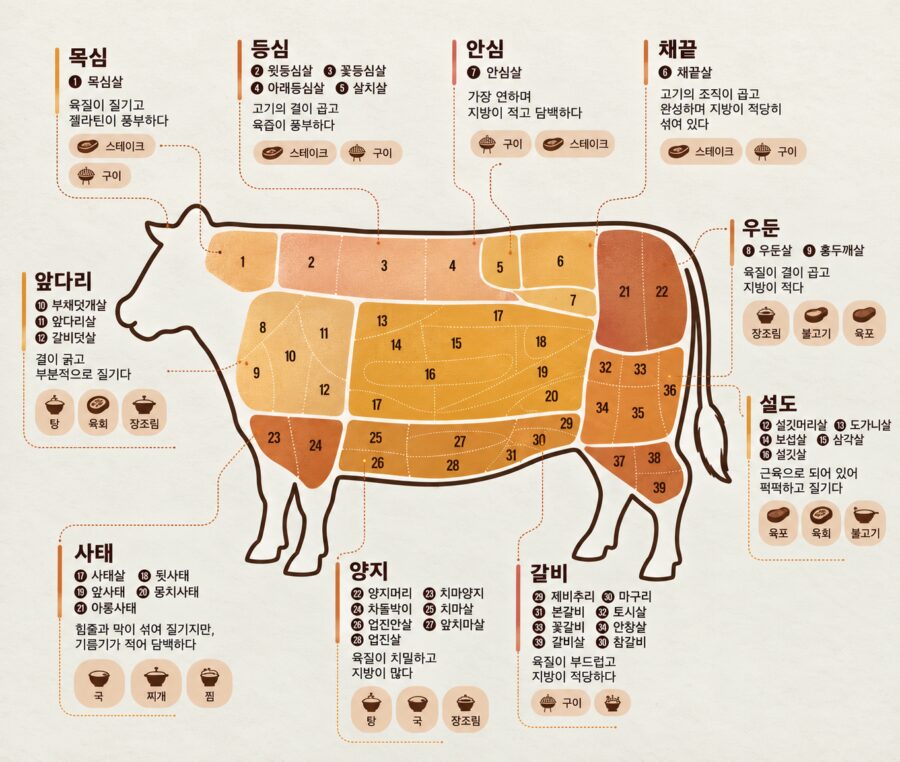
Round and eye round are primarily used for yukhoe. Both are lean cuts of meat located on the inner side of the cow's hind leg, in the rump area, and contain very little fat.
Mungtigi originally used mainly cheojigaesal. It is a type of shank meat, referring to the inner thigh area of a cow's hind leg. This part naturally requires long simmering to become tender. This is because the muscles are constantly used by cows to stand and walk, so connective tissues such as tendons and membranes are unusually densely packed within them.
Usually, cuts like this are perceived as tough, but in their raw state, this density actually comes across as a chewy elasticity. This is where the distinctive texture of Mungtigi comes from.
However, most restaurants these days use round, which is much easier to prepare. It is a tender cut with less connective tissue due to relatively less movement.
The same applies to yuk sashimi, where lean cuts are prioritized. Round, eye round, and sirloin are commonly used. Since the foreign texture of the connective tissue becomes more pronounced when chewing if the meat is fatty, leaner cuts are chosen for cuts intended to be eaten raw.
Depending on the shop, they may use sirloin, which has a slightly coarser grain and a strong meaty flavor, or shank from the foreleg. The choice of cut itself becomes the shop's unique characteristic.
The reason textures vary by part ultimately depends on how much the muscles have been used. The leg and rump muscles, which a cow uses without rest while standing or walking, develop thicker tendons and membranes.
Conversely, muscles that move very little, such as those on the back, have thin membranes that soften with little resistance when chewed. This is also why cuts like sirloin and tenderloin are popular. When cooked, these membranes actually become a hindrance. They only melt into a soft jelly-like consistency after being boiled for a long time, but when eaten raw, the earlier stage—that is, the taut elasticity itself—becomes the appeal.
Recently, a menu item has emerged that completely overturns this formula of lean meat. It is beef brisket sashimi.
Chadolbagi is originally the brisket area of the chest, a cut that is fatty and was traditionally sliced thinly and grilled. Chadolbagi yuk sashimi is made by slightly freezing this cut, slicing it thinly like sashimi, and serving it raw.
In stark contrast to the lean beef round, it is characterized by a rich, fatty flavor similar to tuna belly. It could be considered a new trend appearing on raw meat menus that were previously dominated by lean meat.
Differences in slicing methods and seasoning sauces
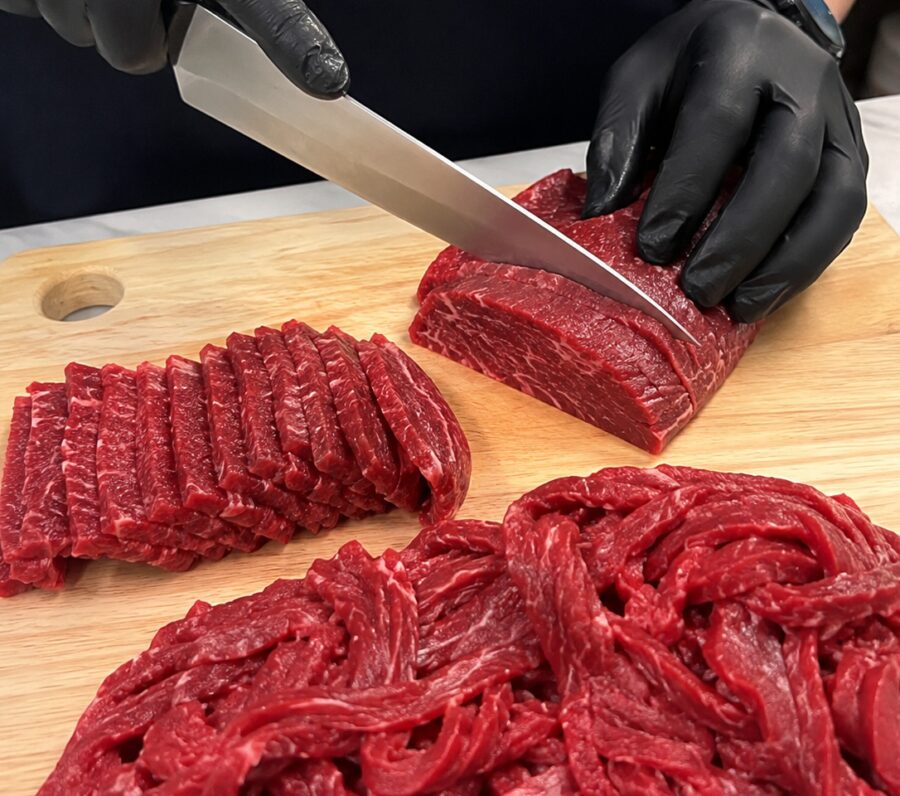
Yukhoe is thinly sliced with a knife. The sliced lean meat is then mixed thoroughly with soy sauce, sesame oil, garlic, and pear. This 'mixing' process is the unique identity of yukhoe.
Mungtigi is cut into thick chunks about the size of a thumb joint. It retains enough juices to be elastic enough that it does not drip even when the plate is turned upside down.
Beef sashimi is sliced thinly, just like raw fish. Depending on the restaurant, it may be served small and thin like rockfish, or thick and neat like tuna.
The seasonings also differ in texture. For yukhoe, the seasoning itself determines the finished flavor, whereas mungtigi is eaten by dipping it deeply into a thick sauce mixed with sesame oil, garlic, and coarse red pepper powder.
While the preparation of yuk sashimi varies by region and restaurant, it is often lightly dipped in soy sauce or a light sesame oil dressing to bring out the natural flavor of the meat.
| item | Yukhoe | Mungtigi | Beef sashimi |
|---|---|---|---|
| major regions | nationwide | Unique to Daegu and Gyeongbuk | Nationwide, especially the Yeongnam and Honam regions |
| major parts | Round steak, eye round steak | Cheojigaesal (Sataesal) → Udunsal | Round, eye round, sirloin, etc. |
| Cutting method | Thinly julienne | A large lump the size of a thumb joint | Thinly sliced like sashimi |
| Cooking method | Seasoned with soy sauce, sesame oil, pear, etc. | Dip in a sauce made with sesame oil, garlic, and coarse red pepper flakes. | Dip in soy sauce or light sesame oil sauce. |
| origin | 1795 Wonhaeng Eulmyo Jeongni Uigwe, Joseon Royal Court Cuisine | Silbijip in Hyangchon-dong, Daegu in the late 1950s | Unclear single origin, regional raw meat sashimi culture |
Ultimately, it is a matter of taste.
Yukhoe, Mungtigi, and Yuksashimi are dishes that differ slightly from their roots. One originated in the Joseon royal court, another within the history of the specific city of Daegu, and the remaining one developed in various regions in its own way.
If you want a sweet and sour seasoned taste, yukhoe is the right choice; if you want a substantial chew, mungtigi is the better choice; and if you want a thin and clean texture like raw fish, yuk sashimi might be more suitable.
The next time you come across a plate of raw meat, recalling these small differences one by one will make for an interesting topic of conversation.


