index
The world's thinnest glass

Usuhari (うすはり)It means 'thin glass' in Japanese.
As the name suggests, it is a glass less than 1mm thick. Shotoku Glass's Usahari series has a thickness of about 0.9mm, which is less than half the thickness of a standard glass (2-3mm).
Regular glass vs. Usahari glass
Standard glass thickness: approximately 2~3mm
Usaharizan Thickness: Approx. 0.9mm
One sheet of paper is about 0.1 mm — the thickness of Usaharizan is about the thickness of 9 sheets of paper stacked together.
When you lift the glass, you feel a lightness as if the drink is resting directly on your palm.
Its transparency is also exceptional. Thanks to the extremely thin glass walls, the color and light of the beer are transmitted exactly as they are, without distortion. This is why it is frequently chosen as the glass that displays the beverage's color most beautifully on advertising and drama filming sets.
A glass born in a light bulb factory
The Usahari is a cup created by technicians who made light bulbs.
Shotoku Glass is 1922 It started as a light bulb manufacturer in Sumida Ward, Tokyo. Light bulb glass must be made thin, uniform, and in a precise shape. Craftsmen produced thousands of light bulbs one by one using the blow-tube technique, which involves shaping glass by blowing it with their mouths.
As the light bulb manufacturing process became automated in the late 20th century, Shotoku Glass changed direction. They decided to apply the thin glass forming technology, honed over decades, directly to tableware.
1989, The 'Usahari' series was born. These cups, made using the technique of blowing light bulbs, quickly spread among high-end Japanese restaurants and sushi omakase shops, and have now become a brand that is consistently sought after overseas as well.
Edo glass and Sumida Ward
Sumida Ward in Tokyo, where Shotoku Glass is located, is Edo(江戸) It has been a center of glass craftsmanship since the Edo period. Edo glass is a unique Japanese craft glass made with delicate handwork, and Shotoku Glass is considered one of the brands carrying on this tradition.
The charm of Usharijan

When you take a sip of beer, the first thing you actually experience is not the taste. It is the glass.
The lips touch the glass, and then the beverage enters. If the glass is thick, the lips become aware of the glass first, and the beverage is pushed to the back. If the glass is thin, that order changes. The presence of the glass disappears, and it feels as though the beverage is making direct contact from the very beginning.
Beer sensory evaluation expert Randy Mosher, author of Tasting BeerIt explains that the shape of the glass's rim changes which point on the tongue the drink touches first. It also adds that a thin rim fits the natural curve of the lips better, making it more pleasant to drink.
It is the moment when the sense of touch becomes part of the taste experience. This is partly why people who try a Usaharizan for the first time are surprised by the sensation.
Usharijan's lineup
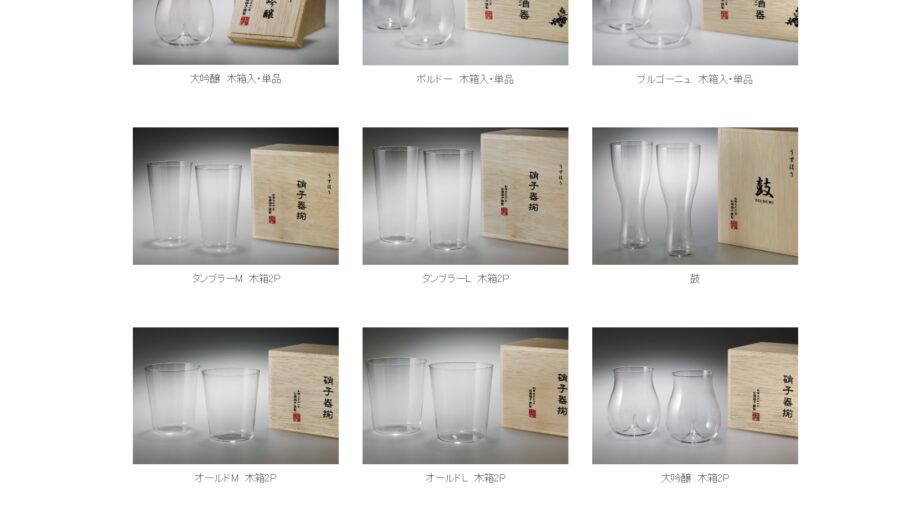
Source : Shotoku Glass
When you hear the term "Usahari glass," you might think of a single beer glass, but in reality, there are various types depending on the intended use. Let's take a look at a few items from Shotoku Glass's Usahari lineup, along with Toyosasaki's Usurai, which shares a similar concept.
Shotoku Glass Usahari
Among Shotoku glass, especially Daiginjo(大吟醸) GlassIt has a unique structure. There is a small protrusion in the center of the bottom of the glass; if you gently rotate the glass after pouring sake, this protrusion acts as an agitator, allowing the aromatic compounds to rise better. It is frequently used as a tasting glass in Japanese breweries and high-end sake bars.
Each product is sold individually packaged in a paulownia wood box and is also popular as a gift.
Toyosasaki Usurai
If you search for Usahari UsuraiThe name appears together.
Toyosasaki(東洋佐々木)It is Japan's largest glass manufacturer, formed by the merger of TOYO, established in 1878, and SASAKI, established in 1902. Usurai is the brand's line of thin glass cups, and the method of finishing the rim to be extremely thin is the same as that of Usahari.
Usahari vs. Usurai, what's the difference?
Usahari (Shotoku) is entirely handmade, crafted by artisans using mouth-blowing. Each cup has subtle individual variations, and the price range is high.
Usurai (Toyo Sasaki) combines automated lines with handmade production, offering sufficiently high quality at a much lower price. Some lines also feature enhanced durability through HS ion strengthening treatment.
If you are looking for a gift or a collector's item, Shotoku Usahari is a reasonable choice, while if you are looking for a cup for everyday use, Toyosasaki Usurai is a reasonable choice.
Washing and Storage
Precautions for cleaning
As Usahari cups are thin, they are prone to breaking while washing.
In addition, both Usahari and Usurai cups cannot be used in a dishwasher. There are two reasons for this.
First, high-temperature washing water impacts glass that has not been heat-treated.
Second, there is the issue of water pressure. A 0.9mm glass is surprisingly light. When water is sprayed inside the dishwasher, the glass cannot stay in place and sways around. It is only a matter of time before it hits the side and breaks.
The official Shotoku Glass guide also specifies that neither microwaves nor dishwashers can be used. The same applies to the Toyosasaki Usurai standard line.
Storage precautions
As a general rule, cups should not be stacked. Unlike ordinary glass cups, cracks can form from the weight pressing down from above alone.
The best way to store them is to use the wooden box included with the purchase or place them on individual shelves. Since they are vulnerable to sudden temperature changes, you should avoid pouring hot beverages into glasses filled with ice.